

If you’re coming to Wicked: Part One like me, with no exposure to the play it was adapted from, what you see may shock you. Not in a pearl-clutching way, but in how it dabbles in mature themes that are completely foreign to the 1939 movie that inspired it. Although it is similarly colorful, witty and brimming with catchy songs, it is much more serious-minded than The Wizard of Oz ever intended to be. The story Wicked tells, pertaining to the origins of The Wicked Witch of the West and Glinda (a.k.a. The Good Witch of the North), is a large-scale parable for racism. It also contains a subplot about how certain denizens of Oz are being demonized for political expediency. In asking the audience to ponder these things while marveling at its whimsy, the experience is not unlike eating a meal of candy bars with a side of broccoli. In other words, feel free to enjoy yourself, provided you don’t forget there are important things under consideration.
Wicked starts off innocently enough, with Glinda’s (Ariana Grande) voice-over narration recapping that fateful event in the original: The Wicked Witch’s demise. We see The Wicked Witch’s crooked hat steaming in a pool of water, then watch the winged monkeys fly off to parts unknown. While taking in the impressive computerized vistas surrounding the witch’s castle, we catch a glimpse of Dorothy and her friends on their way to Oz. We already know how their story turns out, so the movie shifts our perspective back to the Munchkins celebrating their newfound freedom from oppression.
Just like in the original, the Munchkins are ecstatic over the news of their tormentor’s demise. They cheer and dance, and are thrilled when Glinda arrives in a ginormous bubble to confirm what has transpired. Then the Munchkins start singing the movie’s first number, “No One Mourns the Wicked”. Unlike “Ding Dong the Witch is Dead”, “No One” is as angry and defiant. “No one lays a lily on their grave,” one Munchkin sings. Glinda adopts a more sympathetic tone, stating “The Wicked’s lives are lonely…the Wicked die alone,” but the Munchkins are not having it. “Nothing grows for the Wicked, they reap only what they’ve sown!” they bellow in response. These Munchkins are not in a forgiving mood.
Further evidence of the movie’s adult tone arrives in quick succession. Glinda reveals that the Wicked Witch was the result of an affair between the wife of the Governor of Munchkinland (Andy Nyman) and a mystery man whose voice you’ll recognize instantly. When the result of their union is born, her father angrily rejects her because of her green hue. (She’s subsequently raised by a talking wet nurse that happens to be a bear.) This backstory garners no sympathy from the Munchkins, who proceed to burn her in effigy. Clearly, this story from the land of Oz is not meant for kids, but adults interested in an edgy take on the original.
Case in point: Glinda. She is as beautiful as we remember, but in this movie she’s narcissistic and manipulative. When she’s asked pointedly by a Munchkin if she was a friend of the Wicked Witch, she cannily dodges the question and replies that they knew each other in school. We then go back to when Glinda first met Elphaba, which is where the rest of the story takes place.
The two met at Shiz University, where Elphaba (Cynthia Erivo) is present to see her handicapped sister Nessarose (Marissa Bode) off. Father Governor constantly warns Elphaba to not make a commotion, but that’s impossible because, you know. (It ain’t easy being green.) When Glinda makes her grand entrance on school grounds, she’s a study in weaponized vanity. Every one of Glinda’s flamboyant gestures (hair toss!) leaves everyone melting in her wake. For her part, Elphaba also manages to turn heads with her militaristic goth attire of black boots and matching black frock.
Having spent a lifetime dealing with insults about her appearance, Elphaba has retorts at the ready. “No, I’m not seasick. No, I didn’t eat grass when I was a child. And yes, I’ve always been this way.” Glinda approaches her and says that once she learns how to use magic, she’ll cure her of her affliction. Stunned by Glinda’s hutzpa, Elphaba caustically dismisses her “help”. Unfortunately, an incident with Nessa triggers Elphaba’s powers, which set tables and chairs flying.
Elphaba’s display attracts the attention of the Dean of Sorcery Studies, Madame Morrible (Michelle Yeoh, entirely forgettable), who enrolls Elphaba on the spot. Elphaba accepts because this could lead to an invitation from the Wizard, who she believes would appreciate her magical abilities. As Glinda’s reward for butting in, Morrible forces her to share her dorm room with Elphaba, setting up the two as enemies.
Every day is a battle of wills between the two, driven by how Glinda despises how Elphaba gets more attention than she does (even though it’s overwhelmingly negative). Glinda and Elphaba’s strife is soon broken up by the arrival of–you guessed it, a boy. (He’s actually a grown man.) Fiyero (Jonathan Bailey) is a devilishly handsome rake who has been thrown out of other schools before landing at Shiz. Glinda is immediately taken by Fiyero, and Fiyero finds himself strangely attracted to Elphaba’s otherness. Their love triangle is essentially fluff, but it does trigger a rousing song-and-dance number named “Dancing Through Life”.
When the dancing dies down, the movie remembers that it’s supposed to show us Glinda and Elphaba becoming friends. Against her better judgement, Elphaba accepts Glinda’s invitation to join the rest at Ozdust, a Las Vegas themed ballroom. When she realizes that Glinda’s overtures were just a prelude for more ridicule, Elphaba seizes the moment to force everyone to acknowledge her uniqueness. This triggers feelings of guilt and sympathy within Glinda, who decides to befriend Elphaba. Back in their dorm room, Glinda insists on giving her new friend a makeover. Glinda’s anthem of empowerment through beauty, “Popular”, is a showstopper that Grande handles perfectly.
In history class, Dr. Dillamond (Peter Dinklage), a talking goat, explains how the citizens of Oz have demonized the animals for whatever ails them. Lately, they’ve been removing them from their jobs and putting them into cages. (In the movie’s lone instance of restraint, nobody ever says the animals have been “scapegoated”.) Elphaba views Dillamond as a kindred spirit, someone who is attacked for being different. But before she can fight on Dillamond’s behalf, he’s removed from his classroom by stormtroopers sent by her father, the Cuckolded Governor.
We’ve finally arrived at the critical juncture of the movie, when events that have only been talked about directly impact the characters. Funny thing is, everything I described so far only takes us to the first ninety minutes of the movie. There’s still over an hour left to go! After witnessing Elphaba express her heartbreak at her never-to-be-consummated attraction for Fiyero, she receives a personal invitation from the Wizard to meet him in Oz. Elphaba invites Glinda to the Emerald City, where they marvel at how wonderful their mall is. They then meet up with Madame Morrible and the Wizard (Jeff Goldblum), who explains what’s going on with the animals. (The answer alludes to our current political climate.) The Wizard then explains what role he intends for Elphaba to play in his administration, and it’s not a good one. The movie takes a surprisingly dark turn in the end, which sets up an inevitable confrontation between former besties Elphaba and Glinda.
Recommendation
There’s a lot that I liked in Wicked: Part One. The songs are excellent, as one would expect given that they come from a Tony award-winning production. The performances by Ariana Grande and Cynthia Erivo carry the movie, with Ariana Grande being a scene-stealer at every turn. Her Glinda is a delightful comedic confection, a perfect mix of narcissism, haughtiness and condescension. Erivo is also very good as Elphaba, but she takes the material too seriously at times. She’s an earnest dramatic actor who seems more comfortable internalizing her character’s emotions instead of embracing the large, Broadway canvas she’s asked to work with in this movie. Although Erivo’s Elphaba is convincingly moody and flinty, her performance goes against the grain of those around her.
The supporting performances range from fine to worse. Jonathan Bailey is okay as Fiyero, but he comes off as a playboy too old for college. (Erivo, Grande and Bailey are all in their thirties, by the way.) Peter Dinklage finds grace notes voicing the entirely CG Dr. Dillamond. On the bad side of the ledger is Michelle Yeoh and Jeff Goldblum, who are on hand solely because of their name recognition. Neither can sing or dance, and the movie thankfully requires them to do little of either. As Madame Morrible and the Wizard, their performances are awkward, a telltale sign that neither had any insight into their characters beyond reciting their lines. Bowen Yang is irritating as Glinda’s bitchy groupie. Ethan Slater’s Boq is giddy and bland.
Wicked’s length was a problem for me. Director John Chu’s approach to the material is akin to getting one’s money’s worth at a buffet. Instead of showing some (any) restraint, he indulges in everything, to a point where the story is bloated. The movie should have been whittled down by at least half an hour. Instead, Chu extends every scene longer than necessary, resulting in a story with a pace that is lackadaisical. The Wizard of Oz had just as many amazing things going on and managed to wrap things up an hour less than this film. Those who fall into the “more is better” category definitely won’t leave feeling cheated. I, on the other hand, felt a bit exhausted by the end. (But I know what to expect when Wicked: For Good comes out next year.)
Chu insisted on color grading the movie so that the brilliant colors of the sets and costumes appeared muted. His intent was to depict Oz as a real place, which is an odd choice considering how everything that transpires takes place in a fantasy world. Instead of Oz popping off the screen, everything looks like a long-forgotten beach house. I also grew weary of Chu’s restless direction, where the camera constantly forces our attention to what’s happening. The dance numbers, brilliantly staged and choreographed, are almost incomprehensible due to the use of camera moves straight out of Nineties music videos.
Wicked: Part One entertains in spite of its flawed approach. The movie’s lead performances, exceptional production design and Broadway roots outweigh its excessive length and curious directorial decisions. Like the musical it’s based on, the movie’s underlying spirit can’t be denied. Recommended.
Analysis
As someone who loves The Wizard of Oz, I was primed to love Wicked. The former is one of my favorite musicals, one that I watch without ever getting tired of it. I love every aspect of The Wizard of Oz: the costumes, the sets, the songs, the performances. It’s a perfect movie that always grabs my attention whenever I start watching it. With that in mind, my reaction towards Wicked is probably due to how lesser it is in light of the original.
Creating a prequel (or sequel) to one of the greatest movies ever made is a thankless task. Would anyone seriously consider making a follow-up to Citizen Kane? Jack Nicholsen made a sequel to Chinatown and we know how that turned out. While attempting to replicate greatness is a fool’s errand, Wicked had a lot working in its favor. The story originated with a novel from 1995 that Wikipedia says received mostly popular reviews. The book became the basis for a Broadway musical in 2003, won several Tony Awards the following year and has been incredibly popular ever since. Adapting Wicked (the musical) into a movie seemed like a no-brainer. You already have the story and the songs. All you need to do is bring it to the big screen.
My issues with Wicked: Part One don’t involve its fidelity to the musical. (I’ve never seen it, so I had no basis for comparison.) It’s with how the filmmakers approached converting the musical into a film. With its expansive sets, colorful landscapes, outrageous costumes and big musical numbers, the movie is using The Wizard of Oz as its template. But instead of embracing what made the original great, the filmmakers have tried to obscure it in various ways.
For example, I liked all of the musical numbers in Wicked. The problem is that the direction always upstages the performers. Chu’s direction is overly caffeinated, darting here and there, zooming in and out, so that you have to work to focus on what’s happening within a given shot. Compare this visual overload to Wizard of Oz and you can immediately see the difference. When the musical numbers begin, the camera stays at a respectful distance, allowing us to appreciate the actors’ brilliant dancing. The film rarely edits the dancing as well, giving us these sequences in long takes. There are the occasional cut-aways, but when the Scarecrow performs “If I only Had a Brain”, the camera is trained on his every move so that we can see every one of his slips and wobbles.
Wicked, however, captures the musical numbers in the busiest way possible. For a movie with songs that many in the audience (except me) already know, this choice speaks to a lack of confidence in the presentation. When you have great performers in a movie, the movie should let you see them and not turn things into a music video.
Another curious choice surrounds the movie’s color grading. One of the trademarks of The Wizard of Oz is how gloriously it renders the colors of Oz. From the moment Dorothy lands in Oz, the colors pop off the screen. The outfits the Munchkins wear are uniformly bright and fantastically detailed. The Yellow Brick Road sparkles. The feet of the now-deceased Wicked Witch of the East are an ominous shade of green. Those ruby slippers. I could envision all of those colors in my mind while typing those sentences.
What frustrates me about Wicked is that while it does have brilliant colors in its production design, it dulls them in an effort to make things appear more realistic. Director Chu’s explanation was to make things appear realistic. Since this isn’t Dorothy’s story, the colors of Oz would be commonplace for Elphaba and Glinda. The results on the screen show how wrong-headed this decision was. I was expecting to see the Oz from the original movie, not a place that is muted and murky. For the record, I still enjoyed the movie, but poor color grading was impossible to ignore because everything could have looked so much better with little intrusion.
The decision to spend so much time at Shiz University was a mistake. They’re there so long, talking about magic and interacting with magical animals that I found myself thinking of Harry Potter. The subplot involving the mistreatment of the animals reminded me of the house elf subplot in the Potter movies. It’s possible that JK Rowling drew inspiration from 1995 Wicked, which came out two years prior to Harry Potter and The Philosopher’s Stone. My issue isn’t over who ripped off whom, but that Wicked (the movie) appears oblivious to how much it resembles another property that spent years in the cultural consciousness.
Wicked has some of the most egregious examples of stunt casting in recent memory. Need someone to play the kooky wizard? Why not Jeff Goldblum? Nevermind that his way of acting goes completely against the grain of the wizard everyone is familiar with, or that he can’t sing or dance a lick. Audiences will recognize him and that’s all that matters. Same goes with Michelle Yeoh as Madame Morrible. Considering the look on her face throughout the movie, I don’t think she ever had a clue as to what her character was about.
Considering that Wicked is based on only the first half of the musical, yet runs for two hours and forty minutes, critical aspects of the plot feel very sketchy. Why, exactly, must the Wizard demonize the animals to unite Oz? Why are there so few magical characters like Elphaba around? Did the Wizard know that by sleeping with Elphaba’s mother would produce a magical child? Was there a potion in that green bottle her mother drank from? Where is Oz keeping the now-normal animals? I assume that some of those questions will be answered in the sequel, which I intend to see.
Besties, Girlfriends or possibly something more?
I certainly am not an expert in identifying aspects of movies that are queer-coded. However, the duets that Elphaba and Glinda share appear to fit that description. How else to describe the way Chu frames “What Is This Feeling?” Although the two sing about their mutual loathing of the other, the energy between them speaks to frustrated sexual desire, as in “I’m repulsed but strangely attracted to you”. Their animosity, which consists of fighting over where to sit in class and giving each other the stink eye from across the cafeteria, is more like a lover’s spat than genuine hatred.
The dance scene at Ozdust between Elphaba and Glinda reminded me of the mating rituals of birds, where they approach each other and begin to mimic each other’s movements.
Here’s one example: Midway—Black Footed Albatross Mating Dance
Finally, while Glinda’s snazzy “Popular” is ostensibly about giving Elphaba a makeover, Chu stages the number as a playful bedroom seduction between the more experienced Glinda and the virginal Elphaba. Up until this point, Glinda had used her charms to make everyone fall in love with her, except Elphaba. Now that Glinda sees Elphaba’s natural beauty, she goes all-out to make Elphaba feel comfortable being feminine. The experience is too much for Elphaba, who leaves embarrassed by the feelings she now feels. When she’s alone, Glinda proudly exhaults her conquest in the hallway. She’s so in love with Elphaba that everything turns red.
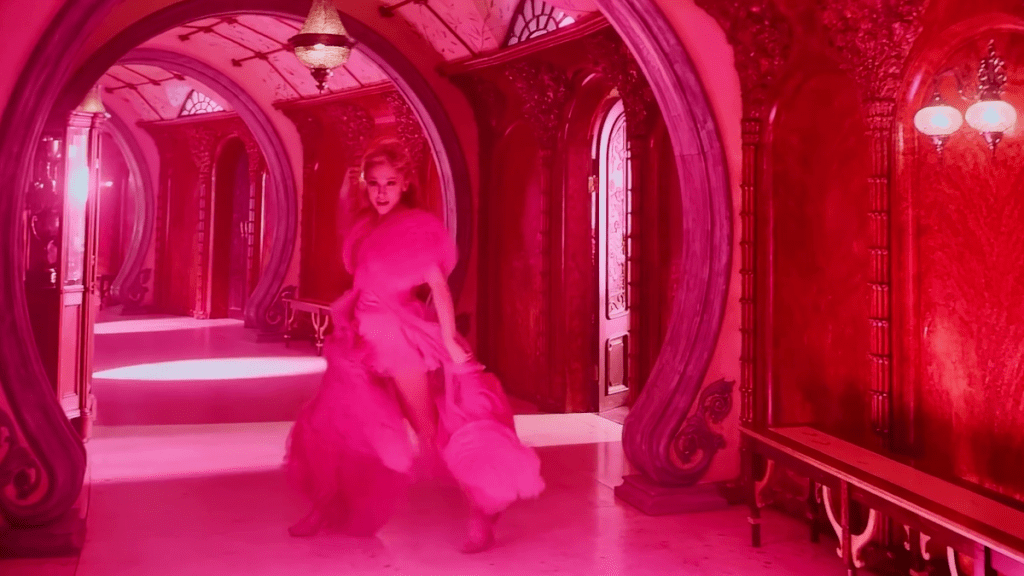
The Wizard of Quirk
Choosing Jeff Goldblum to play the Wizard puzzled me on several levels. I’ve seen him in numerous films for decades, starting with The Right Stuff in 1983. He has such a distinct voice that I knew he was the guy the Governor’s wife was stepping out with after he sang only three words. This makes Chu’s efforts to obscure his face during that early scene comical because I knew it was Goldblum all along. Having this knowledge made Elphaba’s performance “The Wizard and I” oddly ironic, because I knew that she was actually singing about her biological father. I don’t know if this was intentional on Chu’s behalf or not, but it ruined for me what should have been a big reveal in the sequel.
Odds and Endicles
Between Nessarose and Elphaba, the movie broaches the topic of the right way to assist the handicapped. However, the movie never goes further than stating that one should never force their help on another.
Fiyero is so openly bisexual, his jacket should have “I go both ways!” bedazzled on it. Although the movie never says why Fiyero was thrown out of so many schools, it’s implied that he bedded everything with two legs, maybe even four.
Between the opening tryst, Elphaba and Glinda’s unrequited love, Fiyero’s horndog nature and Glinda moaning everytime Fiyero blinks, this certainly is the horniest movie set in Oz to date.
As someone who frets over his writing on a regular basis, I appreciated how both Elphaba and Glinda correct others who mistakenly say “could care less”.
Screenplays sometimes employ stilted dialog to tell us that the characters are from another world, the future, etc. Thankfully, Wicked avoids this approach by having the characters speak normally outside of a handful of Ozian twists given to a subset of words: congratulotions, confusifying, definicious, horrendible, scandilocious, hideodious and so on. All of these deviations are fun and playful and tell us we’re not in Kansas anymore while still being understandable.
I assumed that those studying linguification at Shiz need to come up with a clever version of a word before they pass the course.
Here are two new words I’ve come up with that are well-suited for Fiyero: fornicacious and coitifying.
The whole Galinda to Glinda part fell flat for me. Maybe it played better on the stage but it never pays off in the movie.
Is the presence of the green bottle purely symbolic, or does it represent something more significant within the overall story? Did it contain a potion that the Wizard believed would produce a magical offspring? (A plot as insidious as that would seem beyond the Wizard, though.)
Will we see the Fluff The Time Dragon in the sequel? If he’s not related to Puff The Magic Dragon, I’ll be disappointed.
 Detroit Cineaste
2 thoughts on “Wicked: Part One”