
After twenty-four years, we finally have a sequel to Gladiator. Why did it take so long to make a sequel to a film that was both a box office and critical success? (The film won five Academy Awards, including Best Picture and Best Actor.) There are several answers to that question, the first being that the writers were intent on bringing Russell Crowe’s Maximus back from the dead. In case you may have forgotten, Maximus died shortly after killing the Emperor Commodus (Joakin Phoenix) in a fight to the death in the Colosseum. Given that it’s extremely difficult to sell a sequel without the original’s main character, I can sympathize with why the writers stuck with the idea no matter how impossible it would have been to pull it off. DreamWorks Pictures then went bankrupt in 2006, and Paramount Pictures put the project on hold indefinitely. After eleven years, the story was reworked so that it no longer focused on Maximus, which was probably for the best because Crowe had since aged out of the part. (See 2016’s The Nice Guys for evidence of how Crowe had “filled out” in the intervening years.)
So instead of a resurrected Maximus, Gladiator 2 focuses on Hanno (Paul Mescal, looking out-of-place), a warrior-farmer based in the kingdom of Numidia (northwest Africa). He’s married and is living peacefully until the “call to war” pots are set aflame. The Romans are coming to conquer Hanno’s city, and he and his wife, who is an archer, are asked to defend it. Considering how everyone at this point of history would know that the Romans would send everything to conquer the kingdom in short order, it would have been better for the Numidians to negotiate the best surrender terms possible. But I can see why they decide to fight for their kingdom, even when the odds are stacked against them. (The Ukraine-Russian war, which didn’t exist when this movie was in development, provides an uneasy parallel.)
Although the Numidian city is well-fortified, it doesn’t stand a chance against a fleet of Roman warships. Once those ships began heaving balls of fire over the city walls, I knew things would quickly be over for the Numidians. Hanno and his wife fight bravely, but she is felled on the order of General Acacius (Pedro Pascal), who like Maximus before him just wants the fighting to be over so he can go home and eat grapes with his wife (more on that in a bit).
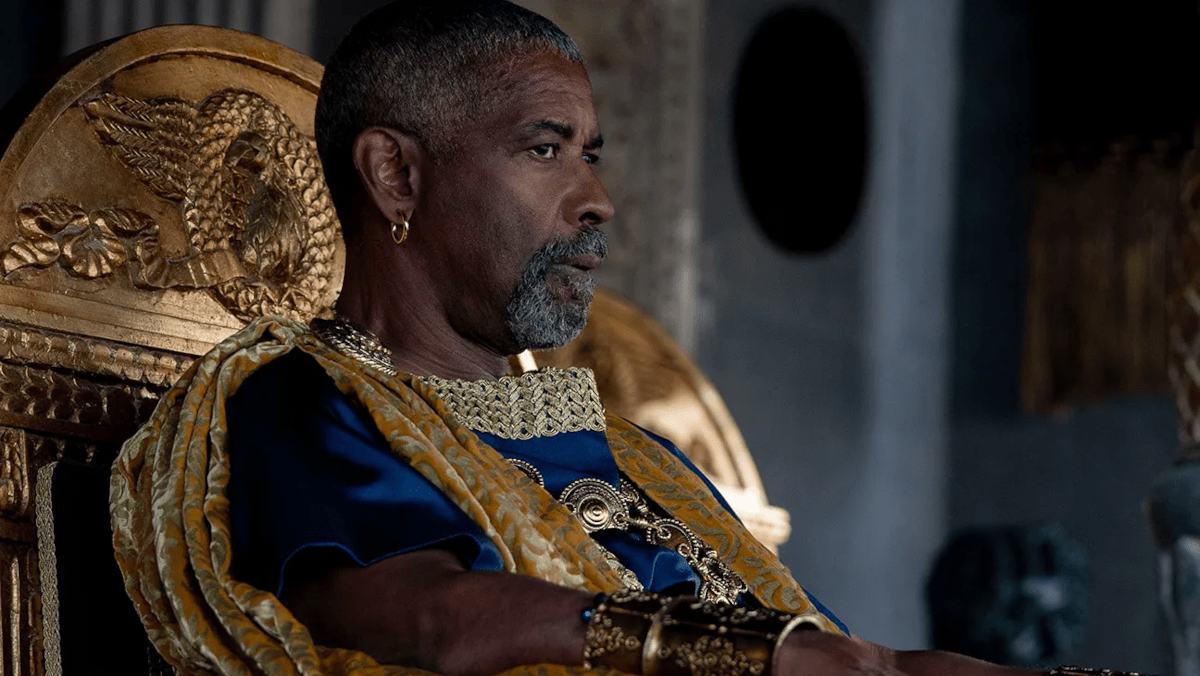
Hanno is knocked unconscious and is yanked away to a life of slavery. (The plot of this movie is so similar to the original, one wonders why it wasn’t seriously considered decades ago.) Hanno catches the eye of slave-trader Macrinus (Denzel Washington, in Training Day mode), who sees him as his instrument for obtaining power in Rome. The twin emperors Geta (Joseph Quinn) and Caracalla (Fred Hechinger) are dimwits who can only conceptualize a few things: mascara, debauchery, conquering the world and gladiatorial games (huzzah!). Macrinus is convinced that he can use Hanno to get close enough to the emperors to become an advisor of sorts. He’s modeled after Oliver Reed’s Proximo–but drenched with ambition.
After Hanno proves his mettle by killing a CGI monkey, he’s asked to fight a gladiator to the death before the emperors. (This movie’s depiction of Rome is basically as an ancient precursor to The Hunger Games’ District 12, if that makes sense.) As his reward for winning, Hanno must fight in elaborate recreations of historical battles in the Colosseum, including one where the floor is filled with water (and CGI sharks!) and two boatfulls of gladiators have at it. Macrinus has promised Hanno a chance to kill Acacius, which initially seems unlikely considering how Acacius is beloved by the people and the commander of Rome’s traveling army. Acacius also happens to be the husband of Lucilla (Connie Nielsen), who played a key role in the original movie (but not so much in this one).
At this point, I haven’t discussed how Hanno’s story ties back to the original. The trailer gives that away almost immediately, so I have no qualms in stating that Hanno is actually Lucius, Lucilla’s son from the first movie all grown up. After having been sent away for his own safety for a very long time, he has returned to Rome to play the role of Maximus. As was the case for that famous gladiator, Lucius’ actions will cause the downfall of the tittering twin emperors, and how that happens is the mystery embedded within the story. Keep your eye on Macrinus, who hides his ambition behind a devilish smile and fondness for modern-day trash talk. He’s the puppet master in this gory, sword-and-sandal epic.
Recommendation
Are you not entertained? Yes I was by Gladiator 2, but not as much as I thought I would be. The reason is that the movie is more intent on impressing the audience rather than making an emotional connection with them. The opening siege of Numidia is suitably epic. The gladiator clashes are large-scale blood baths. The cast is notable for including several up-and-coming actors (Pedro Pascal, Paul Mescal, Joe Wright), returning cast members (Connie Nielsen, Derek Jacobi) and a big-name star in Denzel Washington. The remarkable production design made me feel like I’d been taken back to ancient Rome in a time machine.
The problem with Gladiator 2 is that it doesn’t offer anything that hits you in the solar plexus like the first movie did. Paul Mescal may have spent many hours bulking up and learning how to fight gladiator-style, but he comes off as someone who only uses his muscles for flexing. He’s also not very convincing as either a grieving husband or hollowed-out shell of a man seeking revenge. Mescal isn’t an actor who can outwardly portray emotions like anger or grief like Russell Crowe can. Mescal has been better before in roles where he’s able to internalize his character’s feelings and give us fleeting glimpses of the turmoil within, as he did brilliantly in Aftersun. I think the idea was for Mescal to portray his character as a warrior-poet, but he’s more like a brooding bodybuilder. (His recitation of Virgil at one point falls flat.)
Gladiator 2 is noticeably busier than the first movie, which was a basic morality play. A Roman general seeks revenge upon the emperor who killed his wife and son. While the sequel has a similar angle to it, there are now three villains in the mix, or four if you include Pascal’s character. The movie simply doesn’t have enough time to flesh out all of the bad guys beyond broad strokes. The twin emperors are cartoonish and have no motivation. Pascal’s General Acacius is understandably war-weary, but after the early going he’s mostly an afterthought. The only one who makes a lasting impression is Washington’s Macrinus.
Macrinus is the most interesting character in the movie by far. Part of this is due to Washington’s star-wattage and flamboyant acting style. Macrinus is also the fulcrum for everything that happens in the story, and watching him pull the strings from the shadows nearly compensates for the dramatic shortcomings elsewhere. The movie should have focused on Macrinus, but it can’t because it’s a sequel to Gladiator and therefore must be about the heir-apparent claiming the throne. That doesn’t stop director Ridley Scott from trying, however, as Washington’s character plays an increasing role in the action as the movie goes along. The resulting movie is conflicted as to how to counterbalance a lead actor who is not as compelling as one of the supporting actors. Scott tries to split the difference as best as he can, but it’s obvious that the movie’s heart was won over by the wise-cracking villain instead of the uninspiring hero the movie is ostensibly about. Gladiator 2’s visual grandeur and gripping battle sequences make the movie a fun watch, but it lacks the emotional punch of the original. Mildly recommended.
Analysis
Although Gladiator 2 checks all the boxes for what a legacy sequel should do, it still manages to be only mildly entertaining. The reason for this is that the legacy sequel straitjacket constrains the movie and prevents it from standing on its own. As is the case with other legacy sequels, the movie quotes material verbatim from the original. While I’m generally fine with callbacks, the problem in Gladiator 2’s case is that they are better than any of the new things the movie tries to say. The plot exists primarily as a vehicle for callbacks, with everything else being secondary to that endeavor.
To be fair, some aspects of Gladiator 2 are better than the original. The opening battle sequence in Numidia looks spectacular and is staged in broad daylight. By comparison, the battle between the Roman army and the Germanic tribes in the original was almost impossible to follow, with its dim lighting, snow flurries and blurry camera effects. The CGI visual effects are also distinctly better in the sequel, so much so that the Colosseum actually looks like an actual building and not a computer game graphic. The CGI animal renderings were hit-and-miss, as they often are these days. The rhino looked real enough, as did the sharks, but not the monkey Lucius fights to prove he’s worthy of being purchased for the games. (The execution just doesn’t work and is laughable in my opinion.)
The production design of Gladiator 2 made me feel like I was actually in Rome, and not confined to glimpses of a few palatial rooms, the slave quarters and the arena floor of the Colosseum. The battles staged within the Colosseum are very impressive, in particular the one where the floor is filled with water (and sharks!) while the two boats fight for supremacy. The gore is also emphasized in this movie, where physical damage is depicted realistically and not as a big splash of blood. I gasped when Lucius cut off Macrinus’ hand in their closing hand-to-hand combat scene.
Both films have equivalent central villains, with Washington’s Macrinus being roughly on-par with Phoenix’s Commodus. Both actors are excellent scene-stealers, but Washington easily eclipses the minimal presence Mescal offers as Lucius. I shudder to think what Gladiator 2 would have been like without Washington’s decidedly modern take on his crafty slave trader. His character is the most interesting character in every scene he’s in, to the point where the movie probably should have been about him and not the lackluster Lucius.
The areas where Gladiator 2 goes wrong were glaringly apparent, however, and nearly sank the entire thing.
Too many villains
As I mentioned above, Gladiator was a simple story of murder and revenge. On the one side was Maximus, whose wife and son were killed on orders from the evil emperor Commodus. Maximus’ quest for vengeance was both easy to understand and to root for. In Gladiator 2, Lucius’ seeks revenge for General Acacius’ role in his wife’s death, but he’s not the only villain Lucius is up against. There’s also Macrinus, who sees Lucius as his instrument to gain power, and the twin emperors Geta and Caracalla as well. Perhaps this is why Lucius often looks beleaguered, because he knows he has to defeat four people to avenge his wife’s death.
While I liked Pascal and Washington’s performances, the movie would have been better off if it had focused on one of them and not split its attention between the two. They are both interesting characters and either would have been sufficient as the movie’s primary villain. Even though Geta and Caracalla are, like Macrinus, based on historical figures, they serve no purpose in the movie because their actions have no motive. The characters are nothing more than high-strung, demented flakes who I guessed correctly would die before the movie was over.
A wife’s death
The plot of Gladiator and Gladiator 2 and the original are set in motion when the hero’s loved ones are killed. However, there are key differences between the two scenarios. In Gladiator, Maximus’ wife and son are killed when Commodus accuses him of treason. They were innocent victims of Commodus’ power play to obtain the throne. In the sequel, Lucius’ wife was fighting on behalf of the Numidian people when she was killed. She was effectively an enemy combatant who was killed during battle, which I expected to happen given the overwhelming forces Rome used to lay siege to the city. While it is sad when Lucius’ wife dies, it’s not a tragedy.
Bland dialog
Strength and honor.
What we do today echoes in eternity.
There was once a dream that was Rome. You could only whisper it.
Are you not entertained?
Father to a murdered son, husband to a murdered wife. And I will have my vengeance, in this life or the next.
At my signal, unleash hell.
I will see you again...but not yet...Not yet!
For a movie whose screenplay was constantly revised while the movie was being filmed, Gladiator has an amazing number of quotable lines. They are so memorable that Gladiator 2 repeats them instead of coming up with interesting lines of its own. The only one I could remember is, “Where death is, we are not!” which is incredibly simplistic. Lucius’ best lines are all quotes from Virgil. Macrinus has some nice taunts, but their impact is due to how Washington delivers them.
We came back…for this?
I remember Connie Nielsen’s Lucilla having several nice dramatic moments in Gladiator. The sequel doesn’t offer anything close, and she’s frequently relegated to being present in scenes. Her initial scene with her son Lucius weirdly calls back to her scene with Maximus in the original, except that this time around her heated exchange is with her son and not her lover. Whereas the same scene in the original boiled with passion, the new version is strained and awkward.
I was pleasantly surprised to see Sir Derek Jacobi back as Senator Gracchus. When he first appeared, I incorrectly suspected that his appearance was a CGI creation along the lines of Ian Holm in Alien: Romulus. I was glad to be wrong here, and am happy that he was able to participate in the movie in his late Eighties. I wish he had more to do than confront Acacius with the obvious in the plotting scene and then be killed in the Colosseum.
The one character I really wanted to see again in Gladiator 2 was Djimon Hounsou’s Juba, but he was not part of the story even though his character was alive at the end of the original.
Paul Mescal
I don’t understand why Ridley Scott and his team thought he would be a good fit to play Lucius. The role asks him to deliver the same level of anger, rage and fury as Russell Crowe, but Mescal is unable to do that because he’s a completely different kind of actor. Mescal is more comfortable playing shy, conflicted characters as he did in Aftersun. His best moments in Gladiator 2 are when the other characters bring out his sheepishness, such as when the other slaves make monkey noises around the dining table. Mescal lowers his head and flashes his awe-shucks grin, and you can’t help but like him. However, I never bought for a second that Lucius was a fearsome warrior who would gut me for offending him or his wife. Mescal is just too darn nice to portray someone driven by vengeance.
One last thing
I really liked Alexander Karim as Ravi, the gladiator turned medic. He steals every scene he shares with Mescal with his sly wit. Maybe the movie should have been about him instead.
 Detroit Cineaste
One thought on “Gladiator 2”