
Contrary to what you may read elsewhere, Conclave is not an Agatha Christie style murder mystery. First, there are no murders within the story. The Pope who if found deceased at the outset died from natural causes. Apparently, he kept his health status close to the vest, for reasons that become clear through the actions of those in his inner circle following his death. Additionally, none of the other players–cardinals, nuns and monsignors–wind up dead either. Second, while there is mystery surrounding one key character, the plot is not dependent upon its resolution. While the revelation of this person’s secret comes as a complete surprise, it doesn’t affect the actual outcome of this incredible and thoroughly engrossing story.
(If you’d prefer to skip ahead to my analysis, click here.)
Conclave is a tale of palace intrigue, where a group of candidates vie for the sudden opening at the top job in the Catholic Church. In accordance with a procedure established thousands of years ago, all of the church’s cardinals meet in the Vatican to elect a new pope from their ranks. This voting process is known as a conclave, for which this movie is named. Of the hundred plus who gather for the task, a handful of them have their proponents and a reasonable shot at the top spot. These candidates also have their flaws, which they do their best to conceal before the electorate. From my perspective, the movie is close in spirit to how the majority party in the US Congress elects the Speaker of the House. Remember when it took fifteen rounds for House Republicans to finally make up their minds? The same can happen with a conclave, where the participants keep voting until one among them receives seventy-five votes.
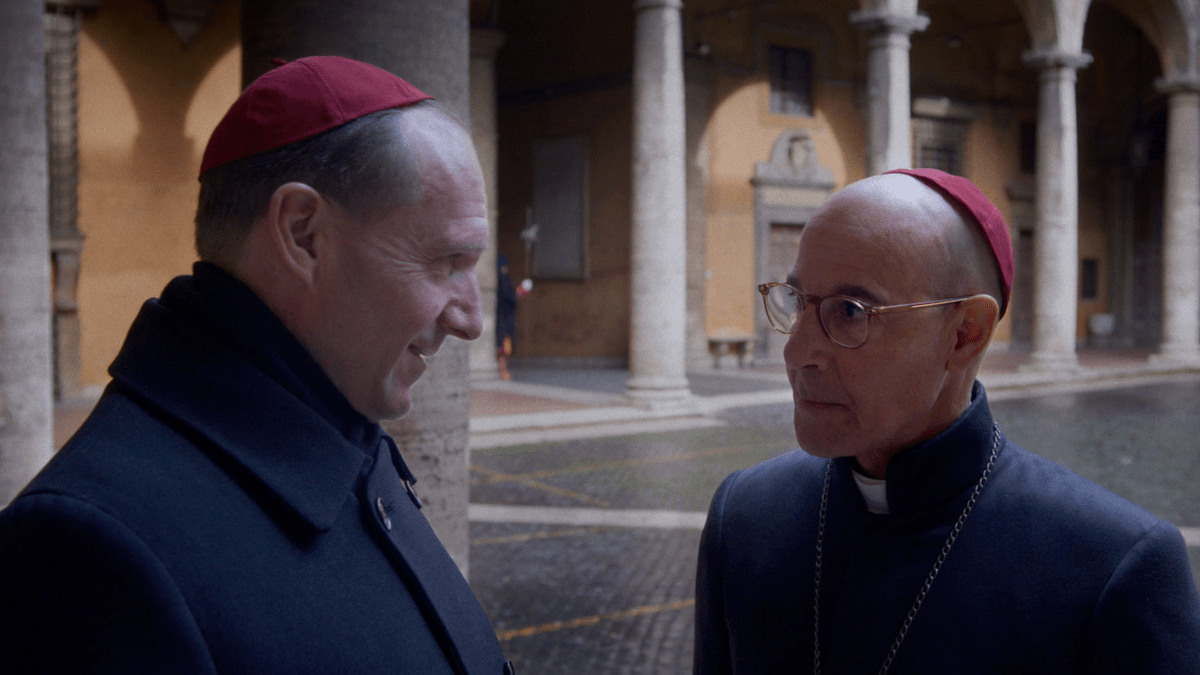
The person in charge of the process is Cardinal-Dean Thomas Lawrence (Ralph Fiennes), who was close to the now-deceased Pope and is responsible for ensuring that the process runs smoothly and, most importantly, results in the best candidate assuming the throne. While the College of Cardinals is sequestered, Lawrence susses out the bad apples and urges them to withdraw from consideration before they suffer from embarrassment. This makes Lawrence not so much a detective, but a background-checker.
Making his job difficult is how the conclave is the fact that all of the cardinals are sequestered throughout the process. No connections to the outside world are permitted, including phones, news reports and so on. As Lawrence reminds Monsignor Raymond O’Malley (Brían F. O’Byrne), the conclave should vote on the information they had before they were sequestered, not information leaked while things are in motion. It’s critical that no outside information of any kind influences the process. Of course, whenever it looks like the wrong man is gaining momentum, Lawrence quickly steps outside of tradition to prevent a disaster from happening. Lawrence is above all else an institutionalist, meaning that he’s comfortable with bending the rules when it ensures that a man with questionable ethics doesn’t become the leader of the Catholic Church. (Read into that what you will.)
The candidates who receive Lawrence’s scrutiny include Aldo Cardinal Bellini (Stanley Tucci), Joseph Cardinal Tremblay (John Lithgow), Goffredo Cardinal Tedesco (Sergio Castellitto) and Joshua Cardinal Adeyemi (Lucian Msamati). As we come to learn, each of these men has flaws. However, as Archbishop Woźniak (Jacek Koman) reminds his colleagues, there are no perfect candidates. His list of the issues that surrounded several problematic Popes was an effective reminder that both Pope Benedict XVI and current Pope Francis had troubling backstories. (If you haven’t yet, I highly recommend watching Netflix’s The Two Popes.)
Lawrence’s task involves not just weeding out obviously bad candidates, but also taking a side for the future direction of the church. Will the new pope swing the pendulum back to the past, as Tedesco prefers, or towards a more liberal future, as Bellini would have it? Is it better to have a Pope who is openly supportive of gay marriage if that man has a temper? What about a Pope from a country that has never had a man in the position who has socially conservative views? Or a Pope who many believe is next in line but seeks the role for the power and the glory? The conclave could wind up electing the right man for the wrong reasons, or the wrong man for the right reasons.
And what of Lawrence himself? He states repeatedly that he doesn’t want the job due to his wavering faith. However, when Lawrence asked to resign, the Pope rejected his request. Does this mean that Lawrence is the right man for the job because he personifies the adage that only men who don’t want a job should get it? As I mentioned above, Lawrence and the pope were close, and a scene where Lawrence weeps in the Pope’s quarters is proof of their bond. Did the Pope see Lawrence as his natural heir and refuse to let him leave his active role in the church in the hope that Lawrence would eventually see the light?
Before we get to that point in the story, there’s the matter of the former Pope’s last night on Earth. He had a heated discussion with Tremblay, and others present at their meeting state that the Pope removed all of Tremblay’s assignments over the findings detailed in an investigative report that has gone missing. As to what was discussed during that meeting, O’Malley has conflicting information. Tremblay strongly refutes that anything negative came out of the meeting at all but refuses to state what was discussed. Tremblay is obviously the Machiavellian figure in this story, but not the worst candidate of the bunch.
As Lawrence (Holmes) and his sidekick O’Malley (Watson) dig into who is backstabbing whom, there’s also the curious matter of Vincent Cardinal Benitez (Carlos Diehz) who was in charge of the missionary in Kabul and was elevated to the position of cardinal by the Pope in secret. He seems like a decent man and casts his votes for Lawrence despite the latter angrily telling him not to. But why did the Pope keep his appointment a secret? And what about Benitez’s scheduled flight to a medical hospital in Switzerland that he canceled? With nothing less than the soul of the Catholic Church at stake, it falls upon Lawrence to solve the riddles surrounding Benitez and the other candidates before the last vote declares a winner.
Recommendation
If Conclave is to be believed, members of the College of Cardinals will scheme their way into a vacant position of power just like men in secular fields. Whether this core assumption is true or not ultimately didn’t matter to me, because the movie is so much fun. When a movie holds my attention from beginning to end like this one did, I don’t care whether it’s preposterous or not. For comparison purposes, Conclave is in the same vein as the John Grisham adaptations that came out in the Nineties (The Firm, The Pelican Brief, The Rainmaker), in how everything depends upon one man getting to the bottom of things before it’s too late. Replace “lawyer” or “reporter” with the Dean of the College of Cardinals and it’s basically the same formula.
Accordingly, Conclave features an impressive group of actors having a blast with dialog that would be right at home in a murder mystery or espionage thriller. Ralph Fiennes is at the top of his game as Cardinal Lawrence, portraying him as a weary yet dedicated man who simply can’t ignore the things keeping him awake at night. The role is a perfect fit for Fiennes, who has made a career out of playing cerebral men who fight against their self-repressed natures. Fiennes’ turn here is a masterful combination of restraint and intensity, which pairs well with the movie’s exceptional supporting cast.
The movie shifts into a higher gear whenever the spotlight shines on John Lithgow, Stanley Tucci, Sergio Castellitto and Isabella Rossellini. Lithgow is reliably blustery and pompous as the deceitful Cardinal Tremblay. Tucci’s Cardinal Bellini is an edgy progressive who switches between offering reassurance and throwing verbal grenades at the drop of a zucchetto. As Cardinal Tedesco, Castellitto is a convincingly toxic mix of racist and traditional attitudes. Lastly, Rossellini electrifies the screen whenever she appears as Sister Agnes. Although she’s only in a handful of scenes, Rossellini makes them memorable with her withering stares and passionate retorts.
Similar to his previous film All Quiet on the Western Front, director Edward Berger constructs Conclave as a fully-immersive experience. He and cinematographer Stéphane Fontaine fill the screen with spectacular images of Vatican City that convey both the large-scale awe of the Catholic Church and the pomp of its inhabitants. In addition to the visuals, the movie’s rich sound design effectively captures the hushed and anxious atmosphere of this world, where every breath and footstep acquires a deeper significance. Although I’ve only seen two of his films, the way Berger’s attention to detail gives his movies such a tactile sense of story and character is extraordinary. Lastly, composer Volker Bertelmann’s sparse and jarring score effectively accentuates the tension and suspense. Bertelmann won an academy award with a similar approach to All Quiet on the Western Front, and he should earn another nomination for his work on this film.
Conclave is a well-acted and impeccably crafted piece of pulp entertainment. Don’t take the movie’s story of papal succession intrigue seriously, just enjoy it for what it is: big, bold and gloriously entertaining filmmaking. With this movie, director Edward Berger has established himself as one of the best visual stylists working in film today. Highly Recommended.
 Detroit Cineaste
One thought on “Conclave (review)”