
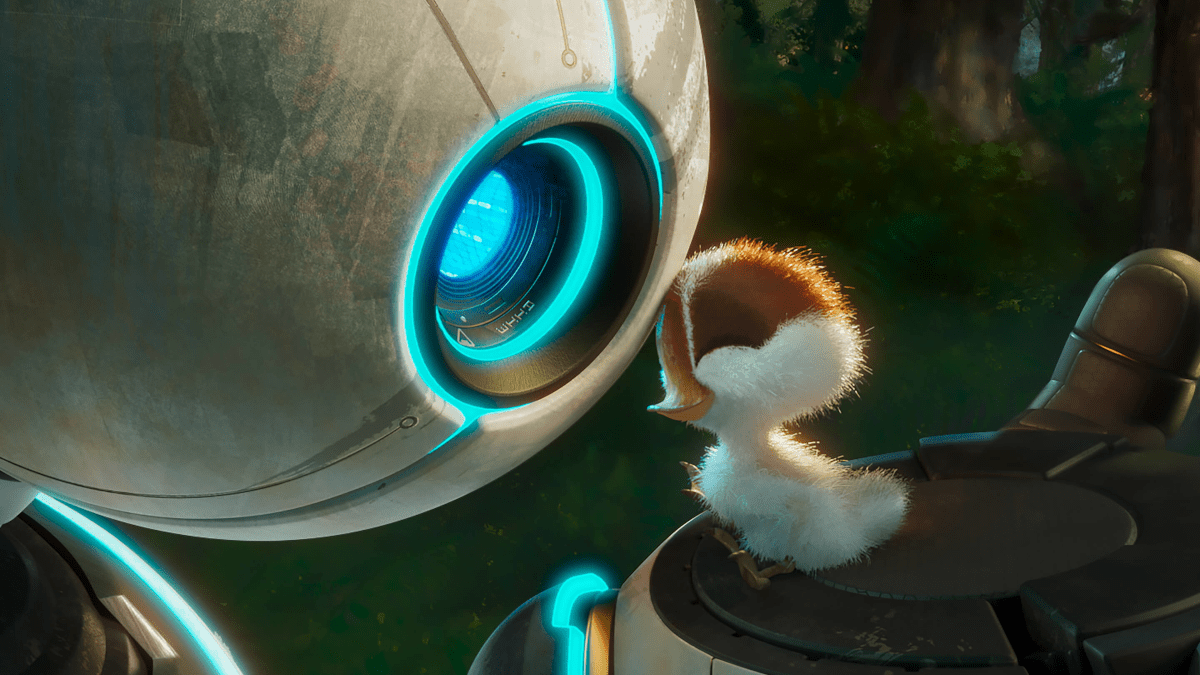
There’s something different about The Wild Robot. There’s a vibrancy to the movie that’s noticeable. You can almost feel the excitement everyone involved had while bringing this story to the screen. Every aspect of this movie–the visuals, the voice acting, the dialog–is executed to perfection. The movie doesn’t have a single false note to it. Yes, it is that good. There are aspects to it that will be familiar. The story features a futuristic robot doing amazing things (Wall-E), migrating birds (Migration) and animals that teach us life-lessons (The Jungle Book, Finding Nemo). The brilliance of The Wild Robot is in how it incorporates themes that we’re already familiar with and breathes new life into them. It accomplishes this by having us experience them through the adventures of the wild robot the movie is named after.
(If you’d prefer to skip ahead to my analysis, click here.)
Initially, the robot isn’t wild but lost. After a dark and stormy night, a ROZZUM Unit 7134 (or “Roz”, for short) awakens to a reality it was not programmed for. Roz is a helper robot created to make the lives of humans easier. (An advertisement proudly states that families who acquire it obtain 40% more leisure time and happiness. Lazy people rejoice!) Unfortunately, there is little use for a robot in a forest populated with various creatures. The animals are understandably hostile towards Roz’ programming, which requires it to seek tasks incessantly. I love that after every failed attempt at being helpful, Roz emits a sticker with a handy QR code for feedback. (For all of those companies that overwhelm me with their survey requests, please take note.)
Frustrated at being unable to communicate with her possible owners, Roz puts herself into learning mode and silently observes the animals. After several days, she understands everything the animals are saying. Curiously, this is the second animated film this year (after The Garfield Movie) to suggest that AI can help us achieve our Dr. Doolittle fantasies. Perhaps it would be better if tech companies trained their large language models on Spot and Whiskers and left creative endeavors to humans, but I digress.
Even after she can talk to the animals, none of them want Roz around. Dejected, Roz decides it’s time to phone home. This leads to a series of mishaps that culminate in Roz accidentally killing a mother goose and destroying her nest. Only one egg survives. While weighing her options, a hungry fox named Fink (Pedro Pascal) steals the egg. After an extended game of keep away, Roz secures the egg and, much to Fink’s surprise, helps him out of a jam.
Shortly afterwards the egg hatches, and Roz figures she’s free to go. Not so fast. The gosling follows Roz and destroys its homing beacon. (The tech in this movie is so fragile they could be Apple products.) Roz notices a mother possum named Pigtail (Catherine O’Hara) with more kids than she can keep track of nearby and figures she won’t notice one more. Roz tries to pawn off the gosling to Pigtail, who explains that that won’t work because the gosling believes that Roz is its mother. When Roz insists on returning to home base, Pigtail states that the gosling is now its task. Roz accepts her assignment and is now responsible for teaching it how to eat, swim and fly by fall. Otherwise, the gosling will die when winter arrives.
Naturally, Roz doesn’t know the first thing about teaching the gosling survival skills. Her failures stoke Fink’s curiosity, who offers his services as “predator and local goose expert”. True to his name, Fink’s offer of help is mainly driven out of self-interest. Fink isn’t all lies, though, and he directs Roz to build shelter for the three of them. Together, Roz and Fink become the gosling’s adoptive parents and do their best to raise Brightbill (Roz’s name for him). Before long, Fink’s cynicism fades and Roz becomes a helicopter mom, watching over Brightbill’s every move.
Things change dramatically when Brightbill finally learns what happened to his real family. Still determined to complete its tasks, Roz makes a deal with her son. If he’ll let Roz help him to fly with the other geese, it will leave the island and return home. Like any good parent, Roz works tirelessly to help Brightbill succeed, even finding him a “flight instructor” named Thunderbolt (Ving Rhames, crushing another cameo role.) Roz’ efforts don’t go unnoticed by migration leader Longneck (Bill Nighy, superb), who offers much-needed encouragement. Then, when the big day comes, Brightbill flies off with the rest of the flock. It’s a bittersweet moment that left me misty-eyed. (The movie is an emotional experience on the level of Toy Story 3.)
Suddenly, Roz and Fink find themselves to be empty-nesters. Roz feels empty with Brightbill gone and contemplates returning home. However, a winter storm hits and it’s the worst one in years. Roz and Fink realize that although they are no longer parents, they can still be helpful. Their forest community needs them, and it’s up to the two makeshift parents to not only save their neighbors from freezing, but also convince them that they must work together to ensure their survival.
The Wild Robot is an extraordinary film. Out of all the words I could use to describe it, the best one would be life-affirming. The movie’s combination of artistry and passion definitely stands out in this era of big-budget animated sequels. Although I am able to enjoy movies like Kung Fu Panda 4, there’s no denying the magical feeling of being engrossed by an original story filled with unfamiliar characters. Remember what seeing the original Kung Fu Panda was like? Or How to Train Your Dragon? That’s how I felt while watching this movie. The Wild Robot is a welcome breath of fresh air because it is a new story told with confidence.
Those who have seen family-oriented animated films will certainly recognize the themes explored in The Wild Robot, which include the selflessness of parenthood, the importance of the community and the power of collaboration. What makes this story special is how it uses the perspective of an outsider–in this case, a robot–to help us to consider these themes from an unfamiliar perspective. For example, every parent would agree that the job is long, challenging, arduous and occasionally thankless. What struck a chord in me was how a robot arrived at the same conclusion.
Like its spiritual cousin Wall-E, The Wild Robot reminds us to appreciate the things about being human that we are too willing to dismiss. Where Wall-E celebrated humanity’s capacity for love, romance and creativity, this movie speaks to our sense of altruism and collaboration. The Wild Robot reminds us that helping others–including our families and neighbors–is one of the best things we can do as human beings. Additionally, both films gently remind us of our fundamental responsibility to take care of the planet we call home sooner rather than later. For its part, The Wild Robot is surprisingly optimistic about our future, in that humanity will be able to rely upon robots that work tirelessly to ensure our survival instead of our demise. In the realm of science-fiction, this movie envisions the future as being more Star Trek than Terminator, which is a relief.
Getting back to why The Wild Robot is so good, every element of the film is flawless. The animation itself is breathtaking. Like two previous films by DreamWorks Animation, The Bad Guys and Puss in Boots: The Last Wish, this one also utilizes an animation technique that gives the action sequences what I see as a “jagged fluidity”. Movement in all of these films has an energy to it that makes it more visually interesting than average computer animation. The characters always look as if they are moving through a painted landscape instead of an artificial one. Even a simple scene of Roz running through a field with a group of butterflies looks amazingly life-like. Beyond the action sequences, every character in this movie looks incredible. The animals look incredibly lifelike, and Roz is one of the best robot designs conceived for a movie.
The voice acting by the entire cast is both distinct and remarkably self-contained. Lupita Nyong’o and Pedro Pascal deliver nuanced performances that are always befitting the nature of their characters. There are also hilarious supporting turns by many other members of the cast, including Bill Nighy, Stephanie Hsu, Ving Rhames, Mark Hamill, Matt Berry and Catherine O’Hara. The filmmakers wisely chose a cast of great voice actors, provided them with strong material to work with and let them do their thing. The results are a collection of characters as richly defined and memorable as one of the classic Disney movies. Last but not least, Kris Bowers’ majestic score brings it all together.
The Wild Robot is a visually poetic and emotionally rich story about how finding our purpose in life leads to helping others. The way it explores its themes of responsibility, self-sacrifice and teamwork with a combination of sincerity and a healthy dose of humor, is simply masterful. The movie is not only one of the best films of the year, but also a no-doubt classic. Highly Recommended.
(For my analysis, click here.)
 Detroit Cineaste