
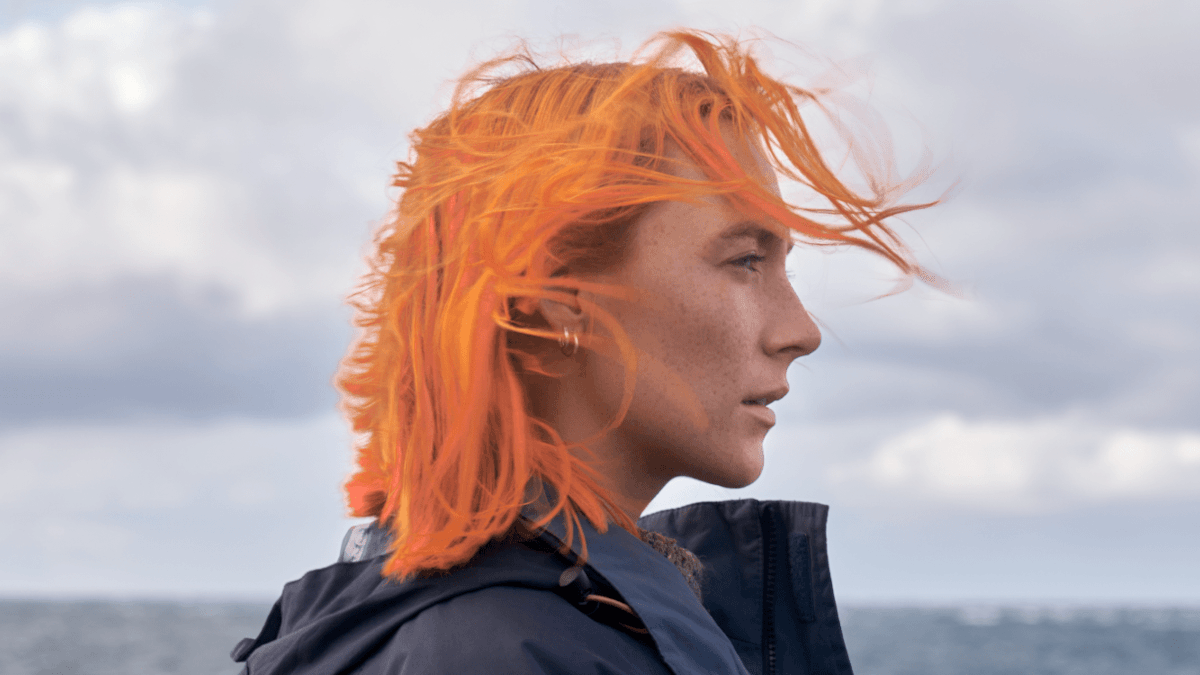
The Outrun begins with a hallmark of all alcoholism dramas: the falling-down drunk scene. Rona (Saoirse Ronan) is the sole patron at a pub past closing time. The barkeep tells her to leave, but she laughs and stays put. Rona finishes her beer and when the barkeep refuses to give her another, she grabs a random bottle on the counter and drinks it. The staff are irritated but let her hang around while they finish cleaning up. When they are ready to lock up and insist she leave, Rona refuses and falls to the floor. When a large man, presumably the bouncer, gets her to stand and pushes her towards the door, Rona angrily fights back. Finally, she’s shoved face-first onto the sidewalk and the door is slammed shut. As she sways down the street, a man driving by states that he’s a friend of so-and-so and offers her a lift. After she gets into the car, the movie cuts to a scene of her in a hospital with a swollen eye.
The movie then jumps ahead by a hundred days or so to show us Rona sober and working on her father’s sheep farm. Not only is the contrast in tone between the two scenes jarring, but the sudden jump in time leaves us with many unanswered questions. What precipitated Rona’s pub incident? What happened after she got into the car? How did she pull herself together after being assaulted? The answers to those questions come in time, but not until Rona is ready to acknowledge why she hit rock bottom that night.
Until then, the movie gradually reveals how Rona’s family dynamics play a significant role in her alcoholism. Rona loves her father Andrew (Stephen Dillane) but she’s openly hostile towards her mother Annie (Saskia Reeves). Her parents divorced some time ago, presumably when she was much younger. Initially, Andrew seems like a decent father who has a healthy relationship with his daughter. It’s only later that we learn Andrew is bi-polar and an alcoholic, and that his manic episodes led to her parents divorce. Rona hates her mother’s religious leanings and derides her reliance on prayers. In flashbacks of Rona’s childhood, it’s obvious that Annie turned to God as a coping mechanism for a very difficult situation. Rona, however, believes her mother’s faith is useless because it didn’t prevent the breakup of her family.
As Rona struggles to keep sober in the present, we learn about her troubled past. She was in a relationship with her boyfriend Daynin (Paapa Essiedu), went to university, obtained a Master’s degree in biology and worked in a lab. Even though Rona had all of the ingredients for a good life, her drinking took everything away from her. If you’ve seen even only a few movies about alcoholism, you know that Rona and Daynin’s relationship was doomed from the start. In an early flashback, Rona quickly polishes off a beer while Daynin looks at her with concern. No relationship, even one as loving as theirs, can survive when one of them is a professional drinker.
Back in the present, Rona struggles to adapt to life without alcohol. She lands a job tracking the rare corn crake bird at night, but the work is boring and tedious and would drive most people to drink. The movie implies that her struggle with finding suitable work in her field eventually led to her relapse. We see Rona receive her ninety day pin, as well as how the urge to drink still hits her in waves. Not long after that triumph, she went out for a drink and we return to where we started. This time, however, we experience the brutality of her assault. Now that enough time has passed, Rona is able to acknowledge everything that happened that night. Despite nearly being raped, Rona still asked Daynin to join her for a drink while sporting a black eye. This was her “dark moment of the soul” that forced Rona to try getting sober again.
Recognizing that she needs to get away from London and her family in order to overcome her addiction, Rona settles on a job working for the The Royal Society for the Protection of Birds. Even though she grew up on the rugged Orkney Islands off the coast of Scotland, her outpost appears to be on the remotest and coldest of all of them. It’s there, through periods of intense self-reflection and physical endurance, that Rona finally learns how to live without drinking.
The Outrun isn’t fundamentally different from other addiction/recovery movies. What separates it from others in its genre is in how the plot unfolds in non-linearly. The story swings between the past and the present, an approach that gives one the sensation of reading a diary or a journal. This makes sense considering that the movie is based on a memoir. However, the frequent shifts in time dissipate the emotional arc we’ve come to expect from movies like this. One moment we’re watching Ronan’s character crawling on broken glass and crying, the next she’s in her car tracking birds. Although the movie is filled with emotional moments, they aren’t as impactful as they should be because they appear randomly instead of building upon each other.
Where The Outrun excels is in having the viewer see the story through the eyes of its protagonist. Director Nora Fingscheidt renders the story with an observant, contemplative tone similar to the approach of her main character, who is a biologist. Accordingly, Fingscheidt records Ronan’s every move and facial expression like a scientist undertaking a field study. Fortunately, her subject is portrayed by Ronan, one of her generation’s best actors. Others have described Ronan as the next Meryl Streep, and her performance in this movie strongly affirms that comparison.
Cinematographer Yunus Roy Imer expertly captures the natural environment where the majority of the story takes place, with scenes of crashing waves, wind-swept fields, shorelines entangled with seaweed, seals peaking through the water, and so on. As undeniably beautiful as the scenery is, the movie spends a bit too much time admiring it. I often wondered if the actors had wandered into a Terrance Malick film. If you like movies with a meditative feeling, you’ll love this movie. (I occasionally found myself growing restless.)
Overall, The Outrun is a fine entry in the addiction/recovery canon. Although I appreciate the movie for coloring outside the lines in terms of genre formula, the approach is often at cross-purposes to the material. That said, the movie has many things working in its favor, beginning with another excellent performance by Saoirse Ronan and fine work by all of the supporting cast. The underlying message of the story–that addiction doesn’t have an obvious origin or easy solutions–is delivered honesty and with compassion. Although sometimes disorienting, The Outrun is a solidly acted and beautifully rendered addiction drama. Recommended.
Analysis
The Persistence of Memory
I’m often mystified at how memory works. Even when I’m focusing on an important task, my mind takes me back to an obscure moment from my past. Sometimes I recognize how the two are connected. Other times I don’t understand the connection until much later. In either case, I have no idea why my mind decided to recall something at that particular moment. The memory simply appears and I’m forced to “watch it” until it’s over.
This is why I’m conflicted about the frequent shifts in time used by The Outrun. As I mentioned above, they diminish the impact the story would have had if it were told in a straightforward manner. However, the movie’s narrative construct is accurate in how our memories tend to intrude on us unannounced, whether we’re ready for them or not.
I also appreciated how The Outrun represents how memories aren’t specific glimpses into the past. Instead, they can show us the same event differently. Sometimes we see things we didn’t notice before, or see the the event from a different starting point. For example, Rona’s thoughts keep taking her back to that fateful night when she was assaulted. The scene that opens the movie doesn’t give us the entire picture of what happened that day. In that sense, the movie approximates how Rona’s mind may have been protecting her from the harsh truths until she was ready for them. It’s only much later that we see her drinking at the pub for hours before she was thrown out, what precipitated her going to the pub in the first place, and her horrifying conversation with Daynin after she receives treatment.
Because The Outrun loves visual metaphors, the movie inspired me to come up with one of my own. The way Rona’s mind kept revisiting the same events from her past reminded me of a sand pendulum toy:
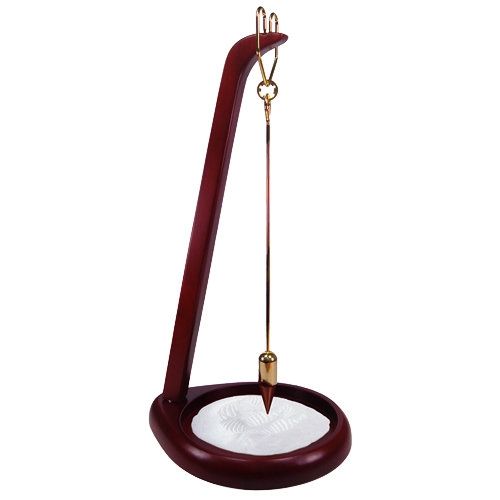
Similar to how the toy continuously draws circles that overlap each other, Rona’s memory keeps circling back to the same memories. It’s only after her mind thoroughly explores the same territory that she can admit to the role she played in her own misfortune.
The Art of Suffering
Considering how respected Saoirse Ronan is as an actor, it was only a matter of time before she took a walk on the seamier side of life. Florence Pugh, a contemporary of hers who is likewise highly regarded, did the same just last year in A Good Person. I suspect that the lure of playing an addict is irresistable to actors. Like Pugh, Ronan was able to showcase the full extent of her emotional range. We see Ronan in various stages of drunkenness, including tipsy, blissful, angry, spiteful and so on. Although she’s convincing in all of her states of inebriation, there’s nothing unique about her performance other than this being Ronan’s turn. In all fairness, the same can be said of Pugh’s effort.
Same But Different
Since A Good Person and The Outrun were released less than two years apart, I couldn’t help noticing how similar they are and how they diverge.
In terms of similarities, both films chart their protagonist’s progression through the addiction “stations of the cross”. Both include scenes of the alcoholic in various states of drunkenness. Both have scenes set at Alcoholic Anonymous meetings and sharing sessions. Both have scenes of fraught sobriety followed by the inevitable relapse. Where the two are different in how they explore the source of addiction and the steps taken towards sobriety.
A Good Person has a “big bang” moment that sets the heroine on a downward spiral. Allison’s distracted driving directly leads to the death of her fiance and his sister-in-law. Similarly, she’s only able to pull herself out of her addiction when she is forgiven by her fiance’s father.
The Outrun, however, doesn’t settle on a single catalyzing event as being responsible for Rona’s addiction. Instead, the movie presents several possible sources of her alcoholism. She grew up in a broken home. She spent years observing her father’s alcoholism up close and possibly learned to drink from him. Her father’s bi-polar diagnosis could indicate that she inherited a mental predisposition towards drinking. Outside the home, she’s unable to find interesting work in her field. Her psychological need for constant stimulation (alcohol, tobacco, caffeine, music) definitely plays a role as well. The movie never states conclusively that any of those factors (or all of them) led to her becoming an alcoholic.
Similarly, The Outrun doesn’t offer a clear-cut solution to Rona’s addiction. While it does show that organizations like Alcoholics Anonymous can offer structure and support, the movie states in no uncertain terms that the addict must cure themselves. Watching Rona’s road to recovery reminded me of a quote from Ringo Starr:
I was afraid at the beginning. [I thought] I don’t know how you do anything if you’re not drunk. That’s where I ended up. I couldn’t play sober, but I also couldn’t play as a drunk. So when I did end up in this rehab, it was like a light went on and said you’re a musician, you play good.
Similar to Starr, Rona needed to learn how to do what she loves when she’s not drunk. To accomplish this, she relocates to the remote Papa Westray island, which places her as far away from the things that trigger her addiction as possible. It’s there that she rediscovers her love of biology and realizes that she can be a biologist without drinking.
To be clear, The Outrun isn’t saying that undergoing a twelve step program isn’t helpful. What it does say is that those programs are only one part of the recovery process. Ultimately, the responsibility falls upon the individual to find out how to deal with everyday stress, anxiety and even boredom without using drugs. Only they can find what works for them.
The Continuing Appeal of Addiction Films
I never have been much of a drinker. My limit is usually three drinks, which firmly places me in the lightweight division of drinking. Even still, I’ve always been fascinated by movies about alcoholics and other forms of drug addiction. Generally speaking, movies like The Outrun reinforce the belief that even the most troubled among us can overcome their demons and live happy, productive lives. Like a phoenix rising from the ashes, Rona’s eventual triumph convinces us that we can do the same in our own lives. Addiction movies turn us into off-screen cheerleaders for characters like Rona, and we root for them every step of the way. In the end, there’s no better feeling than seeing Rona finally walk through her personal ring of fire. If her story isn’t uplifting, what is?
This is the Day
Some trivia about the song that plays over the end credits:
- The song is off of the debut album by The The titled “Soul Mining”.
- This is the second time I’ve heard this song in a movie in the past two years. The first time was in Guardians of the Galaxy Vol. 3.
- The song was released as a single on September 2, 1983.
- Saoirse Ronan was born on April 12, 1994, meaning that the song is 10 years, 7 months, 10 days older than she is.
- Director Nora Fingscheidt was born in 1983, so it’s possible she heard it while laying in her crib.
- While I love that young people are hearing one of the best New Wave songs ever written, I suddenly feel old.
- Here’s hoping that another filmmaker will be inspired to use “Imperfect Smile”, another classic from the same album.
 Detroit Cineaste