
There’s something not quite right with the Daltons. That’s painfully evident from the outset, when they choose to wallow in their own misery despite being in a beautiful part of Italy. They don’t hide their misery, either, wearing it like an irritating jacket wherever they go. Ben Dalton (Scoot McNairy) is morose, while Louise Dalton (Mackenzie Davis) is edgy and controlling. The two are so clenched around each other I imagined they squeak while walking. Unsurprisingly, the two have unresolved issues between them that will play a consequential role in what transpires.
Agnes (Alix West Lefler), Ben and Louise’s daughter, is cute but also brimming with anxieties. Louise’s doting constantly irritates Ben, who has reasons to be concerned about her parenting. Agnes has an app that helps her regulate her breathing and clings to a childhood toy to ward off panic attacks. The three have an unhealthy dynamic, and I would actively avoid them after spending five minutes with them. Not so for Paddy (James McAvoy) and Ciara (Aisling Franciosi), who inexplicably befriend them.
Unlike their American counterparts, Paddy and Ciara are relaxed, gregarious and fun-loving. After they save the Dalton’s from the company of a boring Danish couple, Ben and Louise share what ails them. Ben relocated his family to London, only for his company to shut down the office after they arrived. This explains his depression, but that awful turn of events isn’t the only reason. Louise, however, resists the overtures of their new friends but softens a bit when Agnes befriends Paddy and Ciara’s mute son Ant. Paddy says that Ant was born with a condition, but that is revealed to be one of many lies Paddy and Ciara spin while gaining Ben and Louise’s trust. Paddy says that he was a successful doctor but gave it up to work for Doctors Without Borders, which makes him a hero in Ben and Louise’s eyes.
Back in rainy London, Ben, Louise and Agnes resume being miserable expats. After Agenes goes to bed, her parents have one of those conversations that reveal just how bad things are between them. Ben is convinced Lousie had an affair, and the evidence found is certainly indicative of something. Louise insists that “nothing happened”, but Ben is understandably dubious. Because of her husband’s twin soul-crushing defeats, Louise has been forced to be the breadwinner of the family. Divorce seems like the most likely outcome for Ben and Louise, an option that would allow them to start over. But a postcard from Paddy arrives inviting them to stay at his country estate, causing Ben and Louise to passive-aggressively argue over whether they should accept. They ultimately decide to go as a “hail mary” attempt at saving their troubled relationship, because what could possibly go wrong while spending ten days with people they hardly know, in a part of England they aren’t familiar with?
Of course, the vacation is awkward from the get-go. Everything Paddy and Ciara do triggers Ben and Louise in one way or another. Paddy insists that Louise taste the first morsel from a freshly slain goose he prepared for dinner. We know from Italy that Louise is a vegetarian, but Paddy may simply have forgotten that detail and his transgression is nothing more than a faux pas. The guest bed where Paddy and Ciara sleep has a stained bed cover. It could be, as Ben states, something common with country homes. (I love the notion that the further you are away from the city, everything is just hopelessly stained.) At dinner with only the adults, Paddy challenges Louise’s logic on eating fish but not other kinds of meat. Maybe Paddy is just trying to engage his guests with lively table talk.
Other transgressions seem intended to garner a reaction from Ben and Louise. For example, during the aforementioned dinner, Paddy and Ciara profess to having an open marriage, and Ciara pretends to give Paddy fellatio under the dining table. Ben and Louise think that the two are joking, but as the “performance” continues they become increasingly uncomfortable. (Turns out it was a joke after all.) Paddy and Ciara appear to be testing how Ben and Louise respond to uncomfortable situations. The question is why. What game are Paddy and Ciara playing with the Daltons?
If you’ve seen the trailer, you already know one of the movie’s shocking revelations, and it really should have been kept under wraps. (It’s in plain view in the trailer below.) Thankfully, the explanation for Ant’s “condition” is not the only surprise that awaits us. Given that this is a horror movie, I’m not spoiling anything by saying that once Paddy and Ciara’s insidious plot has been revealed, the movie gives way to a tension-filled third act that had me guessing until the end. I’d heard that the ending of this movie isn’t at the same level as the original movie, but given that I haven’t seen it I have no way of knowing. All I can say is that I thought the way this version of the story wrapped up was effective.
Hang-ups are not only funny, they can be fatal as well. That’s one of my take-aways from Speak No Evil, which generates laughs at the expense of an uptight and self-absorbed American family playfully besieged by their new European friends. The movie is a very funny cringe comedy and certainly could have stayed that way and revealed everything as a series of misunderstandings. That Speak No Evil transforms into a horror movie in its later stages isn’t a problem, because it’s equally effective playing in that sandbox as well. Where the movie distinguishes itself is with the disconcerting subtext that comes to the forefront when things come to a head.
The horror of Speak No Evil isn’t what happens to the unwitting family, but why. The villains chose these targets because of how they present themselves to the world. The movie reminded me of The Vanishing, where a trusting young woman and her obsessive husband meet horrific ends because of who they are. Speak No Evil goes further by saying that it’s the negative aspects of ourselves–our neuroses, our self-absorption–that makes us victims. As such, I wouldn’t be surprised if this movie convinces some members of the audience to seek out therapy afterwards.
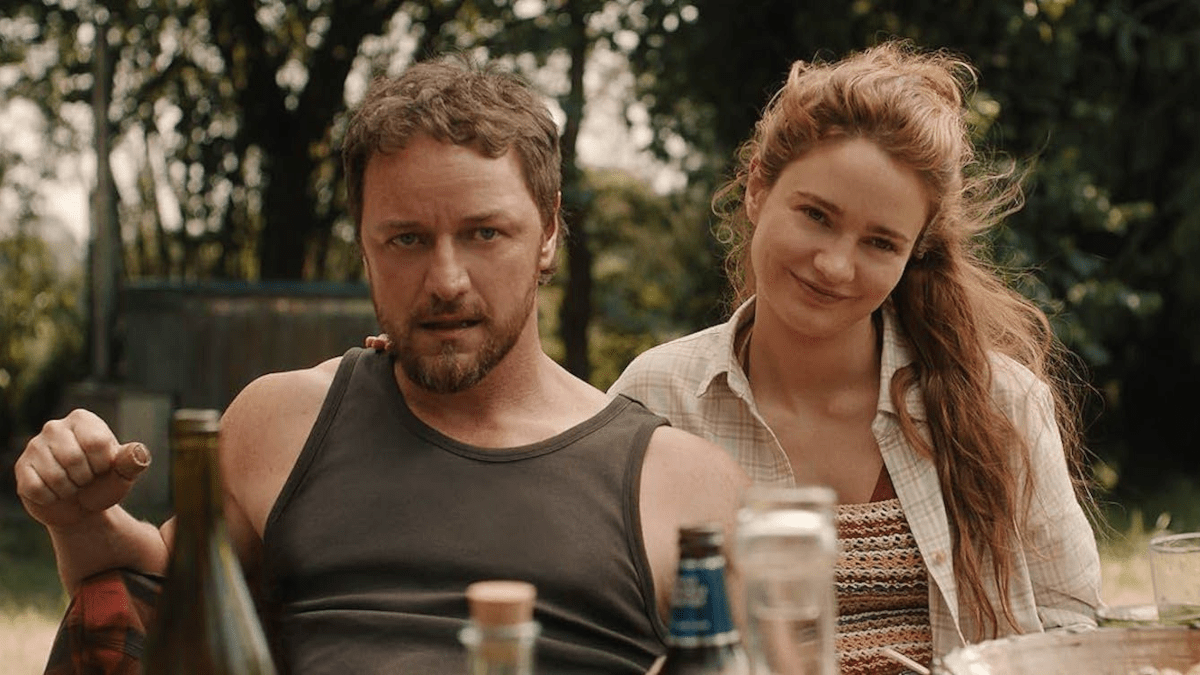
While all of the principals in the movie give solid performances, the movie is a showcase for James McAvoy’s unique mixture of charm, thuggishness and elusiveness. He’s given similar performances before (see M. Night Shyamalan’s Split and Glass), but it’s still fun because his character is so unpredictable until he reverts to “beast mode” in the last act. While watching McAvoy spit venom is entertaining, the movie’s climactic series of confrontations would have been much more effective if he had remained a coiled psychopath instead of a growling maniac. That said, I respect how the movie prevents the culminating act of violence to be seen as a triumph. In the end, everyone is forever changed for the worse, even the survivors. Speak No Evil is an exceptionally taut and unnerving experience. It distinguishes itself in how it subtly challenges the viewer, raising difficult questions while providing no comforting answers. Recommended.
Analysis
Louise: Why are you doing this to us?
Paddy: Because you let me.
This exchange comes immediately after Paddy explains to the Daltons how he’s going to kill them. He will inject them with ketamine and toss them in the pond to drown, so that they will die slowly and agonizingly. Given that Ant had previously shown Agnes that his “father” had killed other families, including his own, this turn of events isn’t entirely surprising. However, Paddy’s response reveals what the movie has been building to from the beginning.
Speak No Evil is not a “twist ending” movie in the literal sense. Its shocking surprise (or twist) arrives at the end of the second act instead of at the end of the movie. And what is revealed doesn’t fundamentally change what happened before. However, the surprises force us to view everything in a much darker context. That reexamination yields not just one uncomfortable revelation, but a second one hiding underneath. All told, there are three levels of surprises, which I delineate below as “Oh!” “Ooooh” and “Oh”.
Level One: The standard horror reveal (Oh!)
In the scene I mentioned above between Ant and Agnes, Ant reveals that 1) Paddy and Ciara have lured several families back to their country estate and killed them, 2) Paddy cut off Ant’s tongue to keep him silent and obedient, and 3) Paddy is not Ant’s father. To me, these are average horror movie reveals. Speak No Evil was marketed as a horror movie and the trailer hints (very strongly) that Paddy is a bad guy who is not to be trusted. Accordingly, the reveal that he has been luring families back to his country estate to kill them is not a huge surprise, as many horror movies have used the “your eccentric new friends secretly want to do you harm” storyline (see: Blink Twice.) However, these surprises effectively change the direction of the story from a comedy of manners into a thriller about a family desperately trying to escape from serial killers. More importantly, it sets up two additional revelations that operate on a psychological level.
Level Two: You set yourself up (Ooooh)
Now that Paddy’s insidious plan is known, his response to Louise that sounds like a taunt is actually an accusation. Paddy implies that the Dalton’s have been complicit in their own demise. At first, this sounds ridiculous, because there wasn’t a moment when the Daltons communicated that they had a death wish. What Paddy is driving at is that the Daltons made themselves targets because of their behavior.
Paddy and Ciara decided that the Daltons were the ideal prey when they first met them in Italy. They were looking for a family who were self-absorbed and neurotic and the Daltons fit the bill perfectly. Ben is morose and passive, Louise is a helicopter mom and Agnes is riddled with anxieties. Given that the Daltons are barely functional individually or as a family, Paddy and Ciara decided that they would be their next victims.
The next step in Paddy’s plan is determining whether the Daltons will put up a fight. Paddy does this with a steady drip-drip-drip of offenses designed to gauge how much Ben and Louise will tolerate before packing up and leaving. Because Ben and Louise are overwhelmingly afraid of offending their hosts, they put up with almost everything, even when their daughter is left with a stranger. After days of experimentation, Paddy knows that when faced with a real threat, the Daltons will probably go down meekly instead of kicking and screaming. The only member of the family who Paddy suspects will resist to some degree is Louise.
Paddy and Ciara proceed to needle Louise to find her weakness. Is it being forced to eat meat? Sleep in a bed with a stained sheet? Jumping off a cliff into a lake below? Having Agnes sleep on the floor? Louise surprisingly acquiesces to everything except when she finds Agnes in their host’s bed. That is the one line that can’t be crossed. Louise insists that they leave immediately, before Paddy and Ciara awaken and find them gone. This would have effectively taken Ben, Louise and Agnes out of harm’s way, but the neurosis that made them targets in the first place rear their ugly heads at the worst possible time. Agnes has a panic attack, Ben becomes frustrated and Louise’s controlling mindset overrules her husband’s common sense.
When the Dalton’s return to find Agnes’ stuffed animal, it confirms to Paddy and Ciara that even when they cross the line with Louise, she’ll still choose to put her entire family in danger to placate her child. Then, when they still could leave, Ben and Louise are easily guilted into staying when they hear Paddy and Ciara’s sob story about losing their daughter. Ben and Louise’s fear of offending others once again overrides their flight-or-fight instinct. This is what Paddy means when he tells Louise “you let us”. The Daltons, with their neurosis and social anxieties, never were in control of the situation. They allowed Paddy and Ciara to dictate the terms of their relationship, up to the point when they were about to be killed.
Level three: We, the audience, went along with it (Oh.)
The notion that the audience plays a role in what happens is the most surprising and unsettling aspect of Speak No Evil by far. The movie accomplishes this by making Ben and Louise unsympathetic, not to the point where we hate them, but enough to be annoyed by them. The cringe comedy scenes are so effective because the two couples are polar opposites. Ben is a dull stick-in-the-mud, Louise a tightly-wound control freak and they have no sex life to speak of. Paddy and Ciara are gregarious, fun and are comfortable with each other.
The movie encourages us to laugh at Ben and Louise every time Paddy and Ciara do something that makes their guests uncomfortable. We’re comfortable laughing at Ben and Louise because they are hopelessly uptight. For example, the mortified reactions from Ben and Louise when Ciara pretends to perform fellatio on Paddy are priceless. Same goes for the befuddled look on Ben’s face when Paddy serenades him with “Eternal Flame”. For a significant portion of the movie, we are lulled into believing that whatever Paddy and Ciara do are either harmless pranks or simple misunderstandings, until we learn the hidden intent behind their actions. Then we realize that everything we laughed was actually actually a form of psychological torture, the results of which determined how easy it would be for Paddy and Ciara to kill the Daltons.
While knowledge of the Daltons horrific fate does make us finally feel compassion for them, it doesn’t absolve us from the fact that until things became overwhelmingly tense, we were ok with laughing alongside the sadists, perhaps even cheering them on. Personally, I didn’t agree with Paddy that the Daltons are so pathetic that they should be put out of their own misery. But I would be lying if the movie doesn’t make the case that a family as miserable as the Daltons had it coming to them, and ultimately dares us to disagree with that assessment.
 Detroit Cineaste