
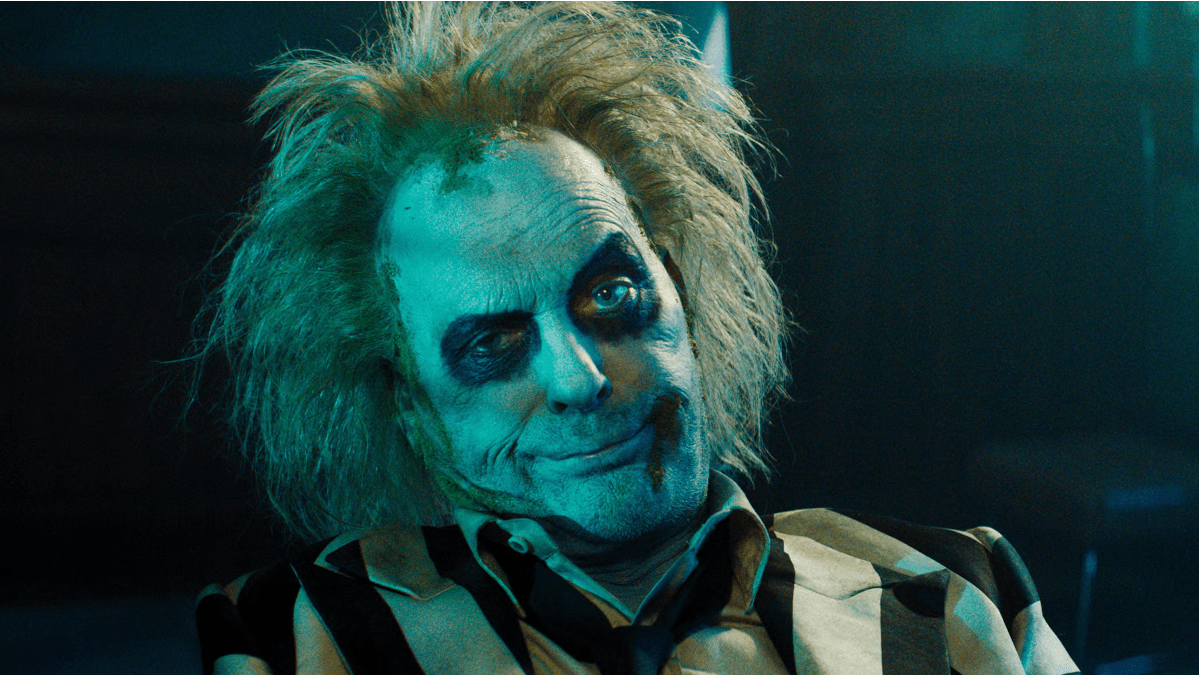
As I grow older, I sometimes wonder what the afterlife is like. Will it follow the Catholic doctrine I was raised in, and be a celestial wonderland where everyone sings hymns and floats along on wings? While that certainly sounds nice, I suspect I would get bored with it after a millennia or two. Or maybe the afterlife will be like what Tim Burton envisioned in Beetlejuice, a world where the dead alternate between haunting the living and traveling to a janky bureaucracy. Call me crazy, but the latter sounds like more fun.
Of course, what’s fun for the dead isn’t a walk in the park for the living. In Beetlejuice, Lydia Deetz (Winona Ryder) was hounded by the eponymous demon, who was infatuated with her fashion sense and joie de vivre (“Edgar Alan Poe’s Daughter”). Fortunately, the friendly ghosts who also resided in Lydia’s home, Barb and Adam Maitland (Alec Baldwin and Geena Davis) sent Beetlejuice back to the afterlife, presumably for good. After all that, I wouldn’t have been surprised if Beetlejuice Beetlejuice revealed that Lydia had gone on to live a quiet life free of ghosts. Instead, the now middle-aged Lydia has instead embraced her ability to see the “strange and unusual” and is the host of her own ghost hunting show.
Lydia’s success has made it possible for her to support her mother Delia (Catherine O’Hara), who still specializes in art that manages to be both hideous and tasteless. Lydia’s daughter, Astrid (Jenna Ortega) attends private school, where her classmates tease her for being the ghost lady’s daughter. Inconceivable as it may sound, Astrid doesn’t believe in ghosts and thinks her mother is a fraud. Will the story present her with reasons to revise her opinion? Absolutely.
As if Lydia’s family wasn’t giving her enough drama, she’s also being wooed by her producer Rory (Justin Theroux), who secretly thinks the whole ghost thing is fake as well, which is odd considering how convincing the footage of a haunting shown during a taping of Lydia’s show looks. To top it all off, a certain frizzy-haired demon who loves stripes keeps popping up, causing Lydia to question whether she’s going crazy or Beetlejuice has returned. Of course he has. Beetlejuice is still after Lydia because their union would enable him to return to the real world. Thirty-six years may have passed in our world, but that’s a blip in the afterlife.
Since the three generations of Deetz’s are leading very separate lives when the movie begins, only a life-changing event can bring them back together. That event arrives in the form of Charles Deetz’s sudden death, which is depicted oddly even for a Tim Burton movie. The gyrations the movie goes through with this character, playful as they might be, are needlessly distracting. Anyone seeing this movie would have to know that the actor who played Charles (Jeffrey Jones) couldn’t appear in this one for obvious reasons.
Lydia, Delia and Astrid reunite at the house where the original movie took place for Charles’ memorial. (An excellent sight gag: Delia has the house cloaked in black to signify that it too is in mourning.) The next order of business is to pack everything up so that the house can be listed. Lydia tries to reconnect with Astrid over photo albums in the attic, but their relationship has been strained after Astrid’s father disappeared while trying to save the Amazon (a trifle of a subplot). When Astrid shows Lydia a Beetlejuice flier she found, Lydia explains who Beetlejuice is and to never say his name three times. Astrid, who defiantly does not believe in spooks, storms off.
Meanwhile, in the afterlife, Beetlejuice’s ex-wife Delores (Monica Bellucci) has returned in search of revenge. Deceased actor Wolf Jackson (Willem Dafoe) is pursuing both of them as if he were an actual detective and didn’t play one on television. The less said about both of these characters, the better.
While exploring the town, Astrid meets a handsome young man named Jeremy (Arthur Conti), and finds that he’s a kindred spirit. (I’m dubious that youngsters read Dostoevsky, but it’s nice that the movie thinks so.) Their budding romance, however, isn’t quite what it seems. Before long, Lydia and Delia are forced to call upon Beetlejuice to rescue Astrid, and everything heads towards another climactic wedding ceremony. Can you guess who the bride and groom will be?
There’s no point in seeing a movie that coasts on nostalgia alone. That said, I would be lying if I didn’t admit to being excited during the opening moments of Beetlejuice Beetlejuice, when an aerial shot stalks the town from the original movie and Danny Elfman’s iconic score lumbers menacingly on the soundtrack. Nostalgia hit me again when the movie took me back to the creepy off-kilter bureaucracy in the afterlife. And again when actors from the original made their entrances. I’ve seen the original Beetlejuice many times and know the best lines by heart. So, in terms of making me glad to return to one of my favorite Tim Burton fun houses, the movie succeeded.
What does Beetlejuice Beetlejuice offer besides numerous callbacks? Several new characters are introduced, but only one factors into the plot: Jenna Ortega’s Astrid. I wish she had more to do besides being cranky before crashing into a romantic subplot. The movie can’t make up its mind as to whether Ryder or Ortega’s character is the lead, and it unwisely chose to have them be co-leads. This results in two thinly drawn characters who spend most of the time reacting to things happening around them. The other new characters, played by Justin Theroux, Willem Dafoe and Monica Bellucci, only exist to pad out what is a very thin story. The original was a breezy ninety-two minutes, which is what this movie would have been had it kept only what works.
Beetlejuice Beetlejuice does have several things working in its favor. The movie has several visually arresting scenes that must have had Burton salivating at the prospect of filming them. For example, there’s a wedding scene set to a notorious pop standard that is so boldly and outlandishly conceived, the movie should be seen for it alone. (Where has this Tim Burton been hiding?) In addition to the visual flights of fancy, Keaton and O’Hara deliver much-needed laughs whenever the movie drifts. I shudder to think what this movie would have been without these two comedy veterans on hand. Beetlejuice Beetlejuice is not as good as the original, but it’s an amusing ride on the nostalgia train. Mildly Recommended.
Analysis
I liked Beetlejuice Beetlejuice. I wanted to love it, though. The original movie is one of my favorites. I’ve watched it countless times and I still find myself engrossed by its unique visual style and wicked sense of humor. Unfortunately, the new movie is a pale imitation of the original. There are parts of it I like, and others that fall flat. The results are a mixed bag, where just enough worked so that I was able to enjoy the experience despite its shortcomings.
From a purely visual standpoint, Beetlejuice Beetlejuice is spectacular. This movie is exhibit A for why practical sets and effects look and work so much better than their CGI equivalents. I love the janky look of the afterlife, where everything is crooked and dimly lit, with the threat of something dangerous lurking behind every door or at the end of the hallways. (If anyone ever made a Beetlejuice theme park that looked half as good as the sets of this movie, it would make money hand over fist.) That this sequel is able to recreate the aesthetic of the original thirty-six years later was a remarkable achievement.
For his part, Tim Burton does an exceptional job directing the movie. Compared to the last one of his movies I saw, Dumbo, his work on Beetlejuice Beetlejuice is a welcome return to form. Returning to a world he created seems to have inspired him. Burton constantly gives us something cool to look at, even when the story lags. Of the scenes that stood out to me:
- Delores pulls herself together and secures every body part with a stapler.
- Beetlejuice recounts his ill-fated union with Delores in black-and-white, with everyone speaking Italian.
- Beetlejuice’s call center from hell, manned by shrunken head explorers.
- Lydia’s television show, including footage of her guests being haunted.
- Delia’s art gallery, filled with one awful piece after another.
- Lydia’s bike-ride through town.
- The disco-themed train station for the soul train.
- The MacArthur Park wedding.
I’m sure Burton had fun with recreating aspects of the original movie, and I wasn’t immune to the nostalgia regularly at play. However, the scenes that depicted something new were the ones that left the biggest impression on me. Burton even makes the scenes where nothing weird happens look special. For example, Lydia’s bike ride through town would have felt right at home in Spielberg’s E.T.
Another positive was seeing Michael Keaton return as Beetlejuice. I was amazed that Keaton was able to portray the character exactly as before after a break of more than thirty years. He consistently gives the movie the energy whenever the story hits a lull. While Keaton still delivers his quips with the same lecherous verve, he does very little physical comedy this time around. This makes sense from a practical standpoint: Keaton is now seventy-three and probably can’t hop, skip and jump around like in the original movie, when he was only thirty-six. That said, Keaton, along with Catherine O’Hara, get the lion’s share of laughs from a fairly tepid screenplay.
Unfortunately, what keeps Beetlejuice Beetlejuice from being better than simply OK is its lackluster screenplay. The story lacks characters that ground the story as it grows stranger and stranger. In the original, that was Barb and Adam Maitland, who acted as the audience’s surrogate and provided the original movie with its heart. They were likable, relatable and we cared about their fate in the afterlife. They also took Lydia under their wing and helped her to accept her new life in the styx. While there is a lot happening in Beetlejuice, the story is about how Barb, Adam and Lydia help each other find their way in the strange new world they’ve been thrust into.
Beetlejuice Beetlejuice, however, doesn’t bring back the Maitlands, who have passed on to the Great Beyond. In their absence, the movie divides the plot between Lydia and Astrid, but this approach doesn’t because neither are fully-developed characters in this story. Lydia wanders through the story in a state of uncertainty, reacting to whatever happens. She’s frustratingly passive throughout, even to the point where her reason for marrying Rory comes down to “it’s now or never”.
Astrid doesn’t fare much better. Her personality is a combination of contempt and irritability, and her behavior is entirely driven by her misplaced animosity towards her mother. The explanation given for her attitude–she believes that her mother is intentionally preventing her from speaking to her dead father–makes no sense. (Why would Lydia prevent Astrid from speaking with their long-lost father?) Astrid has no agency in the story, either. She quickly falls for Jeremy and is easily fooled into giving him her soul. Her flimsy character arc consists of going from being a non-believer to believer, and the story would have worked the same if it had been left out entirely.
Beetlejuice Beetlejuice would have worked better if Astrid were at the center of the action. That way, the movie could have fully explored the character’s feelings towards her mother’s profession, her father’s death, her family’s history, and so on. Considering how well she carried Netflix’s Wednesday, having Ortega be the lead of this movie would have made sense. The only reason I can think of as to why the movie didn’t take that route is that it would have relegated Winona Ryder’s Lydia to being a supporting role. I think the writers decided on giving both of them equal time to satisfy (older) fans of the original and (younger) fans of Ortega. This results in a movie about two thinly drawn characters who weren’t compelling.
Another option would have been to make Delia the lead of the movie. When I thought about the movie afterwards, I realized that she’s the only character who does more than react to what happens. While Lydia and Astrid wait for the plot to give them something to do, Delia keeps busy in the background. She plans Charles’ memorial, puts the house up for sale, gives Lydia motherly advice on how to deal with Astrid, processes her grief by creating art and calls Beetlejuice when Astrid is in trouble. She may still be a flake, but she’s a flake who takes charge of things.
Random Shrieks
Among the many things that made the original a classic was that the script was filled with quotable lines. Its unfair to compare a movie I’ve seen only once with one I’ve watched fifty times, but Beetlejuice Beetlejuice sorely lacking in that department. Beetlejuice has a few lines that made me chuckle, but nothing that really stood out. Check out the IMDB quotes page for the movie and you’ll see what I mean.
The “MacArthur Park” wedding sequence is something to behold. The song itself has an interesting history and is considered one of the worst songs of all time.
Rock & Roll may never forget, but Beetlejuice Beetlejuice proves that Disco lasts forever. I wondered what was going on when Danny DeVito’s janitor is listening to The Bee Gee’s “Tragedy” before running into Delores. Then there’s the Soul Train. I never would have thought Tim Burton was a fan of Disco, but here we are.
Speaking of Danny DeVito’s janitor, did anyone else connect the sight of him drinking Drano with a line from Burton’s Batman?
The camera loves Ortega, and the movie’s costume department deserves credit for giving her eye-catching outfits to wear, like the distressed fabric dress below. Would young girls watching this movie be inspired to replicate her look in the picture below? Or is Astrid’s fashion sense nothing new and I’m hopelessly out of touch?

 Detroit Cineaste