
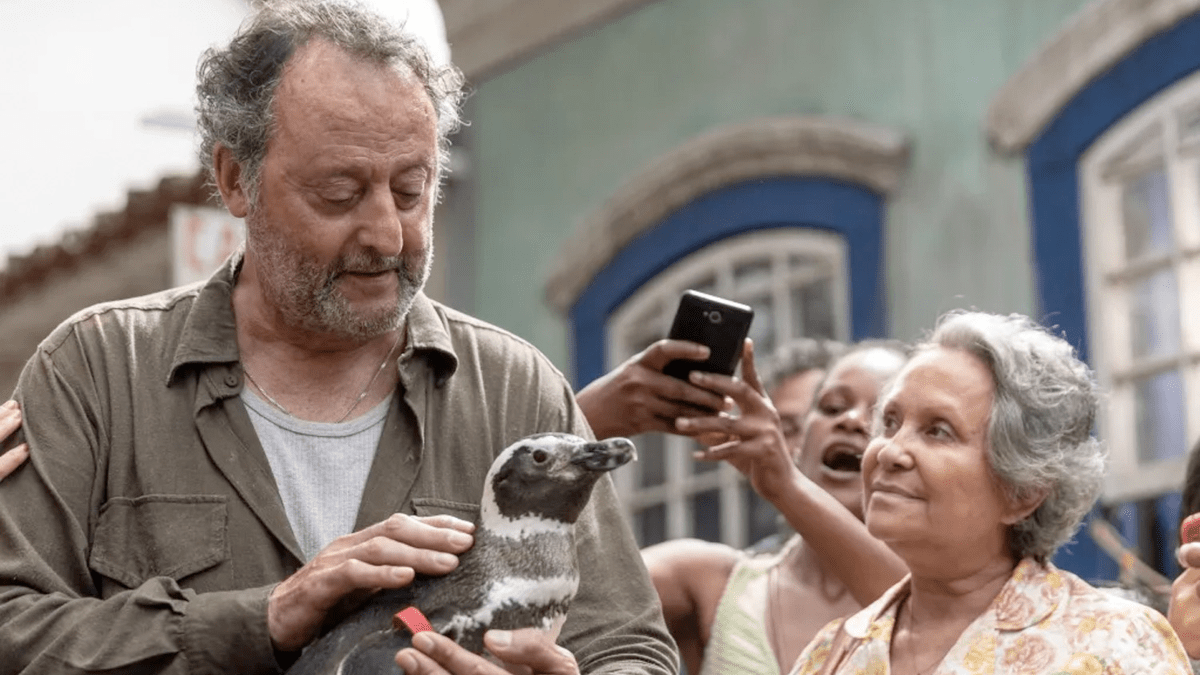
Tragedy can strike anywhere, even on Ilha Grande, an island off the coast of Rio de Janeiro, Brazil. Based on the movie’s depiction of the place, it’s what I’d call a working-man’s paradise, where everyone tanned, smiling and walking around in summer clothes year-round. The beach and the ocean’s shimmering waves are only a short walk from anywhere on the island. If the movie’s depiction of it is to be believed, it’s a happy place for everyone who lives there. Well, almost everyone.
I’m leery of disclosing how the movie begins, because the trailers don’t even hint at it. All I will say is that in the past, a young fisherman named João (played by Pedro Urizzi) unwisely keeps a promise he made to his son, and that results in a fatal accident. Although the movie never makes the comparison, I saw João as a poor-man’s Job. I’m guessing that at the time he felt the same way, and believed that God punished him simply for being happy.
Flash-forward to the present day, and time and fate have turned João (now Jean Reno) into a sad old man. He still fishes, but avoids his neighbors. When not on his boat, João lives a quiet life with his wife Maria (Adriana Barraza), sharing the modest home nestled among trees at the edge of the beach. They stayed together after the tragedy, providing each other with the will to live. It takes strength to continue as they did, especially with the sea constantly reminding them of what it took from them.
While Maria made peace with their loss, João has let it weigh on him ever since. When he gazes at the sea, his eyes plead for it to return what it cruelly took away. However, what happened cannot be undone, and João decided a long time ago that he would never experience joy again. He certainly would have continued living as someone neither alive nor dead, if it weren’t for the unexpected arrival of a penguin.
The penguin, who will later be given the name of “DinDim”, was a member of a colony on Patagonia. One morning, while he and his fellow penguins are searching for fish, he becomes separated from them. After swimming around lost for hours, he runs afoul of an oil slick from a leaky boat. Covered in goo, he somehow finds his way to the Ilha Grande shoreline, where an astonished João spots him while fishing. (DinDim’s home is 5,000 miles from Ilha Grande, by the way.)
João retrieves DinDim from the water and takes him home. After feeding him and cleaning him up, DinDim is much improved. Maria returns home and is not pleased to find traces of oil everywhere and a penguin in their bathroom. João says that DinDim needs to rest before he can return to the ocean. Maria is weary of having a penguin around the house, but notices the effect it has had on her husband and relents. One week turns into two, then three, until finally DinDim’s health is 100%. He’s a very inquisitive penguin, waddling around the town to the surprise of the residents. Eventually, DinDim answers the call of the sea and swims off, leaving João saddened over his departure. But this is not the end of their story.
A family of nature scientists on Patagonia tag DinDim, noting that he’s unusually friendly with humans. DinDim eventually leaves to return to his new friend João, and the two soon become the subject of a viral video. The mother scientist is astonished that DinDim is the same friendly penguin she tagged earlier. After a reporter interviews João and DinDim for television, they both become instant celebrities. Of course, even well-meaning scientists can’t leave well enough alone, and DinDim has a bit of a crisis to be overcome. Rest assured, nothing will stop DinDim from missing his travel plans.
My Penguin Friend is the second movie I’ve seen this year in the “human-animal bond” genre, the first being Arthur the King. These films depict a connection between a human and an animal, with both helping the other to overcome mental and/or physical challenges. Best Picture nominee Seabiscuit remains my favorite of this genre, one that I’ve rewatched many times. While My Penguin Friend certainly fits in this genre, it’s unique in how the story does not have a goal that drives the story. There’s no sporting event involved or race to be won. Instead, the story focuses only on what I would consider to be the core elements of the genre. It establishes the relationship between an animal and their human friend(s), shows how they become friends and heal each other. Although the resulting story is a simple one, it resonates because its simplicity allows its underlying sincerity to shine through.
The movie also reminded me of EO, which was about a donkey and his interactions with a variety of humans, both good and bad. My Penguin Friend is similar in how it shows that DinDim the penguin’s fate is directly impacted by people. The oil slick resulting from human activity injures him. João rescues him and takes care of him. The wildlife zoologists who study DinDim interrupt his life when money is involved. Fortunately for DinDim, he’s the subject of a family-oriented movie that doesn’t delve into the often grim reality that animals face in a human-centric world. Instead, it conveys how humanity is at its best when it befriends animals and treats them with respect.
As DinDim’s human friend, Jean Reno is a revelation. Far removed from the action-adventure roles in his heyday (Mission: Impossible, Leon: The Professional), Reno portrays João with such sadness and sensitivity that I wondered where this actor had been hiding all these years. With his mournful eyes, gray beard and weathered face, he epitomizes a man consumed by pain who has resigned himself to a life of quiet despair. Reno’s performance is so emotionally raw and direct that it often feels influenced by the silent film era. In fact, considering how perfunctory the dialog often sounds, I’m convinced that director David Schurmann could have told this story just as effectively with only music and title cards.
I’ve probably given you the impression that My Penguin Friend is a very sad and serious movie. Rest assured that since the story focuses on a penguin, there are plenty of lighter moments. Many of the film’s funniest moments involve watching DinDim waddle around, exploring and getting into mischief. There was a period not long ago when penguins of all kinds did solid business at the box office (March of the Penguins, Happy Feet, Penguins of Madagascar, Mr. Popper’s Penguins, etc.). I’m curious as to why there hasn’t been one recently. Do studios (mistakenly) believe that there’s no market for them anymore? Regardless, My Penguin Friend is a solid entry in the penguin movie canon, with a heartfelt performance from Jean Reno at its center, amazing natural photography and fun scenes of penguins in action. See it on the big screen if you can. Recommended.
 Detroit Cineaste