
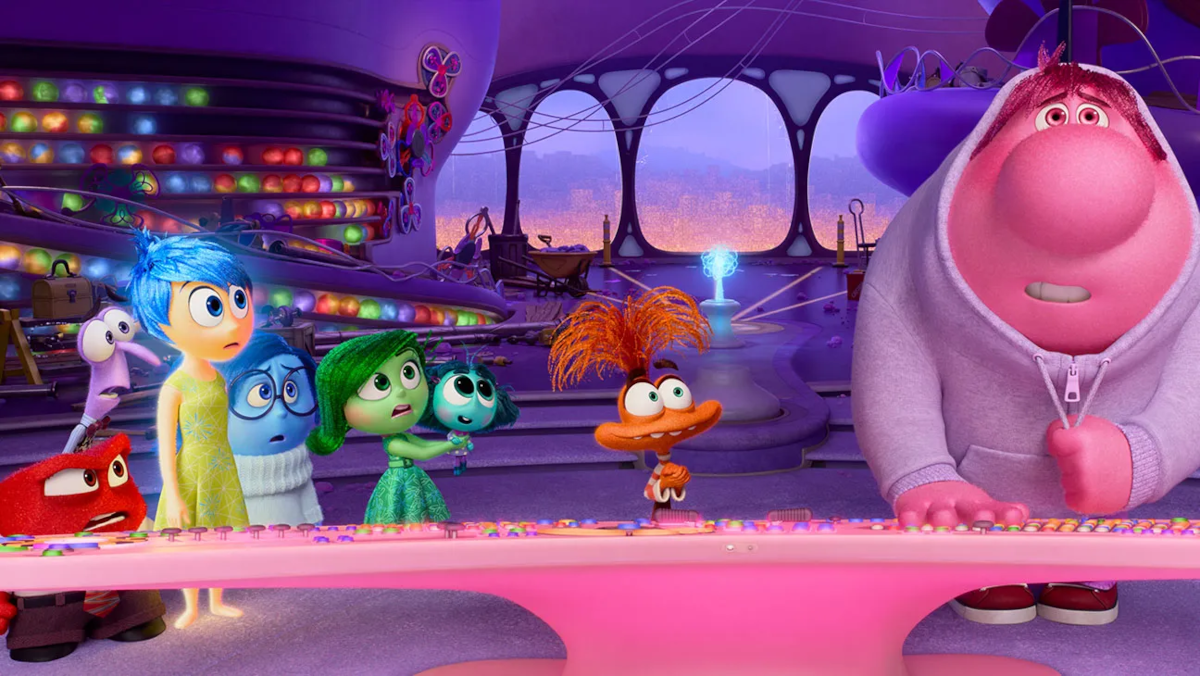
Would it surprise you to know that even after writing well over two hundred reviews, I still feel anxious whenever I start a new one? I always ask myself the same questions. What if I don’t have anything interesting to say? What if nobody reads it? What if I say something dumb and lose what little credibility I have? What if I miss my self-imposed Tuesday morning publication date? Fortunately, after seeing Inside Out 2, I now know that all of these expressions of anxiety emanate from an orange, bug-eyed Muppet who has usurped control of my mind.
When we were first introduced to Riley (Kensington Tallman), the girl at the center of the original Inside Out, it was 2015 and she was eleven. Fast-forward nine of our years and she’s finally turned thirteen. You may recall that at the end of that movie, an alarm labeled “Puberty” had mysteriously appeared on the control panel used by Riley’s core emotions: Joy (Amy Poehler), Sadness (Phyllis Smith), Fear (Tony Hale), Disgust (Liza Lapira) and Anger (Lewis Black). Joy wisely decided to ignore it, but now that Riley has officially become a teen, there’s no stopping the changes that are in store for her and her emotional support team.
Given the amount of time that has elapsed between the original and this sequel, Inside Out 2 wisely takes a few minutes to reintroduce us to everyone involved. Riley is a good girl with two loving and supportive parents (voiced by Kyle MacLachlan and Diane Lane). She still loves hockey, and has excelled in the nontraditional hockey town of San Francisco. (I still wonder why Pixar’s animation team renders the city as drab and washed-out. It must be an insider joke.) Two of Riley’s best friends are also teammates, and they are so in sync they even have their own razzle-dazzle play. (Given that this is grade school hockey, I’ll forgive the movie for being serious about a goalie making an outlet pass.)
Even though Riley has mad skills on the ice, she frets whenever she makes a mistake. Upset over a penalty that could have cost her team the game, Mom and Dad calm her down. Besides, there’s no time to worry–hockey camp starts tomorrow! To help Riley stay positive, Joy uses a contraption to send all of her bad thought globes to the back of Riley’s mind. This couldn’t lead to trouble down the line, could it? If you remember what happened in the original movie, then yes. Just not in the way you’re expecting.
Overnight, a construction crew arrives (on a wrecking ball, no less) to retrofit the place. They install a new control panel that is incredibly sensitive. That morning, Riley is overly sensitive to everything, how she smells, her mom’s comforting words, you name it. Even using a ten-foot pole to touch the panel doesn’t help. Befuddled over her daughter’s behavior, Mom’s Anger responds with one of the movie’s funniest lines, “Well, there’s a preview of the next ten years!”
Riley’s changes also come with a new set of emotions. Yes, these emotions were not part of the original. No, the movie doesn’t explain why we didn’t see them before. If this narrative incongruity will cause you problems, Inside Out 2 isn’t for you. However, if you’re willing to give the movie a pass here, what follows is certainly worth it.
The new emotions: Envy (Ayo Edebiri), Embarrassment (Paul Walter Hauser), Ennui (Adèle Exarchopoulos), Nostalgia (June Squibb) and Anxiety (Maya Hawke) are all memorable and funny, with the latter being the dominant one of the bunch. Think of her as Joy after downing too many Red Bulls.
When Riley learns that her friends will be going to a different high school in the fall, Anxiety quickly takes control of her mind. She disregards the promise Riley made to stick with her friends and tells Joy, “The next three days could determine the next four years of our lives!” Anxiety directs Riley to ingratiate herself with Valentina (Lilimar), the leader of the high school hockey squad. She then puts the original five emotions in a jar and sends them to The Vault, where Riley hides her secrets. (What’s down in the vault is the funniest part of the movie.)
With Joy and company bottled up (the movie’s pun, not mine), Anxiety leads Riley through a series of unwise decisions that will be painfully familiar to all ages. Laughing too loudly at something funny? Pretending not to like something you do? Worrying about everything that could go wrong tomorrow instead of sleeping? Pushing yourself too hard to impress others? We’ve all been there, and Inside Out 2 is spot-on in depicting how anxiety forces us to do things that are out of character. After escaping The Vault, Joy and the rest are faced with the daunting task of restoring Riley’s original belief system before it’s too late. If you guessed the journey would take them through another set of clever visual puns, you would be correct. (Hello, Stream of Consciousness! Right back at you, Scar-Chasm!)
The biggest problem I had with Inside Out 2 was comparing it to the original. As I mentioned above, this is an issue I’ve had with every follow-up to one of Pixar’s originals. Fair or not, the only times when they have met or exceeded what came before was the first two Toy Story sequels. Pixar may have set the bar incredibly high for themselves, but that doesn’t mean a sequel deserves a pass just because its predecessor was perfect. With that in mind (sorry), my initial reaction to Inside Out 2 was that it was on par with Finding Dory and Monsters University. While the animation was still spectacular, I thought that the movie was more amusing than funny, and relied heavily on delivering an emotional wallop at the end to justify the experience.
However, a second viewing changed my mind. I was struck by the way the movie depicted the complexity of Riley’s evolving emotional maturity, as well as how crucial all of her experiences are towards her overall development. The plot is fundamentally the same as the last time out (Joy getting in the way of Riley connecting with the emotions she needs to express, resulting in another mind-spanning journey to correct things), but this one excels by showing how harmful it is when a single emotion holds sway over our behavior. Anxiety’s fear-based solutions to make Riley happier are incredibly problematic, but so too is Joy keeping Riley in a state of denial over her faults. In the end, it’s not a matter of whether Joy or Anxiety gain control of Riley, but that Riley finally acknowledges the good and the bad aspects of herself and grows from them. In the field of psychology, I believe they refer to this as a breakthrough. As with the best Pixar films, Inside Out 2 is more than a fun time at the movies for the entire family, it’s also incredibly therapeutic and cathartic. Highly Recommended.
Analysis
At their core, both Inside Out movies are about how not being honest with oneself leads to bad decisions. It’s what caused Riley to almost run away from home in the original, and in this sequel it is responsible for her shunning her friends and eventually becoming paralyzed with anxiety. So, in the spirit of these movies, I’ll be honest about where I thought the sequel came up short, but also where it shines. But first, my criticisms.
The journey that Joy, Sadness, Anger, Fear and Disgust take in Inside Out 2 is very similar to the one Joy and Sadness undertook in the original movie (they have to traverse the mind and bring something back to headquarters to heal Riley’s emotional state). Since there are a plethora of new characters, Disgust and Fear don’t have much to do aside from the occasional quip. (Perhaps that is why Pixar decided against paying Bill Hader and Mindy Kaling to return.) The new visual puns–Stream of Consciousness, The Vault, The Belief System, were visually interesting but not as inventive as what came before. The Scar-Chasm didn’t work. And when we see Imagination Land again, it’s only briefly because that is where Anxiety’s team of forecasters are located.
The differences in the comic relief between the two movies is very noticeable. The original had Bing Bong, a character that was extremely funny and touching. He was also responsible for delivering the first big emotional moment in the movie, when he sacrifices himself for Joy. Inside Out 2, however, gives us Bloofy, Pouchy and Lance Slashblade, funny characters who don’t add anything to the emotional texture to the story. Given how they only exist to help get the main characters out of several jams, the lack of a Deus ex Machina joke was a missed opportunity.
Then there’s the matter of the new emotions. It is weird that five new emotions that were never mentioned in the original suddenly show up in a sequel. I read commentary where this was a major sticking point for some, and I admit that their appearance is a bit incongruous within the context of this world. If the new emotions coincided with Riley reaching puberty, why weren’t they present in the minds of the adults in the original? The movie tries to address this by having Anxiety briefly appear in Dad’s at the end of the movie, but it felt tacked on. No adult lives anxiety-free, especially a father raising a daughter. Pixar basically tap-dances around this narrative flaw, but I let it slide because the overall story worked in spite of it.
As supporting characters, Envy, Embarrassment, Ennui and Nostalgia are on par with Fear and Disgust in that they have the occasional funny line but only minimally affect the plot. As was the case with Anger in the original movie, they take a back seat to Anxiety when Riley is unable to process a very difficult situation (learning Grace and Bree are going to a different school). Even so, I appreciated the clever look of each of the new characters. If pressed, I would have to say that Nostalgia had the funniest lines of the new characters, with Ennui a close second.
Last on my list of issues with the movie was the reaction of Riley’s friends when they noticed her having a panic attack in the penalty box. I was incredulous that they were concerned about her at all after the way she treated them throughout hockey camp. Would anyone, regardless of age, forgive a friend who purposely avoided them and then mocked them publicly? That they did spoke more about them than Riley. This being a movie primarily for children, I understand the need for a happy resolution to this situation. However, in the real world, I’m dubious that Riley’s friends would have been that sympathetic and understanding.
Where Inside Out 2 achieves greatness is with Anxiety. As drawn, she is a strange looking character. While watching the movie a second time, I kept thinking of her as “orange spazz”. Initially, she only talks fast and provides quick resolutions to uncomfortable situations. It’s only when she commandeers headquarters and her character goes into overdrive that I grasped the psychological underpinnings behind her character.
Although the movie is about a thirteen year-old girl’s onset of puberty and the emotions that come with it, the movie’s themes are universal. Riley’s issues with navigating the social dynamics of junior high is a situation that both kids and adults can relate to. The impetus of Riley’s choices begin with the feelings of abandonment she feels when she learns that her friends will be going to a different school next. (I suspect some of this is also due to Riley being an only child.) Starting the next school year with no friends puts Riley into a panic, and she views the situation as a binary choice: remain loyal to her new friends or make new ones? Even though she could have done both, Anxiety convinces her to ditch her old friends and ingratiate herself with Vanentina and the other Firehawks. Even though high school was a long time ago for me, the movie brought back memories of how anxious I was over fitting in.
Later, when Anxiety convinced Riley to covertly review the coaches notebook, remembered doing something similar back in the day. In my case, I couldn’t help looking at a teacher’s grade book that she left open while her attention was on someone else. Getting good grades was rarely an issue with me, but one bad quarter in grade school always made me anxious about my grades.
Other aspects of Riley’s anxious mind rang true to me from the perspective of an adult. When Anxiety forces Riley to get up early to practice, I realized how often my own fear of failure has pushed me to work harder. I’ve had many nights when I couldn’t sleep because my head was filled with doomsday scenarios, in the same way that Anxiety fills Riley’s mind with negative projections about the scrimmage the next morning. And I’ve used the mental trick of focusing on positive outcomes to settle down and fall asleep. In moments like these, the representation of anxiety in the movie is so uncanny that I wondered if a psychologist was consulted on the screenplay.
Anxiety may be the driver of the story, but Joy is a close second. Her struggle with Anxiety for control of Riley’s mind is an aspect of the plot that I didn’t fully appreciate the first time out. The movie shows how easy it is to give into anxiety over potential fears like the unknown, loneliness, failure, rejection and so on. I was taken aback when the movie uses Joy to depict the struggle of being positive when facing those fears. In the latter half of the movie, when Joy’s cheerful facade breaks down, I was touched by how frustrated and despairing she had become.
That moment directly leads to another equally unexpected one, with Anger deciding to help her. This may be me reaching, but I thought that the movie is using Joy and Anger working together to represent determination. Additionally, Inside Out 2 expands on a concept from the original on how emotions have a dual nature. When Anger offers up a delightful drawing to Joy, he responds to her incredulity with, “What? I can’t always be the rage guy.” The point being made is that Fear, Anger and Disgust aren’t purely negative emotions. Although their part in the story is small, we see how a constructive Anger acts as resolve, Fear is helpful as caution, and Disgust can give way to attraction. All are beneficial, provided they are accessed in a positive way.
The first time I watched the movie, I was convinced that everything was Anxiety’s fault. She’s the one behind every bad decision Riley makes. However, after a second viewing, I realized that just like with the original movie, the issues begin and end with Joy. I didn’t fully appreciate that Joy using her device to jettison troubling thoughts to the back of the mind was harmful. However, what Inside Out 2 shows is that Joy was preventing Riley from realizing that she wasn’t perfect. Riley wasn’t completely comfortable in her own skin and relied heavily on her friends as her support system. (Note how the movie depicts Family Island as being minuscule.) When faced with the threat of going to school with no friends, Riley caved into her anxieties and made a lot of bad decisions in an effort to regain that feeling of belonging.
What’s interesting between the battle for supremacy between Joy and Anxiety is that both want Riley to be happy. Joy was attempting to make that happen by keeping Riley focused on the positive, which kept Riley in denial about her faults. (Anger was actually right for calling Joy delusional.) For her part, Anxiety tried to make Riley “happier” by preparing her for every uncertainty, but that resulted with Riley going into a full-blown panic. It’s only after all of the bad thoughts Joy had suppressed come to the fore that Riley is able to calm down. The solution to Riley’s panic wasn’t more joy and positivity, but a reckoning with both the good and the bad aspects of herself.
After that moment, Riley is able to explain to her friends why she acted the way she did, and it’s a genuine moment of personal growth for her. She finally admits her fear of abandonment to herself and her friends, which frees her from anxiety and allows her to experience joy again. This moment also signifies that Riley is on the path to emotional maturity, with honesty guiding her along the way. I’m not a psychologist, but I found the way that this movie (as well as the original) depicts both the wrong and the right way to approach emotional distress extraordinary.
Random thoughts
“Maybe this is what happens when you grow up. You feel less joy.” When Joy uttered these words, I was stunned. How Pixar is able to deliver incredibly painful truths like these so simply and directly is astonishing. This heartfelt admission had me thinking, maybe I need to stop being so hard on myself and experience joy more often.
Each of Riley’s Anxiety-fueled believes were haunting:
If I’m a Firehawk, I won’t be alone.
If I’m good at hockey, I’ll have friends.
I’m not good enough.
When Dad told Mom that it was a big weekend and asked her what she wanted to do, I laughed at her suggestion of cleaning out the garage. We all know what dad had on his mind. After thirteen years of having a daughter around the house, he finally has Mom all to himself, if you get my drift.
Did Pixar model Anger off of Michael Douglas’ character in Falling Down?
In depicting Ennui as a snooty French person, I guess Pixar’s love of the French began and ended with Ratatouille.
I wonder how many people learned that Adèle Exarchopoulos, the actress who portrays Ennui, was in the NC-17 Blue is the Warmest Color? She has to be the first voice actor to work for Pixar with a credit beyond an R.
I’m still shocked that Pixar released two movies led by a young, female character whose life revolves around hockey and not soccer or basketball.
So how far does Pixar go in charting Riley’s evolution as a person? Will the next entry delve into her dating and potentially being dumped by her boyfriend (or girlfriend)?
 Detroit Cineaste
One thought on “Inside Out 2”