
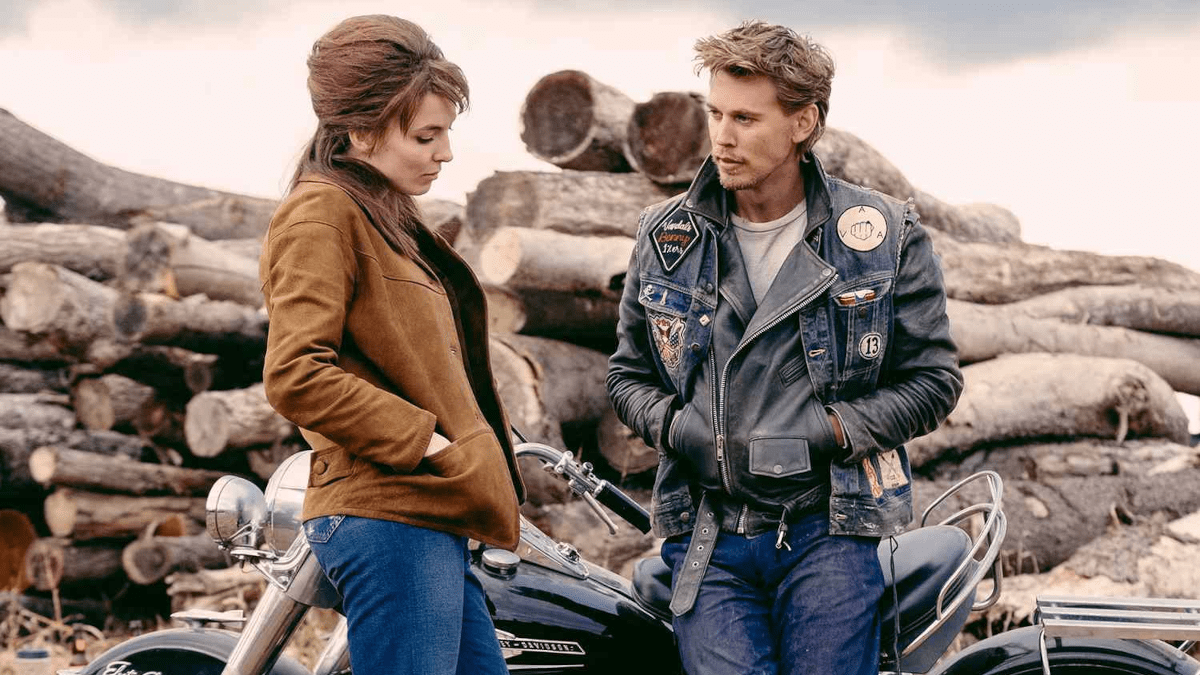
The Bikeriders is filled with memorable scenes, and it opens with that immediately grabs our attention. Benny (Austin Butler), a biker, is peacefully enjoying a whiskey and beer at a bar in the middle of the day. He’s approached by two imposing men who angrily tell him to remove his colors. After looking them over, he says with a smirk that they’d have to kill him first. The men are happy to oblige and proceed to pummel him. As the incredibly violent confrontation played out, I found myself asking questions. Why did those guys want to beat up Benny just because of his jacket? And more importantly, why does Benny invite the confrontation?
Based on Danny Lyon’s photo book from 1968, the movie feels like a stylish documentary. Here, a fictionalized version of Danny (played by Mike Faist) interviews and photographs members of the (fictionalized) Vandals Motorcycle Club. With his friendly, unassuming nature, he gets them to reveal why they decided to become members of a riding club. With little prompting, they casually reveal what led them to join the club, and their answers are candid and affecting.
In one scene, while members of the group are sitting and drinking around a fire, Zipco (Michael Shannon) reveals how he tried to enlist but was rejected by the draft board. Not even the military was interested in sending him overseas to kill Viet Cong and die there. Then, despite his warnings to stay in college, his brother shockingly drops out after one year to join the AirForce. After being rejected by the military and his family, the only place left for Zipco was a riding club like the Vandals.
Not every member’s story is a tragic one. Cockroach (Emory Cohen) is a geek who likes to eat bugs. He would never get a foot in the door with any other club, but he fits right in with the Vandals. Wahoo (Beau Knapp) and Corky (Karl Glusman) are a couple of goofballs. Cal (Boyd Holbrook) is the resident mechanic. Brucie (Damon Herriman) looks like a middle-aged accountant. With each introduction, the purpose and appeal of the club becomes clearer. The club is the one thing they all can all belong to, regardless of who they are. If you’re an outcast, misfit or reprobate, the club will welcome you. It’s a haven for outsiders, both by design and otherwise. The club doesn’t care if you are ugly or handsome, poor or middle class, dumb or educated. As long as you have a bike to ride, you can be a member. Well, almost everyone.
As depicted in the movie, a riding club is a loosely run organization of men who are interested in bikes and hanging out. There’s mention of club dues, but it must have been small given how some of them don’t have jobs. There are a few rules all members are required to abide by. You must proudly wear your club colors (your riding jacket) whenever you’re in the club itself or riding with them. You can’t leave one club to join another. And you must respect the club president. This brings us to the club’s founder, Johnny (Tom Hardy).
Unlike most other members of the club, Johnny was from the middle class. He had a steady job as a truck driver, a home and a family. He spent weekends racing with Brucie as a hobby but was inspired to found his own club after watching Marlon Brando in The Wild Ones. The scene of him watching that movie on TV implies that Johnny changed how he talked to sound like Brando. For him, the club isn’t about belonging, but projecting an image of being in command. Like Brando, Johnny wants to be the leader of the pack, a man respected and feared. If you challenge Johnny’s authority, he’ll bluntly ask you if you want to settle it with “fists or knives”. Founding the club gave Johnny the opportunity to be something other than a husband and a father, but as the club grows it becomes increasingly evident that he never had a plan for running things. Johnny just wanted to give everyone the impression that he was.
Benny, who serves the role of club mascot/recruiting tool, also sees the club as the means to adopt the iconography and mythology of the Fifties. His model is James Dean, and like him he is roguishly handsome and has a knack for always being seen in the best light. Unlike Johnny, Benny doesn’t want to be a leader but rebel. In the beginning, he leads the police on a cross-county chase that results in multiple traffic violations and thousands of dollars in fines. Benny is impulsive and reckless and only wants to ride, fight and drink. He wants nothing more than to be tragically cool, which is what attracts him to his future wife, Kathy (Jodie Comer).
Kathy instantly falls under Benny’s spell when she sees him from the other side of a biker bar. Even though she barely knows him, she immediately falls under the spell of his masculine charisma. Her boyfriend is so threatened by him waiting outside the house that he leaves Kathy one day in a huff. Like Johnny and Benny, she’s also in love with the biker lifestyle. She stays by Benny’s side even though he never seems to hold a job and never acts like a husband or a friend. Even though she comes from what she describes as a “respectable” background, she believes she’s safe hanging with the club because Johnny and Benny will protect her. Then, one evening, after Johnny and Benny come to the aid of Cockroach, she’s physically threatened by some of the club’s newer and more unhinged members. This forces her to face the reality that the club has grown increasingly dangerous not only for her, but for Benny as well.
There’s something undeniably Scorsese-esque about The Bikeriders. Although writer-director Jeff Nichols isn’t as dependent upon visual fireworks as Scorsese, he depicts this story of rebellious bikers with a distinct visual flair that is occasionally broken by horrifying violence. The parallels are more obvious in how the story is structured. The first half introduces us to the central trio (played by Austin Butler, Jamie Comer and Tom Hardy), their colorful associates and documents the origin of the Vandals Motorcycle Club. We see the club rise in popularity and power. Then, in the second half, we see everything spiral out of control. In simple terms, the movie strives to be Goodfellas on motorcycles.
The movie has more on its mind than providing us with an easygoing and sympathetic depiction of bikers, however. Through its three leads, it delivers an unflinching portrait of the dangers of living one’s life in honor of imagery. Looking and acting dangerous is fun at first, but they aren’t enough to keep everything under control. As the movie shows, giving middle-class Midwesterners the finger while riding your Harley Davidson is one thing, confronting the violence simmering within your ranks is another thing entirely.
In addition to being beautifully shot, The Bikeriders is led by three impressive turns by Butler, Comer and Hardy. Their acting is so captivating that Nichols is content to keep the camera still to capture their performances. As such, the movie’s dueling approaches were occasionally at odds with each other. On the one hand, it is focused on capturing a moment in time in a very stylized way. On the other hand, it also wants to be a laid-back indie drama with character-driven performances. Nichols gets this combination to work for most of the movie, which perfectly epitomizes the freewheeling spirit of his subject matter. The movie loses some momentum during the latter third, when events take a dark turn and violence poisons the club. Fortunately, Nichols brings things to a close in a way that left me admiring the deadpanned irony of it all. I definitely enjoyed The Bikeriders. Like its namesake characters, it’s engaging, funny, eccentric, revealing and unexpected. Recommended.
Analysis
While The Bikeriders is a solid character-driven drama, it also is a window into how riding clubs like the Vandals gradually changed from a mostly harmless form of expression into increasingly violent gangs. As I mentioned above, riding clubs provided a home to those who felt on the outside of normal, middle-class society. In return for their loyalty, The Vandals Motorcycle Club gave its members brotherhood and acceptance, as well as an outlet for rebellion. The scene where The Vandals ride past a town picnic encapsulates both aspects of the club and its members perfectly.
At first, only the sound of the club’s motorcycles can be heard. Then, when they come into view, the soundtrack is filled with their thundering noise. From its humble origins the club has grown considerably, to somewhere between thirty and fifty members. As the Vandals ride past the townspeople, the stares they get run the gamut from anger to stunned admiration. For their part, the riders only care about pissing people off. Like the patch depicting an extended middle finger that they wear on their jackets, they are a deliberate affront to “normal society”. Like the Hippies, they exist as a counterpoint to conservative, suburban American values. But unlike the Hippies, motorcycle clubs like the Vandals have a decidedly macho edge.
After we are introduced to all of the founding members of the Vandals, it’s obvious that none of those guys would ever consider being a Hippie. Maybe Zipco would, given how he’s so “out there” that he’d probably try anything once. The other guys would never be caught dead smoking pot, wearing flowers in their hair and singing about peace and love. Hippie culture is an anathema to them and an affront to their notions of masculinity. The guys in the club embrace being unkempt, beer drinking, cigarette smoking bikers. For them, the riding club is where they can express themselves freely without worrying about offending anyone.
Then, as time passes and the club begins to admit problematic members home from the Vietnam War, the overall vibe changes. It becomes less about motorcycles and riding and more about enabling behavior that is wild, violent and increasingly criminal. The movie shows this at the fateful party where Cockroach and Kathy are assaulted. When Benny and Johnny aren’t around, the new members aren’t afraid of recriminations for taking matters into their own hands. Then, when Johnny is killed by The Kid, Kathy’s voice-over narration states how the club had finally become a gang of criminals. For those familiar with the incident at the Rolling Stones concert at the Altamont Speedway in 1969, the only thing surprising about this transformation happening within the Vandals is that it took so long. (For an excellent article that describes how the Altamont Speedway incident lead to the death of the Sixties, click here.)
The Vandals as Goodfellas
The way that the narrative structure of The Bikeriders mirrors Goodfellas is uncanny. Of course, this could just be a coincidence. I haven’t searched for interviews with writer-director Jeff Nichols to see if Martin Scorsese’s movie was an influence on how he approached the material. That being said, the similarities between the two movies were inescapable to me. And if you’re going to borrow from any filmmaker, you can’t go wrong with Scorsese.
Following are the similarities I noted while watching The Bikeriders:
Both feature extensive voice-over narration that provides a first-person account of the events.
- Bikeriders: Kathy
- Goodfellas: Henry Hill (Ray Liotta)
Both movies depict the rise and fall of a couple of unseemly guys and a woman in love with one of them.
- Bikeriders: Johnny, Benny and Kathy
- Goodfellas: Henry Hill, Tommy DeVito (Joe Pesci), Jimmy Conway (Robert De Niro), Karen (Lorraine Bracco)
Both introduce a colorful group of supporting characters known by their nicknames.
- Bikeriders: Zipco, Wahoo, Corky, Cockroach
- Goodfellas: (c’mon, don’t be a mook)
Both stories feature a character who becomes a bad guy because they wanted to be like someone they admired.
- Bikeriders: Johnny (Brando, in The Wild Ones) and probably Benny (James Dean)
- Goodfellas: Henry Hill meeting a gangster as a child.
Both movies depict how an early success is quickly followed by a violent downfall from within.
- Bikeriders: the club’s growing popularity attracts members who use drugs and are violent and attack the founding members.
- Goodfellas: the Lufthansa Heist makes the gang rich but becomes the source of violent reprisals from Jimmy.
In both movies, a non-violent member of the group is violently attacked for speaking their mind.
- Bikeriders: Cockroach is attacked when he tells them his plans to leave the club and become a cop.
- Goodfellas: Spider (Michael Imperioli) is shot dead by Tommy over an insult during a card game.
In both movies, the female lead is threatened with violence.
- Bikeriders: Kathy is mistaken for a groupie and is nearly raped.
- Goodfellas: Karen suspects that Jimmy wants to kill her and declines his free dresses.
In both movies, one of the protagonists meets a violent and unceremonious end.
- Bikeriders: Johnny is shot by a rival at a knife fight.
- Goodfellas: Tommy is killed instead of being made.
In both movies, the couple survives by going clean.
- Bikeriders: Benny and Kathy move to Florida. Benny stops riding and becomes a mechanic.
- Goodfellas: Henry and Karen go into witness protection and live out their lives like shnooks.
An Unusual Love Triangle
Throughout the movie, Austin Butler’s Benny represents the description of a classic Hollywood leading man: women want to be with him, while men want to be him. With his ruggedly handsome looks, growl of a voice and penchant for dangerous behavior, Benny is the idolized version of a biker. Johnny is aware of this and uses Benny as a walking advertisement for the club. What isn’t clear until later is that Kathy isn’t the only one in love with Benny. Johnny is also in love with him, and his feelings are manifested when he offers Benny the leadership of the club. In that scene, director Nichols places the actors close together and has Johnny whisper the offer in Benny’s ear. Through the use of blocking, the scene suggests that Johnny is giving Benny a kiss on the cheek. To Johnny’s surprise, Benny rebuffs his advances and declines the offer. On the surface, this is an admission by Benny that even he finds the idea of him being a leader laughable. In terms of subtext, Benny’s rejection also represents his rejection of Johnny’s sexual advances.
About that ending
At first, Johnny’s killing left me cold. The story seemed primed to deliver his death as a searing gut punch. However, Nichols frames that scene and the ones leading up to it in a darkly comical way. First, we see Johnny getting prepped for his life-or-death struggle as if he were leaving for a trucking run. Then, on his way out the door, he agrees to pick up eggs for his wife on his way back home. She never makes eye contact with him and instead is entranced by on the TV. Johnny then stops by Kathy’s house to say goodbye to Benny, but Benny is still AWOL. Johnny tries to impart some final wisdom to Kathy, but he’s cryptic and she doesn’t understand him. Then, when Johnny arrives at the parking lot, he notices that everyone arrived by car. (Tough bikers, eh?) Finally, when Johnny approaches The Kid with his knife, the Kid shoots him. Corky and Wahoo are stunned, leading one of them to ask rhetorically, “What do we do now?”
After reflecting on Johnny’s anticlimactic ending, I realized how it aligned with how Nichols positioned Johnny as a character. Johnny was never really dangerous, more menacing than anything. He positioned himself as a tough guy and wrongly believed that his posing would protect him from any fatal violence. Furthermore, Johnny underestimated how much animus he created when he disrespected The Kid, and believed that The Kid would still respect him as a leader. The Kid saw through his act, promptly took him out and took over the club. Johnny learned the hard way that pretending you’re dangerous is a bad plan, especially when confronting someone who has nothing to lose.
 Detroit Cineaste