
Of all the reasons people use to justify developing previously untouched land, creating a glamping site has to be right up there. I was unfamiliar with the term before seeing Evil Does Not Exist, and after two characters explained what it meant I was appalled. The thought of bulldozing trees and smoothing a natural landscape so that rich people can have a glamorous camping experience is silly, but I fully understood why people would pay for it. Unlike a public camping site, glamping offers amenities and resort-style services. There’s no need to “rough it” when you can relax in the equivalent of a hotel room nestled amongst trees. (This begs the question as to whether an activity can even be called camping if there are no inconveniences involved.) Second, glamping is all about exclusivity. There’s no need to worry about camping around normal, everyday people when you can use your money to pitch your yurt next to other rich people like yourself.
The plan for a glamping site in a forest outside of Tokyo acts as the triggering event for the plot of Evil Does Not Exist, a movie with a pro-environmental message that also questions our relationship with the natural world. As such, it’s not in the same category as Dark Waters (2019) or A Civil Action (1998), two movies that focused on good people uncovering how bad people poisoned the environment and attempted to hold them to account. Comparatively speaking, the glamping development at the center of Evil Does Not Exist is small potatoes. While the villagers do express concerns about waste water runoff, the issue can easily be addressed with a revision to the site’s development plan. The developers, however, are intent on keeping costs down and don’t want to agree to this, but this problem isn’t of the same magnitude as poisonous chemicals in groundwater. This is how Evil differs from the other environmental movies; it’s not a story of retribution, but of reflection and awareness.
While Evil takes a very dim view of glamping, it also shows how the villagers have developed the forest for their own purposes. Takumi (Hitoshi Omika) and his daughter Hana (Ryo Nishikawa) live in a cabin in the woods, and the village elder has a two-story house there as well. Taken together, the movie shows how our impact on the natural world is a matter of degree. The villagers insist that they live in balance with the forest, that they only take what they need. They see the glamping development as bad because it will be much more intrusive and may cause damage to the forest. In either case, Evil shows that neither scenario is a “good” option for nature. The only difference is in how people view their intrusion into the natural world.
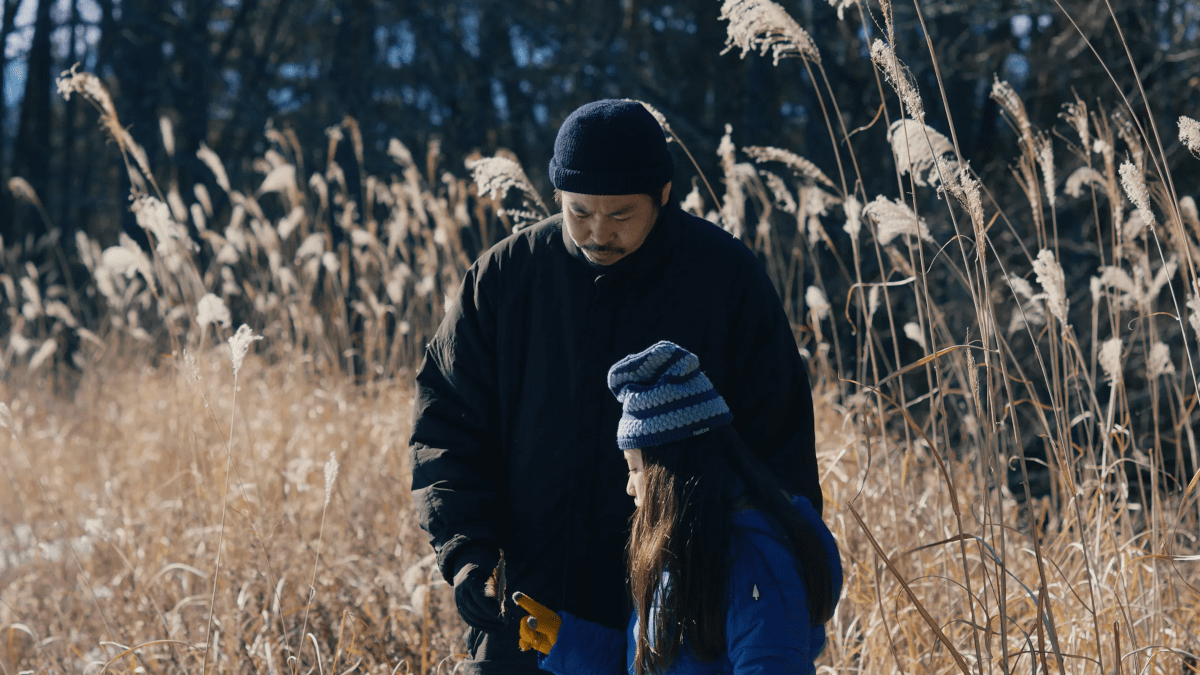
At the outset, the movie introduces us to Takumi and Hana and provides glimpses of their life in the forest. He turns logs into firewood while she collects feathers and observes deer. That there are only the two of them is one of several instances where director Ryûsuke Hamaguchi refuses to give us more information than necessary. Takumi and Hana never mention her and we only are aware of her through a family photo. Based on a later reference to Covid I assumed that she contracted the disease during the pandemic and died, but that is only one possibility.
Aside from taking care of his daughter, Takumi does odd jobs like collecting spring water for a local restaurant. The chef in turn uses the water to make a local dish, one of several examples of how the villagers are portrayed as being both respectful of the forest and mindful of how they utilize its resources. Later, when the Takumi and the rest of the villagers meet with two glamping site representatives, all of their questions and concerns are about how developers will safeguard the resources that the forest provides. It doesn’t take long for the villagers to find problems with the development plan. Using simple math, one of them states the water treatment plan isn’t large enough to handle the site when it is at capacity. This means that untreated waste would run into the stream below the site. Then there’s the issue of the glamping operators not staffing the site 24-7. Without supervision, young people could unintentionally start a fire.
Although the villagers clearly aren’t thrilled with the development, they aren’t against it initially. Unfortunately, Takahashi and Mayuzumi, the representatives sent by the developer, can’t answer any of their questions because they aren’t developers themselves. He is a former talent agent, while she was an actress. Their role is to present the plan, take down questions and report back to home base. The villagers take this as a sign of disrespect and state that they will oppose the plan. When the reps return to the office, they relay the villagers’ issues to the developer. When he suggests adjusting the plan in trivial ways to make it look like they are changing things, Mayuzumi says that the villagers are not stupid and will know what is going on. The developer says that they should enlist Takumi to run the camp, cynically believing that with his buy-in, the rest will go along.
Takumi, like the rest of the villagers, wants to keep an open mind about the glamping site. When Takahashi and Mayuzumi meet him, he decides that educating them on what the forest means to the village is the best way forward. He has them help gather spring water and takes them to dine at the restaurant that uses it. Takumi’s intent is simply to show them that the forest is more than a site waiting to be developed, but something that provides unlimited value to the village. This reasoning is lost on Takahashi, who asks Takumi to oversee the glamping site. Takumi rejects the offer, stating that he doesn’t need the money.
Takumi takes Takahashi and Mayuzumi with him to retrieve his daughter, and because he is late Hana has walked home by herself. On the ride back to Takumi’s cabin, the three discuss the deer in the forest, and Takumi quickly realizes that the representatives do not understand that deer are wild animals. Instead, they regard deer as pets. An increasingly wary Takumi warns them that they contain diseases and will charge when they are wounded. When the three arrive at Takumi’s cabin, they can’t find Hana in the forest. Something is wrong, and a search ensues. When darkness falls, Takumi and Takahashi finally locate Hana. Then, within the span of a few minutes, two fateful confrontations take place that together force us to reconsider all that we’ve seen and view the events of the story within a much larger and sobering context.
Evil Does Not Exist is fascinating in its construction. It initially presents itself as a straightforward story of environmentally conscious villagers who are pitted against greedy developers and their plans for a glamping site in a nearby forest. Director Hamaguchi clearly wants us to sympathize with the villagers, who both respect and utilize the forest in their daily lives. The developers, however, are only concerned with using Covid relief funds before they expire. As we observe the human characters discuss the fate of the forest, a larger narrative subtly takes shape metaphorically in the background. Hamaguchi builds this parallel narrative through scenes, images and sounds that I initially interpreted as eclectic stylistic choices. For example, I wondered why he had me observe a man cutting wood for a long period of time. Or why the camera continued to show us the forest background long after the human characters had left the frame. I wasn’t prepared for Hamaguchi’s approach to storytelling, and it tried my patience on several occasions. However, I figured that Hamaguchi was doing what he was doing for a reason, so I let the movie happen and stopped pressing for explanations. Then, while I pondered the movie’s shocking ending, the intent behind Hamaguchi’s deliberately abstract directorial choices came into focus. While it was always obvious that Hamaguchi does not approve of the development of untouched land for dubious reasons, he also wants us to consider our relationship with the natural world more realistically. Humanity and nature may coexist, but there is no mutual understanding between us, something that we forget at our own peril. In the end, Hamaguchi leaves us to contemplate not one tragedy, but two. Evil Does Not Exist is exquisitely cunning, designed with an overt minimalism that deftly conceals its true nature until the very end. The movie is haunting and uncompromising, with an underlying message that is impossible to shake. Highly Recommended.
Analysis
The best way for me to discuss what happens in Evil Does Not Exist (or Evil) is to start at the end. The climax of the movie is so shocking and unexpected that when the credits rolled I wasn’t sure what I’d seen. Well, I knew what I saw, but wasn’t sure exactly why it happened or what it meant. It was only after I worked my way back to the beginning that I understood what Director Ryûsuke Hamaguchi was telling me, or what I think he was telling me. I doubt that my interpretation is the only one, or even the right one. It’s merely the best one I could come up with.
Folding the narrative
My initial reaction to the shocking series of events that conclude Evil were that they were frustratingly opaque. Why does Hana approach the wounded deer, something that her father certainly warned her never to do? Is Hana alive or dead? And most importantly, why does Takumi strangle Takahashi, seemingly without provocation?
As I searched for answers to these questions, I noticed that elements from the beginning of the movie are also present at the end. Shots, scenes and music are echoed to such a degree that the narrative begins to resemble a folded piece of paper, with the beginning and the end superimposed on each other. As I reflected on how Hamaguchi constructed the movie, the meaning of the story became clearer. Hamaguchi uses this mirroring device to tell us that our understanding of our relationship with nature is flawed. When viewed side by side, the beginning represents what we think that relationship to be, while the ending represents the harsh reality.
In the beginning, Hamaguchi depicts the relationship between the villagers and the natural world as largely benign. After the opening tracking shot of the sky at daybreak (accompanied by the sad chamber music on the soundtrack), he shows us Takumi and Hana going about their everyday morning routines. She studies the remains of a deer, gathers a feather and observes a living deer from a safe distance. Takumi, completely unconcerned about Hana or her whereabouts, focuses on his chores. Hamaguchi has us spend an inordinate amount of time observing Takumi turning logs into firewood, then gathering spring water for the restaurant. The pacing and staging of these scenes imply how Takumi and Hana are mindful consumers of natural resources. Takumi only takes what he needs from their environment, while she is respectful towards it. This leads them to falsely believe that because they are benevolent towards the natural world, it will treat them in kind.
However, when we arrive at the end of the movie, the echoed (or mirrored) scenes in the forest now have an unmistakable element of danger. The deer carcass is unchanged, but Mayuzumi and Takahashi gawk at it with morbid curiosity. There’s fresh blood dripping from a thorn. When Takumi finds a feather by the lake, something he knows Hana normally would have picked it up. Mayuzumi suffers a significant hand injury while walking in the forest. Finally, when Takumi and Takahashi find Hana standing in front of a wounded deer, the underlying theme of the movie becomes evident. Before that climactic moment, Takumi and Hana never took the implicit danger of the forest–and nature–seriously. They mistakenly believed that their respect of nature would protect them from harm. Hamaguchi shows us how this naivete (or complacency) comes with fateful consequences.
The forest has presence
What is ingenious about Evil is how deftly Hamaguchi constructs this larger narrative in plain sight and refuses to reveal it until the very end. Before arriving at that point, the movie appears to be about peaceful villagers pitted against the greedy developers from the city. Because this is a familiar narrative trope, I assumed early on that the story would have a tragic end. The developers would ultimately win because they have money and the law on their side, and the natural world would once again be helpless in the face of human greed and ignorance.
The opening scenes of the movie certainly invite this interpretation. The opening tracking shot of the sky through the trees coupled with the sad chamber music imply that what we are about to see will result in a tragic conclusion. This is followed by scenes of Takumi and Hana moving about the beautiful forest surrounding their home, implying that their lives would be changed for the worse upon the arrival of the glamping site. While all these things will eventually come true by the end of the movie, Hamaguchi also intends for these scenes to do more than convey nature abstractly, or contextualize it within human existence. He also wants us to see nature as a character in the story itself. In doing this, Hamaguchi is able to make his larger argument that our understanding of our relationship between humanity and the natural world is fundamentally flawed.
The ways in which Hamaguchi forces the audience to recognize nature’s presence within the movie were initially puzzling to me. For example, I thought I understood what the initial tracking shot was meant to convey. However, after Hamaguchi closes the movie with the same shot, I realized that my original interpretation was incorrect. In the beginning, Takumi and Hana are doing fine within their surroundings. Then, in the closing scene, Hana is either unconscious or dead and Takumi is carrying her to get her medical attention. In both scenes, Hamaguchi doesn’t show us Takumi or Hana and has us focus on the forest and the sky. In doing so, Hamaguchi implies that humanity and nature operate in different places of existence. While Takumi and Hana are aware of their surroundings, the natural world is ambivalent towards their presence. This is one way that Hamaguchi tells us that the relationship Takumi and Hana thought they had with nature was actually one-sided.
Hamaguchi continues to reinforce the presence of nature within the story when the camera lingers in scenes after the human characters have left the frame. (I noticed this when Takumi and his helper carried water jugs from the stream to their vehicle.) At first I found Hamaguchi’s direction to be an interesting stylistic choice. It was after the movie had ended that I realized how Hamaguchi was forcing me to look upon nature as something that exists without humans being present. Instead of nature being reduced to something humans protect or possess, it exists in and of itself. Of course, whether it is allowed to persist or not is dependent upon human interaction. Barring that, Hamaguchi wants us to see how nature is something that has its own life, whether humans are present or not.
For the majority of the movie, Hamaguchi depicts nature as being passive, completely unaware that its fate is being debated by the villagers and the developers. Then, in the closing moments when the deer attacks Hana, nature finally reacts to humanity’s presence. This moment epitomizes how humanity and the natural world do not live in balance as the villagers believed. In depicting nature as a character within the story, Hamaguchi shows us that tragedy is inevitable when humanity mistakenly characterizes their relationship with nature as one based on mutual respect and understanding. Hamaguchi shows us bluntly that there is no relationship between the two.
Fatal actions
I suspect that others who have seen this movie were just as confused as I was by how it ends. Both Takumi and Hana’s actions seem inexplicable when the story is viewed linearly. However, as I have detailed at length above, the ending makes sense because it crystalizes the larger narrative Hamaguchi has been establishing from the beginning.
While it is very likely that Takumi told his daughter to never approach a wounded deer, she believed that her kindness towards the forest and respect of nature would protect her. Unfortunately, her naivete puts her life in danger and the deer charges her anyway.
Then there is the matter of Takumi tackling and strangling Takahashi. Because of how Hamaguchi frames the action, we don’t know what triggers Takumi’s violent action. Does he do this to prevent the deer from charging? Or does he do this because Takahashi’s actions caused the deer to charge? The reason why Hamaguchi never cuts back to Hana is because Takumi’s action is symbolic. He views Takahashi as a generalized threat and decides to kill him. Let me explain.
After spending the better part of a day with Takahashi, Takumi realizes that Takahashi neither understands nor cares about the environment. Takahashi only sees the natural world as an opportunity ripe for the plucking, one that may provide him with a more comfortable life. When Takahashi moves towards Hana, his actions are perceived by Takumi as a threat not only to his daughter, but the forest as well. By attacking and killing him, Takumi is trying to protect both his daughter and the forest. Unfortunately for Takumi, nature–as represented by the wounded deer–doesn’t care that Takumi is acting on its behalf. It charges to protect itself, just as Takumi knew it would. Taken together, Takumi and Hana’s actions perfectly illustrate Hamaguchi’s larger concerns. Humans misconstrue their relationship with nature, which can result in tragic consequences.
If evil does not exist, then what does?
Hamaguchi doesn’t characterize our continual and unabated development of the natural world as being inherently evil. Like the villagers, he’s resigned to it being an inevitable aspect of human nature. All that one can do is try to minimize the damage. Instead of evil, Hamaguchi wants to draw our attention to other aspects of human behavior that negatively impact our world, specifically our entitlement and ignorance. We assume we have the right to reshape the world to suit our needs. However, in doing so we eliminate much of what the world has to offer. When we turn a forest into a glamping site, there is no going back. This may not be evil per se, but it is incredibly short-sighted.
 Detroit Cineaste