
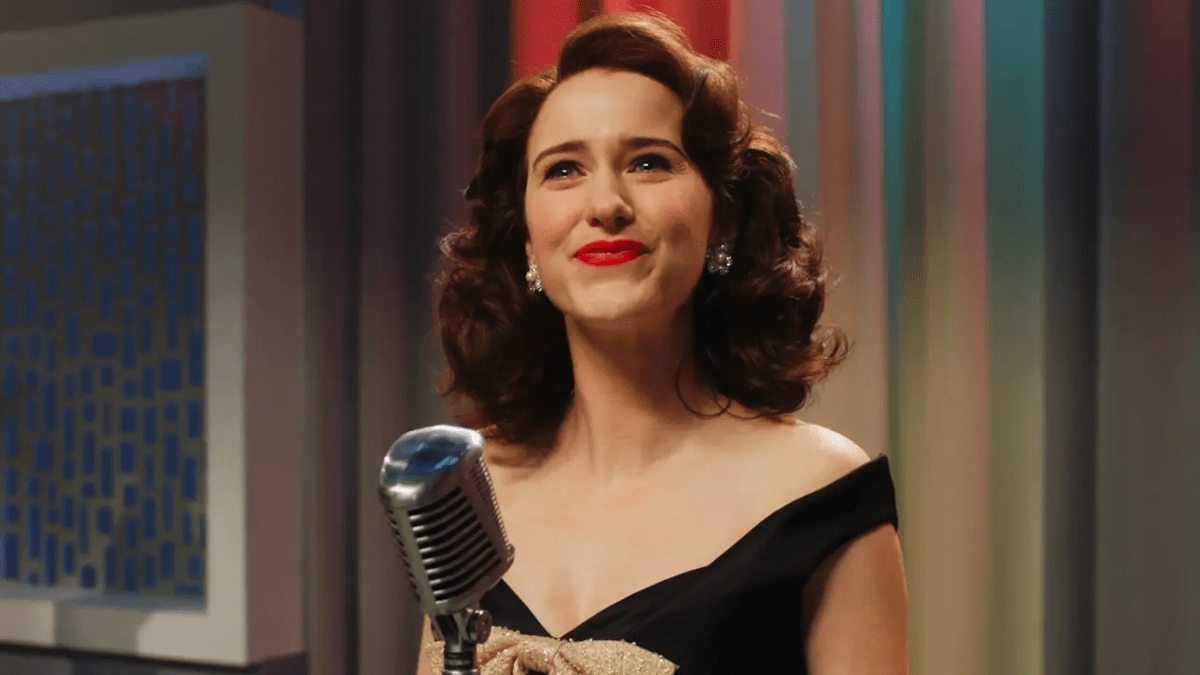
Season Five represents the final curtain call for The Marvelous Mrs. Maisel. After the previous four seasons detailed Midge’s trials and tribulations involved with becoming a famous stand-up comedian, she finds herself closer than ever before to realizing her dream. This doesn’t mean that success will come easily for Midge. She still proves to be her own worst enemy more than once, taking two steps back for every one step forward. Then there’s the ever-present sexism that permeates her line of work. In a male-dominated field, the men refuse to take Midge seriously. Her boss, Gordon Ford, hires her to balance out his all-male writer’s room but mainly wants to sleep with her. And when she auditions for Jack Paar’s show, the producer doesn’t get Midge. It’s enough to make a scrappy, no self-pity woman cry, which she does at one point.
Fear not, faithful Maiselite! Midge’s big break finally arrives, albeit with some shenanigans Midge must circumvent before she’s able to fully grasp the spotlight. And when the moment fans of the series have been anticipating since it debuted (way back in December 2017) actually happens, it’s handled perfectly. Midge gets to announce herself before a national audience, and her career skyrockets from there. How do we know this? For the first time in this series, writer-director Amy Sherman-Palladino introduces flash-forwards into the narrative structure. We see how Midge, Suzie, Joel, Abe, Rose and Midge’s children turn out. We’re given periodic glimpses of these characters all the way to 2005, telling us how everyone’s future played out. While these vignettes do answer a lot of questions, they effectively deflate any sense of surprise the show has routinely offered. Yes, Midge’s success was always assumed, but it’s different hearing that Midge played a series of sold-out shows at the Copacabana, or that Suzie sealed three huge deals playing one day. If you love having a sense of completeness when a series ends, then you’ll appreciate all of the details Sherman-Palladino offers up. I thought that the flash-forwards tell us things that really weren’t necessary and would have been better off being left to the imagination. And seeing my favorite characters in old-age makeup and crazy hair was the last thing I needed.
Because of the pressing need to wrap things up and tell us what happened after Midge’s breakthrough, the arcs of the supporting characters suffer noticeably. For Midge’s inner circle (Abe, Rose and Joel), their stories start and then shift gears abruptly to align with the sneak previews. Abe, for example, goes from having anxiety over a trivial error in one of his reviews to focusing on the genius (or lack thereof) of his grandchildren. Joel goes from Chinatown night club operator to being married to the mob. Rose’s business suffers some curious accidents and then is dropped entirely. Suzie’s other clients are introduced and basically forgotten. The flow of the nine episodes imply that the season was written one way and then revised mid-stream to wrap everything up by the end. Coupled with the narrative time traveling, the show felt disjointed at times, reaching for pathos when it should be light on its feet. Fortunately, the season keeps Midge and Suzie front and center through it all, and brings their journeys to a satisfying conclusion. In other words, this season sticks the landing despite getting distracted telling us the future on many occasions.
As Midge and Suzie, Rachel Brosnahan and Alex Borstein have always had great chemistry, and they shine as well as they ever had in this series. It was satisfying to see both characters finally learn from their mistakes, control their tendency of self-sabotage and help each other succeed. Regardless, I’m grateful I was able to enjoy this fabulously retro world and its characters for five incredible seasons. Thank you, Amy Sherman-Palladino and everyone in the cast and crew who made this special show a reality. Recommended.
Analysis
When Amazon announced that The Marvelous Mrs. Maisel would end with a fifth and final season, I was crestfallen. After a three-year hiatus due to Covid, the show returned with a brilliant fourth season. How could they possibly wrap up all of the disparate plot threads in one one season? Turns out they couldn’t, for various reasons. Season Five was still good, but it suffers from including too many glimpses into the future that explain what happened to everyone after Midge finally gets her big break. In the previous four seasons, Midge’s journey has been about when (and how) she would finally become a mainstream success. Did I really need to see that her children would become adults who barely tolerate her presence? That always seemed likely, given how little time Midge spent with her kids. Or that Midge and Suzie would have an argument over Suzie’s involvement with the mob that created a rift that lasted for years? Midge knew that Suzie’s two favorite Goombas–Frank and Nicky–weren’t helping Suzie out of the kindness of their hearts. There was no reason for her to be shocked when Joel tells her that the mob was getting a cut of her earnings all along.
Perhaps these flash-forwards would have worked if the show had been given more time to cultivate these threads in a more meaningful way, as it has done in prior seasons. Unfortunately, Amy Sherman-Palladino was given one more season to wrap up the show and she had to decide what she would focus these remaining nine episodes on. As you can tell, I would have preferred she eschewed the ping-ponging between the past, present and future and instead focused on taking Midge to her career-defining four-minute stand-up set on The Gordon Ford Show. Sherman-Palladino, who clearly loves Midge and all of these characters like family, envisioned how these characters would evolve over the next forty years and shares that vision with us. The best I can say about the time traveling episodes that interject every episode in season 5 is that they are a small part of the overall story that is being told.
The main arc of the Season Five is rooted in the early Sixties, where Midge has finally embraced doing whatever it takes to get a segment on The Gordon Ford Show. This was the message she took as being delivered from up above at the end of Season Four. As you may recall, Midge had a heated argument about accepting help and opening gigs from her mentor/paramour Lenny Bruce and walked out of Carnegie Hall straight into a blizzard. After losing one of her favorite hats and becoming disoriented in the maelstrom, Midge looked up to see a billboard promoting Gordon’s show beaming down from above.
Taking that moment (along with Lenny’s chastisement) as a sign from Up High, Midge tells Suzie that she’ll gladly take the opening gig for Tony Bennett. Problem is, that gig is no longer available. So, as often has been the case with Midge, she needs to keep toiling away to get her break. Yes, the one she had in the palm of her hands that she refused on principle. Midge’s decisions may be infuriating at times, but they have always been based on the painful lessons she’s learned along the way. When Shy Baldwin left her humiliated on the runway, she told Suzie “no more opening gigs.” As an opening act, she found out that she works with the benevolence of whomever she’s opening for. Unfortunately, drawing a line in the sand has only made things harder for her. And it will take until the end of this season–and series–until she finally gets what she’s worked so hard for.
Not that anything that Midge earns comes easily. When Gordon Ford stops in at the Wolford burlesque where Midge MC’s, Suzie tries to get Midge a booking on the show. Gordon declines, mainly because stand-up is largely seen (by men) as a man’s profession. The fact that Midge’s act is decidedly adult-oriented also likely gives him pause. So Suzie thinks on her feet and asks Gordon to add Midge to his writing team. The idea is brilliant, a sign that Suzie is learning how to negotiate on behalf of her talent. With Midge working around Gordon on a daily basis, Suzie is confident that Midge will convince Gordon that she’s worth getting the mic on his show. Unfortunately, Gordon and his producer George have a standing rule: nobody in the writer’s room can appear on the show. This naturally infuriates Midge and Suzie as well because the rule is unfair and arbitrary. Even after Suzie helps Mike (who books the talent on the show) get George fired, Gordon holds firm.
Midge, who has never been known for her patience, remarkably keeps her cool after this setback. She continues to work as a staff writer and pushes Suzie to find her another way onto television. An audition for Jack Paar looks promising, but it fizzles because his (male) producer doesn’t get Midge as a comedian. This leads to the one moment in the series where Midge breaks down and cries. She’s never allowed herself or anyone else to feel sorry for her, but that last rejection was crushing. As a result, when Midge learns that Gordon’s wife Hedy knows Suzie, she decides she’s played the game long enough. She insists that Suzie call in a favor with Mrs. Gordon Ford, which Suzie initially refuses without explaining why. Later, in a rare moment of vulnerability, Suzie tells Midge how she and Hedy used to be a couple in college, only for Hedy’s parents to break them up. Despite her misgivings, she asks Hedy for a favor. Which, to Suzie and Midge’s surprise, gets Gordon to break his rule and put Midge on the show. However, Midge’s path to stardom has never been straightforward, and this opportunity proves to be no exception.
Because Gordon was manipulated by his wife into putting Midge on his show, he acts like a total jerk and has her on not as a comedian but as a “human interest” interview. With this move, Gordon can say he did what he was asked to do and come off looking like a forward-thinking male boss. His actions seem very short-sighted to me, given how icy his bed would be for the foreseeable future. Midge is hurt by Gordon’s pettiness but goes along, until Gordon surprisingly ends their interview and the show four minutes early when Midge tries to do her act as part of the interview. Better to end the show early than give her a win. Midge, however, isn’t going down without a fight. After gaining Suzie’s approval, she co-opts the show after the commercial break. The audience eats up Midge’s routine, and even Gordon can’t help laughing. After her set is done, he tells her that she’ll be back, whispering that she’s fired as a result of her stunt. That’s fine, because all Midge needed was that one chance to break through. Now everyone knows her name, and she can come back onto Gordon’s show (or Paar’s) as a guest, which will in turn accelerate her career like rocket fuel.
That is where the show should have ended. It’s the high note that the series has been working towards for forty-three episodes. We know that Midge is going to be a star and can imagine what happens next. Instead, the show flash-forwards yet again to show Midge and Suzie in old-age makeup and hair. They chat on the phone until they both queue up a tape of that night’s Jeopardy and crack wise. It’s comforting to know that these two longtime friends managed to patch things up and remained close until they passed on, but none of this is necessary. In fact, the only reason for this coda at all is because of the numerous flash-forwards that showed us how the two stopped speaking to each other and later patched up their differences. It’s an arc that, unlike most everything about this show prior to this season, is so familiar that it’s cliche.
Everything about the flash-forwards in this season felt entirely out of character and intrusive. For a show which has been reliably fresh and edgy from the beginning, the decision to shift gears and indulge in melodrama and sentimentality could have been disastrous. Thankfully, the main timeline, with its focus on Midge and Suzie, keeps chugging along to save the season from itself. This isn’t to say that everything else set in 1961 works. Because of how the series has to set aside time to reveal everyone’s future, most of the plot threads from the present suffer as a result.
Joel
When Season Four ended, Joel was managing a hip night club in Chinatown and had Mei as his girlfriend. There was trouble on the horizon though, as Mei had planned on becoming a doctor and not getting married and having a family. That entire plot thread is completely resolved in episode one, when Mei reveals that she terminated her pregnancy and is leaving for Chicago to go to medical school. This development is necessary because the remainder of the season has to show us how Midge and Joel still love each other and always will. To prove his love, Joel goes into business with Frank and Nicky, agreeing to open and run more clubs with their money. This leads to him going to prison for a long stretch, where Midge visits him. As someone who has watched past seasons twice, it was obvious that the two always had a thing for each other. What I never envisioned was how quickly the show would stop letting Joel have his own destiny and have him fall on his sword to sever Midge’s ties to the mob. This development feels unjustified because Joel had forgiven himself for his bad choices and had finally decided to live his life on his terms. That he wound up in jail to save Midge felt punitive. Besides, why talk about Joel opening a new club in a church but never show it?
Abe
At the end of Season Four, Abe was hitting his stride as the theater critic for the Village Voice. Unlike his prior positions as a professor and mathematician, his new job allowed him to explore the artistic and philosophical aspects of himself that he had long denied. In Season Five, Abe’s opinion of himself and his job became the punchline for jokes early on. First he’s curiously obsessed with his simple error of misspelling Carol Channing’s name. Then he insists that a very straightforward play is much deeper than it really is. The latter confirms that Abe, who clearly enjoys his position as a diviner of taste, had gotten his head wedged firmly up his own aesthetic. Point made. From that point on, Abe goes on a strange journey of realizing that his grandson Ethan is not a genius but that his granddaughter Esther actually is one. This leads to a poignant moment where Abe realizes that he’s never taken any interest in Midge’s life, yet she turned out to be a courageous and intelligent woman. If the show had gone on another season or two, Abe’s epiphany would have come by naturally instead of being the result of several planned storylines being crammed into one.
Rose
At the end of Season Four, Rose was making a name for herself as a matchmaker. Too much of a name, in fact. Her competition had openly threatened to harm Rose’s business, and she considered quitting rather than fighting. Abe, in a noteworthy moment of support for Rose’s interests outside their marriage, told her to stick to her guns. When Season Five begins, Rose suffers a series of peculiar setbacks, culminating with the Tea Room catching fire. Through the flash-forwards, we learn that Midge continues to support her mother’s business, including a money-burning decision to expand. Turning Rose into a vain money-pit felt mean-spirited. The series tries to frame this development as Midge honoring her mother, but it comes off as her being patronizing. Rose was never a fool. There was no reason why she wouldn’t have realized that her own business wasn’t making enough money to justify its existence.
Alfie
Remember Suzie’s client, the magician inspired by David Copperfield? Series Five barely does. After Suzie has Midge to take him to the airport and get him on an airplane for a gig in Vegas, Alfie doesn’t reappear until the finale. I wanted to see more from this oddball character, but there wasn’t any room left for him.
James Howard
James is another client of Suzie’s that was being built up in Season Four. This season has him up for a plumb film role and in line for a gig on Jack Paar. After he threatens to leave Suzie if she doesn’t book him on Paar, we’re never told anything else about him. How he turned into such a hot commodity from the prior season to this one is also a mystery.
Lenny Bruce
After having Lenny serve as Midge’s mentor and on-again, off-again lover, Season Five relegates him to two brief appearances. The first one is a gig in San Francisco where he’s overly preoccupied with his legal battles, to the point where he’s reading legal documents on stage. The other appearance is a nice scene in the final episode, a flashback to when he and Midge had dinner at a Chinese restaurant. (I think this was before their argument at Carnegie Hall.) We all know how the real Lenny’s story ends, but the show trivializes his descent for no apparent reason. It would have been better to have left Lenny out entirely, or have Midge address it in one of the flash-forwards.
Suzie
There’s a lot I like about how Season Five handles Suzie, but there were missteps with her character. Injecting her into photographs of other well-known celebrities just felt wrong, a gimmick that has been done many times before. Aside from that, the flash-forwards explain that Harry Drake bequeathed all of his clients to Suzie on his deathbed. While I understand the desire to have Suzie be rewarded for her kindness and loyalty, it’s too much. For four seasons, the series had been showing us Suzie’s growth as a manager and a promoter. To have her be instantly rewarded with an enviable roster of clients undermined what the series had been building to from the very beginning. Instead of continuing to work hard as a scrappy, tenacious underdog, she inherited a position that would set her up for success for the rest of her life. She would still have to work for her clients, but it’s not the same when you’re holding a royal flush.
Midge
For a show that made a point out of making Midge the most desirable divorced mother of two in New York, this final season turns her into a chaste careerist. It brought back Milo Ventimiglia’s character for one episode to say hi/bye, then had Midge fend off Gordon’s advances several times. It’s not that I wanted (or needed) to see Midge jump into the sack with someone else, but the show had always had an underlying theme of Midge’s sexual re-awakening. After divorcing Joel, she suddenly found herself single again and desirable to most of the available men in Manhattan. Yes, the idea was always to get her and Joel back together. It still felt odd to have Midge’s fully-liberated libido take a back seat to her career goals.
Ending on a high note
After having criticized several of the narrative decisions in Season Five to death, I’ll highlight what this season got right.
Joel
After teasing at how Midge and Joel still love each other in prior seasons, this one finally admits that the two are soul mates and will always be in each other’s orbit. I appreciated seeing Midge and Joel before they were married, to remind us that they were very much in love before their lives were taken over by family commitments. I didn’t need to see Joel ask his secretary out for a drink, but I’ll overlook that because of the surprising reveal that Midge was a blonde when she and Joel were dating! The scene where Midge and Joel go from arguing on a cab ride home to dancing in the street was priceless, epitomizing that the two really were a great couple when they stopped trying to control each other’s lives.
Suzie
Suzie’s journey has been about her learning to harness her bulldog mindset and use it to her benefit. Season Five shows how far she’s come in being an effective manager. Suzie has always been tenacious to a fault, but she’s learned to balance it by conveying her unbridled passion for her clients. In this final season, Suzie emerges as a passionate, take-no-prisoners advocate for her clients. As I mentioned above, Season Five goes overboard by turning her into an entertainment industry heavyweight. However, the destination always was getting Midge a prime-time television gig, and getting to see Suzie watch her most difficult client finally succeed on the biggest stage was extremely gratifying. Also, her sudden love of pigeons was one of those off the wall touches that I’ve always loved about this show.
Midge
For almost eight years, I’ve been enthralled by a stunning brunette from New York City with a penchant for telling dirty jokes. And not just any brunette, a Jewish divorcee with two young children who dreamed of being a famous stand-up comedian. Don’t worry, my wife always knew about my interest in Mrs. Midge Maisel. She and I watched the first episode together back in December, 2017, and I’m still shocked that she wasn’t interested in it. This series seemed tailor-made for my wife, with its New York setting (where she lived for four years), heavy interest in ladies fashion (my wife is a fashionista) and rat-a-tat-tat dialog straight out of a Broadway play or musical (my wife loves both). That I watched every episode of this series alone is one of the more ironic developments in my marriage, but that’s what makes marriages interesting. So how did I become such a devotee of this series throughout its five seasons? The answer is Midge and the actor who plays her, Rachel Brosnahan. But first, Midge.
From the very beginning, I was hooked on Midge’s unlikely journey from humiliated housewife to a whip smart stand-up comedian. In the first episode, when she jumped on stage and channeled all of her anger and frustration into comedy, I thought, “This show isn’t like anything I’ve seen before.” In the span of an episode, Midge went from being her husband’s ghost writer for her husband to using her own pain and anguish to make people laugh. Since Midge was loosely based on Joan Rivers, I always knew she’d wind up famous in the end. Besides, the show has been too upbeat to have her fail and go back to directing calls at the department store. Midge’s success may have always been in the cards, but seeing her finally triumph was magical.
And true to form, this season showed us again and again how Midge was often her own worst enemy. After she wows the Diddy Doo diaper cream sponsors on a cruise, she (justifiably) picks a fight with one of them for being too aggressive with a waitress. When she finally gets a joke in Gordon’s monologue, she argues with him in public that he got the “wrong laugh”. When she learns that she’ll never appear on Gordon’s show, she phones in her performance for Frank and Lenny’s garbage disposal production. Throughout the series, Midge’s flame-outs have been the stuff of legend. (Shy Baldwin, refusing to open for Tony Bennett, her public feud with Sophie Lennon, etc.) It seemed like Midge was destined to always get this close to that brass ring, only to have it yanked away at the last second. So to see Midge confidently hold forth in front of a national audience was the crescendo the series had to end on. (If only it had ended there.)
Midge just wouldn’t be Midge without Brosnahan in the role. I love how she brought so many facets of Midge’s personality to life in this series. Brosnahan is, of course, very pretty, so there was no need for her to craft anything in that department. (Don’t worry, this analysis won’t turn into a mash note.) That being said, Brosnahan’s performance captured the essence of observational stand-up comedy: the keen insight, the truthful admissions, the ability to know when to go salty or keep it clean. She also epitomized the frustration that every female comic has felt when they aren’t taken seriously. The old saw was that pretty women couldn’t be funny because men couldn’t look past their physical attributes. Well, what if a beautiful woman is actually very funny? Should she be penalized for it? Brosnahan played Midge as a feisty counter-argument to the naysayers, demanding to be accepted on her terms because she’s better than almost every man she’s competing with.
As others have commented, Brosnahan winning the part of Lois Lane in the upcoming Superman movie is the definition of spot-on casting. She’s a perfect fit to play the hard-hitting, big city reporter, one who would feel perfectly at ease cracking jokes at Superman’s expense. Gunn’s character-driven approach to superhero movies should allow her to bring the same winning combination of smart, funny and sexy that she’s been as Midge. It’s the type of role Brosnahan has been auditioning for for years, and if she knocked it out of the park I wouldn’t be surprised. Brosnahan has come a long way since I first noticed her playing doomed escort Rachel Posner on House of Cards. No matter how the Superman turns out, I look forward to watching whatever she does next.
 Detroit Cineaste