
Few among us would look forward to a day spent cleaning public toilets. Most of us would consider the work to be demeaning and would be too embarrassed to admit to doing it. Not Hirayama (Koji Yakusho). Every morning he leaves his apartment, looks up at the sky, breathes deeply and heads out with a smile on his face. He always gets a can of coffee from a vending machine nearby and drinks it on his way to his first stop, nodding and tapping along to music playing on a cassette. (Otis Redding, Patti Smith and Lou Reed are favorites of his. The man knows his classics.) Does Hirayama know something we don’t know? Is being a janitor the easiest way towards finding inner peace? The answer is not that simple.
Despite the nature of the work involved, Hirayama takes pride in his work. He scrubs all surfaces down thoroughly and even uses a mirror to check under the toilet lid. His much younger co-worker Takashi (Tokio Emoto) observes him and shakes his head. He doesn’t understand why Hirayama bothers with giving the toilets a detailed cleaning. “Somebody will just mess it up later,” he reminds him. That doesn’t matter to Hirayama, because he considers his work to be a public service. The toilets he cleans are used throughout the day by limousine drivers, delivery drivers, police officers, moms and children visiting the park, and so on. No matter what Takashi says, Hirayama believes his work is of value and appreciated. Evidence of this is provided by an unknown patron who engages him in a daily game of tic-tac-toe on a hidden piece of paper. People see Hirayama, and vice versa. (Although the movie never says so, I believe Hirayama is a firm believer in the “dignity of work” philosophy.)
Hirayama is more than a humble servant, though. He lives his life in the moment and values every interaction he has with the world around him. He loves eating his lunch in the park in front of his favorite tree. He loves the tree so much he takes a picture of it with an old model Olympus camera. (Hirayama is an analog guy, an aspect of the movie I examine below.) A younger, miserable-looking woman who eats her lunch nearby looks upon him with a mixture of bewilderment and confusion. How can this man wearing a blue jumpsuit with “The Tokyo Toilet” emblazoned upon it not be as miserable as I am? (My guess is she’s an office worker that hates her job.)
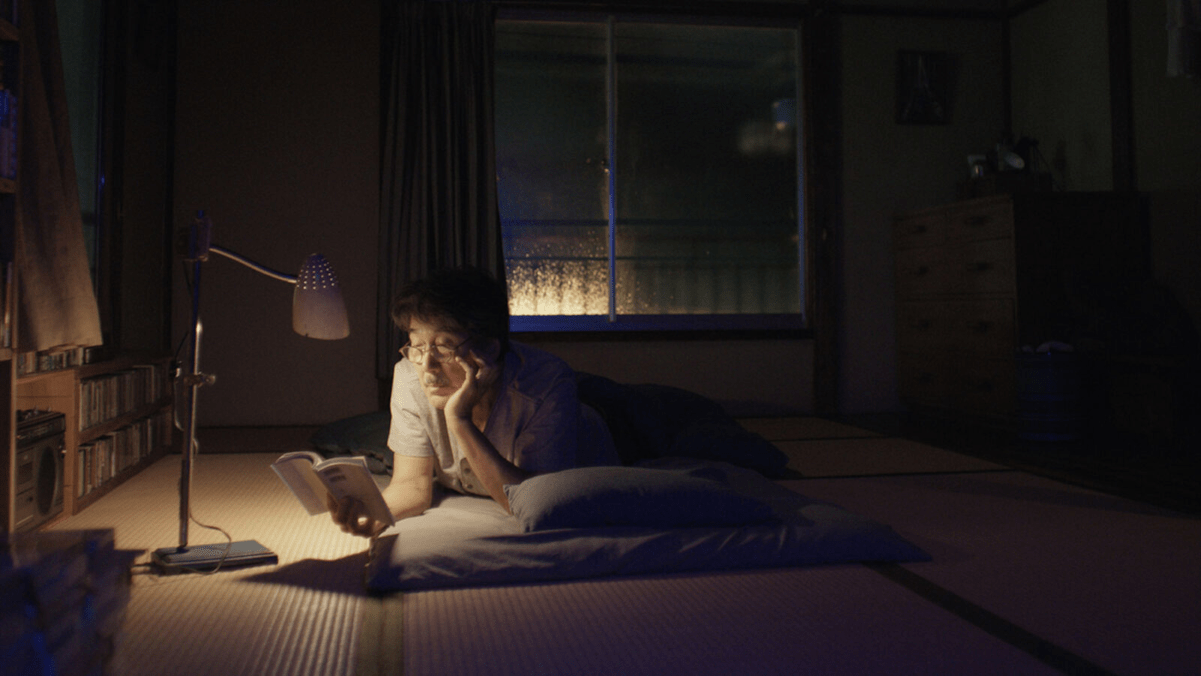
There’s much more to Hirayama than his day job. His life is full of small routines predicated on mindfulness. He lets himself be awakened by the sound of a neighbor sweeping the street below his window. He goes to sleep reading a book and returns to it after waking up. His dreams are vivid collages of the sights and sounds he experienced during the day. If I were to characterize Hirayama’s lifestyle, I would call it a spiritual journey. He appears to be working towards a deeper understanding of life and his place in it through art and nature. Like the Japanese Maple trees in his apartment that he waters daily, he uses routines to nurture his soul. (Given the spiritual aspect of his routines, calling them rituals is probably more appropriate.)
Although Hirayama lives alone and has no friends, he is not a recluse. He appreciates his connections to his community and being recognized at the places where he eats dinner, buys books, drops off film, takes his weekly baths, etc. When he arrives, the proprietors greet him with a warm smile and welcome him. However, all of those are cordial by design. The reason why Hirayama’s life is devoid of close relationships becomes clear with several encounters that take Hirayama outside of his comfort zone.
The first one is with Hirayama’s colleague Takashi, who desperately wants to get in with a girl named Aya (Aoi Yamada) and needs Hirayama’s help to do so. (She’s very pretty, so Takashi’s plight is very relatable.) Next is with his niece Niko (Arisa Nakano), who visits her uncle to escape her mother. Finally, there is the ex-husband of the restaurant he visits on weekends. Through each of these encounters, Hirayama is forced to deal with the one aspect of life he’s kept at a safe distance: personal connections. As we observe Hirayama’s interactions with these three people, we see that while he’s a nice man who will help others, he’s unable to handle the difficult emotions that come with these relationships.
Perfect Days is a mysterious and enchanting character study. Whereas the daily rituals that comprise Hirayama’s existence are straightforward, the question is why he has decided to devote his life to these rituals. What is writer-director Wim Wenders trying to say to us through this graceful story of a man who spends his days cleaning public toilets and the rest of his time experiencing art and nature? Yes, it is about the dignity of labor and personal enlightenment, but like Hirayama, there’s an incredible richness hiding just below the surface.
On one level Wenders is making a philosophical argument about how we, as human beings, cannot live within society and be apart from it at the same time. Hirayama’s quest for enlightenment may be the most important thing in his life, but he can’t ignore the connections he creates with other people. Although he aspires to live a solitary life like an artist or a philosopher, he must be there for others when they need him.
The movie also speaks to how futile it is to believe that we can dictate the terms of our lives. Even though Hirayama structures his days to be perfect, where each one is devoted to the activities he enjoys, reality eventually catches up with him. He believed that he could successfully limit the impact that other people would have on him, only to realize in the final heart wrenching scene that life simply can’t be controlled. Despite his best efforts, Hirayama can’t isolate himself from the bittersweet nature of human existence any more than the rest of us. Even though you never really left, I’m compelled to say, “Welcome back Wim Wenders, and thank you for giving us one of the best movies of 2023.” Highly Recommended.
Analysis
Perfect Days is one of those movies that becomes more rewarding with every viewing. While watching it, I was amazed at how many facets there are in what is a simple story about the daily life of a janitor. Below are a few items that piqued my interest.
Mr. Analog
Throughout the movie, Hirayama shows his preference for all things that predate the digital age. He reads paperback books, listens to cassette tapes and takes pictures with a camera that uses film. His apartment doesn’t have a television. He doesn’t wake up to a clock radio. When he needs to make a call, it’s on the rotary phone at the local bath house. When his niece ponders whether a song is on Spotify, he asks where they’re located, thinking she’s referring to a physical store. Some would describe Hirayama as being “old school”, which is true, but that doesn’t explain his very intentional choices.
For a while I wondered if Hirayama was a technophobe. However, when Takashi abruptly quits, Hirayama is forced to call his company on his company-issued flip phone. He clearly doesn’t have any problem using technology, he just chooses not to. I interpreted Hirayama’s behavior as being in step with his overall philosophy. He wants to have a close relationship with art and nature, so he deliberately chooses ways to interact with both that involve physical contact. He appreciates the tactile nature of holding a book and inserting a cassette into the dashboard. He’s able to touch the photographs of his favorite tree. When he’s off for the weekend, he rides his bike because he wants to experience the sights and sounds of the neighborhood.
Hirayama prioritizes physical contact because he believes that this approach will help him to be better attuned to the world around him. He avoids the plugged-in and disconnected life of younger people, choosing to be in the moment and open to experiencing everything around him. The movie emphasizes how different Hirayama’s approach to life is in comparison to younger people by showing Takashi watching his phone while cleaning a toilet. Where Takashi actively uses technology to distance himself from his reality, Hirayama is always in the moment and focused on the task at hand. In deciding to always be present in the moment, Hirayama is gifted with the anonymous game of tic-tac-toe.
The path to enlightenment is not always easy
In a movie filled with priceless scenes, I especially loved the one where Hirayama grows frustrated with his copy of William Faulkner’s “The Wild Palms”. His reaction is the same as anyone who has ever tried to read a book that they thought they would enjoy but don’t–he flips to the end to see how much further he has to go. Like Hirayama, I’ve selected a number of classic English novels to read based on their reputation, only to give up on them because I either couldn’t follow them or just didn’t like them. The lesson here is that no matter how much you may want to be enlightened by a book, it just might not be right for you.
Let the music play
Hirayama loves music from the Sixties and Seventies, and has amassed a collection of cassettes that speak to his eclecticism and good taste. Based on what we hear in the movie, he leans towards the blues, rock-and-roll and post-punk. (Here’s a list of the songs: https://www.perfectdays-movie.jp/en/collection/) Similar to his interest in English literature, American and British music provide Hirayama with another way to experience complex and painful human emotions from a safe distance. He can relate to the anguish in “The House of the Rising Sun” and the mournfulness of “(Sittin’ On) The Dock Of The Bay” without having to experience those feelings directly.
Life is bittersweet
As I described above, Hirayama’s life is a conundrum. He’s trying to live a fulfilling life within society without having any close relationships. The movie implies that Hirayama’s lifestyle is based on his inability to cope with sadness and tragedy. As a result, he’s chosen a life of solitude that focuses on enlightenment through appreciation of art and nature. Unfortunately, this approach hasn’t worked because human existence is predicated on our relationships with others. Furthermore, it has also left him incapable of handling the beautiful as well as the tragic aspects of life whenever he encounters them.
For example, Hirayama grudgingly helps Takashi try to win his girl’s heart. He lets him drive the company van and gives him money for a date. As a reward for his kindness, he’s forced to sell his Lou Reed tape so that he can buy gas to get home and must eat Ramen for dinner because he gets home so late. Then, when things between Takashi and Aya don’t work out, Hirayama is required to handle all of Takashi’s assignments for the day. On the one hand, it looks like life is punishing Hirayama for being nice. However, Hirayama’s reward was just delayed. Aya meets him the following day and returns the Patti Smith tape she stole from him. In return for letting her listen to it one more time, she gives him a kiss. He’s taken aback by her behavior and is unable to interpret her gesture. Because he prefers to keep others at a distance, he doesn’t understand that Aya sees him as a person of substance who is more worthy of her affection than the horndog Takashi. Her kiss is symbolic in how it represents the beauty and tenderness that can only be achieved through our close relationships with others, which ironically is what Hirayama seeks to avoid.
Another example of when Hirayama is unable to handle the bittersweet aspects of life is when he befriends the ex-husband of the restaurant he visits on the weekend. When he stumbles upon the two embracing at the restaurant, he’s embarrassed by the display of emotion and abruptly leaves. When the businessman later tells Hirayama that he’s dying of cancer and that he visited his ex-wife to thank her for being married to him, Hirayama is understandably troubled by the incredibly personal disclosures. However, instead of fleeing, he asks the businessman questions about shadows and engages him in a game of shadow tag. This scene subtly encapsulates the enlightenment Hirayama has been seeking all along. First, that while life is ultimately tragic, it is less so when we share our lives with others. Second, that true enlightenment can only be obtained by appreciating the beautiful and the tragic aspects of life. Finally, that our lives gain meaning by sharing them with others.
Echoes
Years ago when I was in college, I took a class titled “Modern European Art Cinema”. Among the movies we watched and discussed was Alain Tanner’s In the White City. In that movie, Bruno Gantz plays Paul, a worker on an oil tanker who abandons his job and his girlfriend back home to live in Lisbon. While Paul’s new life appears to be an aimless one on the surface, his actions are driven by an unconscious need to understand who he is and how he arrived at this point in his life. Although I haven’t seen that movie in decades, I was reminded of it while watching Perfect Days. To my surprise, Hirayama’s search for enlightenment echoes Paul’s in several key ways. They’ve chosen to live within but distinct from society, have slowed their lives down in order to better experience the world around them and have embraced using art as a path towards meaning. I’ve been fortunate to have many great teachers throughout my life, and I want to thank George Tysh for being one of them. If you get a chance to meet him and talk to him, you’ll find him to be an incredibly insightful man on many topics. In addition to patiently explaining the meaning behind European art films to me, he’s also responsible for providing me with my lifelong appreciation of Surrealism.
https://www.poetryfoundation.org/poets/george-tysh
 Detroit Cineaste