
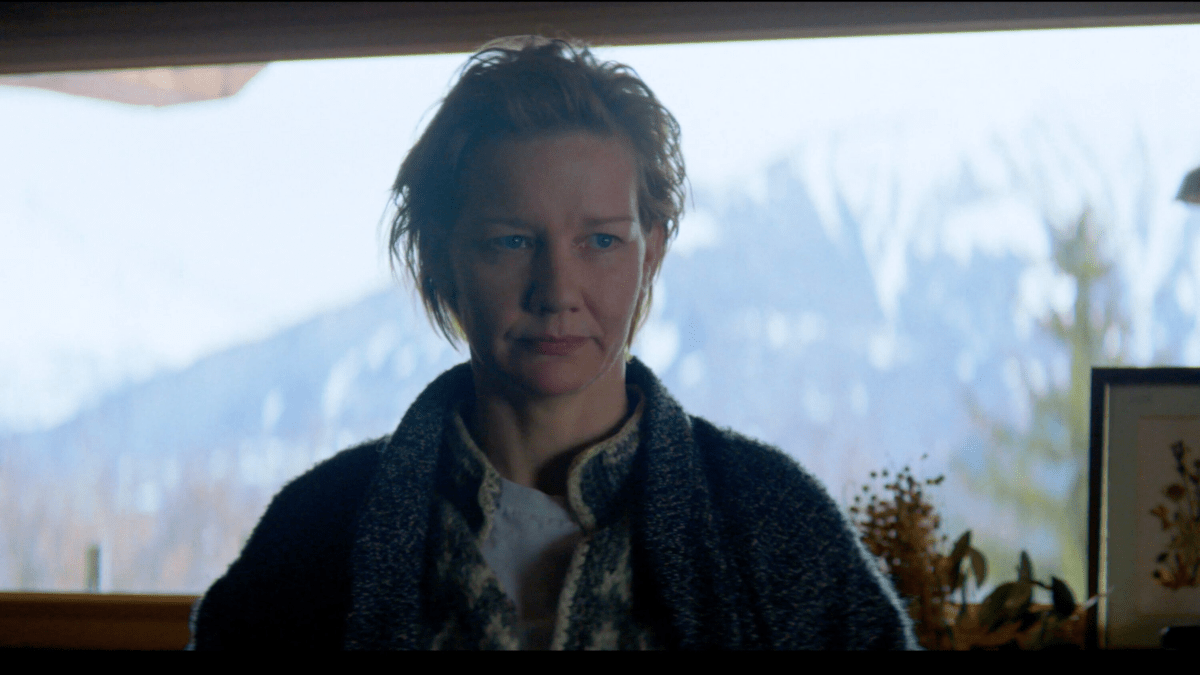
Anatomy of a Fall looks and sounds like a standard courtroom drama. It opens with a startling scene, where a young boy named Daniel (Milo Machado-Graner) returns from a walk with his dog to find his father dead on the snowy ground outside the chalet where his family lives. Daniels’ mother Sandra (Sandra Hüller) rushes outside and calls for an ambulance. When the police arrive, she explains that she was asleep when Samuel (Samuel Theis) jumped to his death. The police, however, don’t buy her story. After analyzing the crime scene and digging into Samuel’s past, they conclude that Sandra pushed her husband to his death. Charges are filed against her, and the resulting trial includes the requisite scenes of prosecutor/witness pyrotechnics. On this level, the story would serve as a gripping episode of Law & Order: The French Alps.
Anatomy of a Fall, however, isn’t interested in giving us the outcome we’ve come to expect from movies about criminal trials. As the proceedings grind on, we learn that Sandra’s version of the events can’t be ruled out. Samuel was depressed and had–according to Sandra, tried to committ suicide before. Thanks to expert testimony, both explanations for how Samuel died are equally plausible. Since the prosecution can’t prove their case through physical evidence or eye witnesses, they focus on motive and opportunity. On the latter, Sandra was the only person who could have killed Samuel. The prosecutor tries to establish that she also had ample motive to do so. The trial then shifts from being an anatomy of Samuel’s fall to an anatomy of Sandra and Samuel’s fallen marriage. Years ago, an unfortunate lapse in judgment on Samuel’s behalf left Daniel legally blind, and his parents have drifted apart ever since. The way the movie shows how a shared tragedy can utterly destroy a marriage reminded me of 2020’s devistaging Pieces of a Woman, if Vanessa Kirby’s character had been put on trial for choosing to use a midwife.
As the trial delves into the incredibly personal details of Sandra and Samuel’s relationship, it becomes clear that writer-director Justine Triet isn’t concerned with solving the crime or how justice will be meted out, but how much the legal system is stacked against the accused. Instead of being about uncovering the truth, Triet shows how a criminal trial can devolve into a high-stakes game where prosecutors will do whatever it takes to win. They shamelessly use whatever evidence they have to prove their case, without regard to how prejudicial it is. If establishing motive becomes a character assassination, so be it. The only way Sandra stands a chance is by successfully countering every intrusive accusation made by the prosecution. (As a writer, Sandra has the mental fortitude to do that. Others would wilt in her position.) Like most cinematic trials, Sandra’s fate depends on last-minute testimony that will either clear her or send her to prison. While that testimony is incredibly dubious and self-serving, it effectively makes the case that the movie had been making all along. Anatomy of a Fall puts the legal system on trial and shows how the pursuit of a guilty verdict is both highly subjective and incredibly flawed. Crisply directed and superbly acted, the movie is one of the best legal dramas in recent years. Highly Recommended.
Analysis
For a while there, Anatomy of a Fall had me convinced that it would be another courtroom drama that would: a) methodically prove that the accused really did commit the crime, and b) deliver justice on behalf of the victim in the form of a guilty verdict. However, as the legal scenes played out, I realized that the movie wasn’t concerned with either of those things. Instead, it puts the legal system itself on trial. It does this by showing how the prosecution is free to use every tactic at its disposal, no matter how prejudicial or speculative, to achieve their desired outcome.
The critical question posed by the movie, whether Sandra killed Samuel is left unanswered. The movie conspicuously doesn’t include a flashback scene that shows what happened immediately before Daniel found his father lying dead and bleeding on the ground outside their home. Through the police investigation and then the defense’s rebuttal crime scene analysis, two possibilities emerge. The official explanation is that Sandra confronted her husband on the balcony, hit him in the head with something and pushed him over the edge. The defense argues that it is just as likely that Samuel decided to jump to his death. As the trial plays out, we see that both explanations are probable but not ironclad.
The prosecution’s case for Samuel’s murder, logical as it is, has obvious holes in it. There were no witnesses. The weapon that Sandra used to hit Sanuel was never identified by forensics. The prosecution’s case is entirely circumstantial, predicated on motive and opportunity. Their argument is that Sandra was not getting along with her husband and was the only person who could have pushed him. The defense’s explanation for what happened is that Samuel, in a bout of depression, jumped to his death. The fact that there was no no blood found on the snow covered structure below he struck on his way down was due to the sun melting it. Taking into account Samuel’s deteriorating mental state following his son’s accident, him committed suicide is very possible.
In the absence of incontrovertible evidence, the prosecution has to prove Sandra was motivated to kill her husband on that particular date and time. To do this, it builds a narrative that paints Sandra as a bad person who reached the breaking point in her relationship with Samuel and took matters into her own hands. To prove that Sandra had the mentality to kill him, the prosecution recounts the salacious details of their marriage to establish that Sandra was as cold-blooded as her husband accused her of being. She moved on from her son’s crippling accident after a few days. She had affairs while Samuel was in the throes of despair. She’s a bisexual. She spurned her husband in the bedroom and sought out affairs with women. She has an icy demeanor. She focuses on her career at the expense of her family. Taken together, these details paint an incredibly unflattering portrait of Sandra. The prosecution keeps banging the drum that she’s a bad wife and mother so that the jury will believe that she’s capable of murder as well.
From my standpoint, the prosecution’s line of questioning only proves that Sandra had become the stereotypical bad husband in their marriage. (With Samuel humorously assuming the role of the aggrieved and emotional wife.) Furthermore, the prosecution’s tactic opens the door to the defense to attack Samuel’s character in absentia. They bring up his history of depression and question his therapist. Sandra recalls a time when he apparently overdosed on aspirin, an incident that she never mentioned to anyone else. On the day of his death, the defense argues that Samuel was upset over wife ignoring him in favor of the girl who was interviewing her. They subsequently argued and he jumped to his death while she napped. For as unseemly as this defense may be, it is fair game because the prosecution decided to make a dead man their star witness.
The prosecution believed that Samuel’s recording of his argument with Sandra the day before would be the final nail in Sandra’s coffin, but it has the opposite effect. Instead of giving proof of Sandra’s motive, it raises some very troubling issues about Samuel’s state of mind. First and foremost, Samuel had secretly recorded several of his conversations with Sandra. The explanation given was that he wanted to use them as the basis for a story. Even if that’s true, doing so was undeniably creepy and shows how Samuel was untrustworthy. Second, Samuel appears to have intentionally baited Sandra so that their after dinner chit-chat would quickly devolve into a heated argument. He seems to be throwing every resentment he can think of at Sandra in the hopes of getting an angry response from her, which he eventually does. Finally, the recording shows that Samuel was a troubled person overall. He was envious of her career and blames her for all of his problems. When the playback of the recording concluded, the question I was left with was how their marriage lasted as long as it did.
Throughout the recording, Samuel holds Sandra responsible for every failure in his life. However, she steadfastly refuses to accept blame for any of it. For every complaint Samuel makes on the recording, Sandra has a rational response. She shrugs off his insulting complaints about her not willing to be adventurous in the bedroom. She reminds him that she’s been supportive of every decision he’s made that affected their family. The main thing that Samuel appears to be upset about is not having enough time to write. Samuel believes that Sandra should give up some of her time so that he can start writing again. Sandra counters that by saying that the only thing preventing him from writing is himself. If he stopped mothering his son out of guilt and let him go to school, he’d have plenty of time to write. Also, she can’t give up writing because she’s the only one supporting their family. Giving up writing and teaching, moving back to his childhood home, homeschooling Daniel, those were all decisions she fully supported him on. From her perspective, Samuel’s claim that she’s blocking him from writing is preposterous.
Having a recording as damaging as the one played for the judge and jury would have devastated most witnesses. Sandra, however is mentally strong enough to defend herself against the accusations made by the prosecution. Because it’s only an audio recording and Samuel is no longer able to give his version of the events, Sandra is free to give an interpretation that is favorable to her. She explains that the sounds indicating a physical confrontation between the two were actually Samuel throwing things and slapping himself in the head. As far-fetched as Sandra’s explanation for the sounds on the recording and the bruise on her arm might be, the prosecution has no way to counter them because Samuel is dead.
To the prosecution’s surprise, the recording damages their case because it disproves their characterization of Samuel as a sympathetic victim. On the contrary, it shows him to be a pathetic person who was emotionally abusive to his wife. Sandra, on the other hand, comes off surprisingly well. She was the one holding her family together while Samuel was coping with his depression. That Samuel and Sandra’s relationship had become toxic is irrefutable. However, that fact doesn’t prove that Sandra killed Samuel or that he killed himself. In its zeal for a guilty verdict, the prosecution inadvertently helped prove the defense’s case for them.
As if the legal system’s treatment of Sandra isn’t horrifying enough, her son Daniel fares poorly as well. As the only other person in the home before his father’s death, he’s forced to play a critical role in determining his mother’s fate. The pressure on him to prove the case against his mother is enormous. Both the detective investigating the crime and the court itself show little concern is shown for the well-being of a boy who is still grieving over the loss of his father. On the contrary, a detective is visibly upset with Daniel for getting confused about a crucial detail just days after finding his father’s body. Then, when the trial begins, he’s reminded daily that his mother is being accused of killing his father through the use of a court-appointed guardian whose presence is intended to safeguard his testimony from her influence. Ultimately, his scientific experiment on the family dog and his recollection of a conversation with his father sway the jurors enough so that they find his mother not guilty. While I could argue that the former would probably be inadmissible in any court of law, that’s irrelevant to the overall argument the movie is making. The legal system put Daniel into an impossible situation when it asked him to decide between having one parent or no parents for the rest of his life. It should come as no surprise that he did what he felt was in his best interests, regardless of whether justice was actually served.
Footnotes
Regardless of how you think Saumel died, Anatomy of a Fall makes a clear-cut case that two writers shouldn’t share the same roof. Samuel’s feelings of envy at Sandra’s success may not be the only thing that drives a wedge between the two of them, but it feeds every complaint he has about their marriage.
Many years ago, I watched a 20/20 episode about The Gottman Institute. The episode interviews Dr. John Gottman, a marriage researcher who discussed reasons why relationships fail. One finding they shared is how four communication patterns can predict the end of a relationship. They dub them “The Four Horsemen”, in a nod to the Book of Revelations. The four horsemen are: criticism, contempt, defensiveness and stonewalling. Anyone hearing Sandra and Samuel’s heated argument would find all four of those elements present. With that in mind, the Gottman Institute should recommend this movie to couples who don’t realize they need counseling but are having issues. If you or your spouse identify with the couple in this movie, seek professional help immediately.
 Detroit Cineaste