
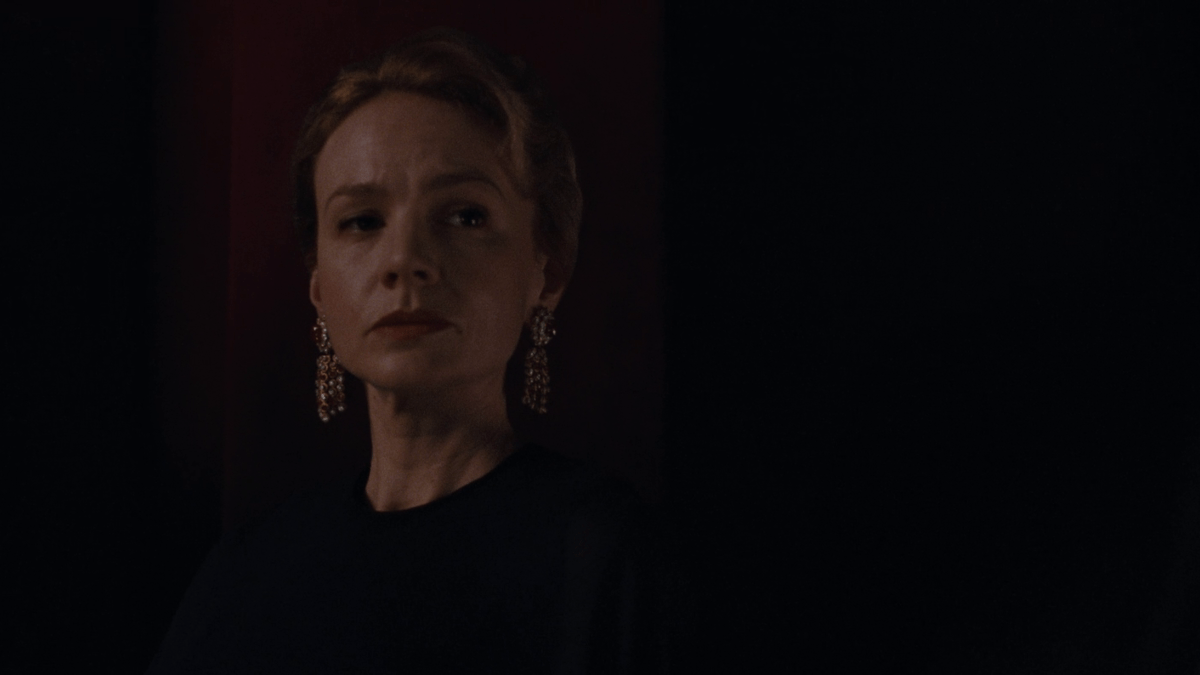
Maestro covers roughly forty years of Leonard Bernstein (Bradley Cooper), from his big break in his twenties to when he’s an older man in his sixties ruminating on his failure as a husband to his wife Felicia (Carey Mulligan). As the director and writer of this film, Cooper shows the two falling in love, getting married, having a family, and how Bernstein’s wandering eye and sexual appetite tested their union. Along the way Bernstein did many things that established him as a world-renowned conductor and composer. The movie isn’t interested in exploring either his creativity or his art, and instead focuses on his relationship with Felicia. She plays the long-suffering wife to her husband, the genius. Beyond the obvious marital strife, the story Cooper tells is not compelling because it is largely devoid of conflict. When he’s not being a genius, Bernstein treats his wife with little regard for her feelings. He does answer the call when he needs to, and the movie ends with tinges of regret, but the overall impact of this true life story felt muted.
Maestro is a frustrating biopic. It covers all of the bases I would expect from a biopic, but the movie keeps the audience at a safe distance from its subject. Despite having several scenes that should have elicited an emotional response from me, I never connected with the movie at that level. While there are many aspects of the movie that I admire, particularly the cinematography, the makeup and the performances, the end result left me wanting. Cooper’s decision to limit his examination of Bernstein to his bisexuality, philandering and the impact both had on his marriage is a daring choice, but Cooper seems queasy with confronting those topics directly. Instead, he cloaks them in a heavy sheen of artifice, using stilted dialog and fancy camera work to overshadow the intimacy of the events. Many scenes eschew raw emotions in favor of making us feel slightly uncomfortable watching how things play out. Cooper clearly reveres Bernstein, but his interpretation of his subject is curiously devoid of insight. It reveals Bernstein to be a gregarious cad but offers no point of view on his behavior. As Bernstein, Cooper acts his tail off in this, but his herculean effort is all for naught because the overall portrayal comes off as glib. Mulligan’s performance as Felicia is admirable, even when she’s forced to say the fakest dialog this side of the Forties. As someone who really enjoyed Cooper’s A Star is Born, this movie was a huge letdown. However, it is worth a look if you are genuinely curious. Toss Up.
Analysis
In all honesty, I admire the risks that Cooper takes with telling Bernstein’s story. I can’t recall another biopic that devotes so little screen time to their subject’s accomplishments as this one does. I fully expected the movie to have many scenes showing Bernstein in the act of composing and conducting. Instead, all we get are a few snippets showing him working: “Gallop” from Fancy Free and Mass. The movie tells us that he composed the music for On The Town, West Side Story and On The Waterfront, but tells us nothing about his creative process or what inspired him. In an interview scene, Bernstein is very dismissive of those accomplishments, saying:
Actually, when you add it up, there’s not much that I’ve created. And music is, and I know this is going to sound strange to you, it is the most important thing that I can do. And it’s a great source of dissatisfaction that I haven’t created that much at all. I mean, when you add it up it’s not a very long list.
I was dumbfounded by this remark because any composer would give their right arm to be known as the composer of just one of those pieces.
The movie does give us a bit more time with Bernstein the conductor, but never explains why his achievements in that field were noteworthy. There’s a lengthy scene showing him rapturously conducting Mahler, but the movie never explains why this moment was so special for him. For a man whom everyone in the movie refers to as a genius, the movie never bothers to explain why that is so. The movie adopts Bernstein’s own nonchalant attitude towards his accomplishments, including his compositions and symphonic recordings throughout the movie as needle drops. For example, in one scene where Bernstein arrives in a car with two friends, music for On the Waterfront is played on the soundtrack. How the music corresponds to the scene itself is a mystery because the movie only acknowledges that Bernstein wrote the score. Maestro contains no scenes showing him composing it, describing the inspiration behind it or giving his opinion about the movie itself.
One possible explanation as to why Cooper spent so little time exploring or explaining Bernstein’s artistry and professional career is that he made the movie for those who were already well-versed in both. Another explanation is that Cooper wasn’t comfortable with providing his own interpretation of Bernstein’s work. In either case, the choice is odd because it leaves neophytes like myself with a lot of unanswered questions at the end of the film.
As I mentioned above, almost all of Maestro is devoted to Bernstein’s relationships and sexuality. The movie tells us that Bernstein was bisexual, that he had affairs while he was married and flaunted them in front of his wife. His proclivities were an open secret to everyone in his inner circle. Bernstein’s behavior obviously affected his marriage, and the movie gives us the expected scenes of spousal tension and yelling. Generally speaking, the arc of Leonard and Felicia’s marriage is a very common cinematic trope. They meet, recognize themselves in each other, give into their mutual attraction and fall in love. He forgoes his carefree lifestyle to get married and raise a family, but begins to take his wife for granted and has affairs. She expresses her anger at how he treats her but never leaves him. After a period of separation, he returns when she becomes ill and stays by her side until she passes. (The plot is incredibly similar to the Kevin Kline/Ashley Judd movie De-Lovely.)
Cooper obviously knew that audiences would be very familiar with the melodramatic beats of his story. As such, he uses every tool in his filmmaker’s toolbox to make the familiar unfamiliar. He focuses extensively on the movie’s formal presentation, using expressive cinematography to bring out as many facets of the scenes as possible. His scenes are frequently long, unedited takes. The dialog has a distinctly stagy quality. Cooper leverages this approach extensively in the first third of the movie, which encompasses the forties and fifties. Every scene evokes the striking black and white photography of Life magazine, and the dialog mimics the cadence of classic romantic comedies from that period as well. From behind the camera, Cooper shows his directorial prowess, employing rolling dolly shots, deep focus and seamless edits to give the action a kinetic feeling. Unfortunately, for all the technical wizardry on display, the construction only reinforces how artificial and impersonal the overall execution is. Cooper wants us to view Leonard and Felicia’s romance in the same light as Hepburn and Tracey (or Bogart and Bacall), but the comparison fails because he has not given us sufficient reason to invest ourselves in them.
When the story proceeds to the Sixties, Cooper changes the look and feel of the picture accordingly. He films the action in vibrant color and allows scenes to simmer much longer than before. The overall changes in aesthetics only prove how much the movie is an exercise in presentation at the expense of intimacy. Instead of trying to explain why Leonard became such a selfish, uncaring bastard, the movie is content to show us behaving that way. We see Felicia express her rage at how his behavior hurts her feelings, but don’t understand why she stays with him. Leonard and Felicia may be famous people, but they never become more than “bad husband” and “dutiful wife” archetypes.
There are moments when Cooper tries to peel away the layers from his subject and reveal what makes him tick, but he never follows through. The movie gives a sense of Bernstein having a degree of inner turmoil on being equally great as a conductor and a composer. On the one hand, he prefers not being forced to choose between two professions he’s excelled at. When he and Felicia are getting to know each other, he states how he prefers being able to live his life this way:
So I had no choice but to become a composite of adopted speech, manner, outlook on life, a composite which enables me to be many things at once. And that’s why we, you and I, are able to endure and survive. Because the world wants us to be only one thing, and I find that deplorable.
When Bernstein sizes up his output as a composer as slight, he implies that he probably wished he had settled on being a composer. However, if he had done that, he would have disappointed everyone who considered him to be a genius as a conductor. (Bernstein had a tendency to over-commit himself, another aspect of the man that Cooper never explores.) Bernstein may have given himself professional freedom in not deciding between one avenue or another, but he also opened himself up to self-doubt as to whether his non-choice was the right choice.
Maestro does establish a parallel between Bernstein’s dual professional careers and his bisexuality, but never uses the comparison to reveal anything compelling about him. Cooper spends an inordinate amount of time documenting his boorish and insensitive behavior in the second half of the movie, and the implication being made is that Bernstein would have been happier later in life if he had gotten divorced and chosen to live outwardly as a gay man. However, Cooper dodges the issue entirely and focuses on how the remnants of Bernstein’s former life as a heterosexual man were an occasional annoyance. Aside from Felicia’s angry outbursts and having to lie to his daughter, he’s able to do as he pleases. The only perspective the movie has on the dualities in Bernstein’s life is that they made him regretful.
Perhaps it was the dual-nature of Bernstein’s life that inspired Cooper to take on his life’s story. Like his subject, Cooper is also a multi-hyphenate: actor, writer, director, producer. Like Bernstein, Cooper has been able to excel at more than one thing, at least in terms of his professional life. I think he admired how Bernstein was able to be both a conductor and a composer and never had to compromise to achieve greatness at both careers. Maybe this is the reason why his version of Bernstein’s life story is largely without conflict. Cooper doesn’t believe that choosing to do more than one thing (professional) should result in problems, let alone conflict. It didn’t for Bernstein, and it hasn’t for Cooper so far.
While many of Cooper’s directorial choices left me puzzled, one that stood out is his use of close-ups. While he often uses close-ups to reveal the emotions Bernstein brings out in others, he rarely uses them for Bernstein himself. For example, he uses close-ups to register the admiration, love and disappointment of David Oppenheim and Felicia, but not to show us how Bernstein felt about them. Additionally, in the scene where the first two meet, Cooper focuses on Ellen while she sings “You’ve Got that Look” while Bernstein plays the tune off camera. Was Cooper trying to say that Bernstein could only express his true feelings for others indirectly through his art? If so, that would be incredible, given how effortlessly Bernstein talks about himself throughout the movie.
Cooper’s reluctance to get under Bernstein’s skin is painfully evident in the scene after he and Felicia make love. Cooper doesn’t portray the lovemaking at all, instead showing the two on the floor as a result of Leonard’s back pain from sleeping on Felicia’s foreign bed. As the two cuddle and smoke, Leonard reveals that, when he was a boy he had dreams of killing his father and would awaken and fantasize about it. Leonard says this is because his father was cruel, which explains the source of the dreams. However, without context, this admission doesn’t go anywhere. The obvious question of how his father was cruel to him is never asked by Felicia or addressed in the movie.
On the surface, Maestro follows the biopic recipe to the letter. It covers decades of Bernstein’s life and recreates several important events over that period of time. The movie provides a window into his personal relationships and recounts many of his professional achievements. Cooper’s remarkable transformation into Bernstein and the intensity of his performance comes across as sincere. However, the movie is not successful because it refuses to provide a critical point of view about its subject. Cooper never attempts to explain what drove him to become the man who is now considered to be a legend. Maestro gives us the “who” and the “what”, but it never addresses the “why”. That Cooper spent so much time and energy making a beautiful-looking yet superficial retrospective of a person he idolizes is baffling.
 Detroit Cineaste
One thought on “Maestro”