

May December is not merely clever, it’s diabolical. That’s the best way I can describe a movie that adopts a persona to hide its true intentions–while telling a story about characters who do the exact same thing. On the surface, Elizabeth (Natalie Portman) is a professional actress who wants to learn everything she can about Gracie (Julianne Moore), the basis of her next role in an independent movie. Like the real life case involving Mary Kay Letourneau, Gracie seduced Joe (Charlie Melton) when he was in grade school. Elizabeth says she wants to give a true performance of Gracie and does what actors normally do to prepare for their next role. She interviews the people involved, scouts locations and scours the media coverage of the incident. However, it soon becomes evident that Elizabeth’s intentions aren’t as noble as she says they are. Additionally, understanding Gracie and Joe is difficult, given how they’ve learned to shield themselves with their own performances for the past twenty years.
Like a detective in a murder mystery, the movie follows the characters like suspects and documents their troubling behavior, but to what end? While the plot assumes the guise of an investigation, the goal isn’t to uncover who actually committed a crime. Indeed, the facts of the case are never in doubt. What the movie is actually about is deception, or as it’s referred to in the world of acting, performing. Elizabeth, Gracie and Joe have adopted public personas that hide their true feelings and motivations. However, as we observe them in private, we get a clearer picture of who they really are. The movie is a captivating character study of predators, their victims and the people who are fascinated by them. Brilliantly written, directed and acted, May December is one of the best movies of 2023. Highly Recommended.
Analysis
My December is such a deceptive movie that I wasn’t sure what it was trying to tell me. I recognized early on that the three main characters were hiding behind personas, but I didn’t understand why. It was only later that I realized that the movie was about performing, or more specifically, acting. Elizabeth, Gracie and Joe are each giving a performance instead of being honest with each other and the world around them. The movie is a character study of three people who act in ways that block others from finding out who they really are.
Like the main characters in the story, the movie itself is duplicitous. It hides its intentions by adopting the guise of a detective movie and places Elizabeth in the role of a detective. She interviews witnesses, talks to the victim, observes the suspect, visits the scene of the crime and records her findings in her notebook. However, Gracie has already been punished for the crime, so there is no mystery that needs to be solved. Elizabeth’s pseudo investigation is actually an ingenious mechanism designed to pull us into the story and ask us to unravel the mysterious nature of these characters. The central question we’re being asked as cinematic detectives is, why are these characters giving these particular performances?
Elizabeth
Elizabeth is the professional performer in the story. When she first appears, she’s adopted the persona of a famous actress who’s trying to not draw attention to themselves. As Gracie’s friend Rhonda predicts, Elizabeth shows up wearing a stereotypically big hat and sunglasses that make herself conspicuously inconspicuous. As the story unfolds, Elizabeth’s motivations for taking the role of Gracie and going to Savannah for research become clearer.
For the first two-thirds of the movie, Elizabeth uses all of the acting tools at her disposal to understand Gracie. This, Elizabeth claims, will enable her to give a “truthful performance” of Gracie. She reads newspaper and magazine articles for background. She interviews people who were involved with the case (Gracie’s-ex husband, Gracie’s lawyer, the pet shop owner and Joe) to gain insight. Elizabeth observes Gracie, documenting her physical appearance and mannerisms. She also visits the physical locations, specifically the pet store and the store room where “the crime” took place. All of this is considered normal prep work for an actor. However, when Elizabeth begins to seduce Joe, it becomes clear that she took the role so that she would be able to vicariously experience what Gracie did. She wants to know what it’s like to be a sexual predator.
Actors routinely discuss how they spend time learning a skill that is particular to the character they’re playing. They take training so they can ride a horse, shoot a gun, sing, play a musical instrument, and so on. If the character they’re playing is still alive, they may observe them while they are working. For example, an actor may ride along with detectives, or sit in the team’s dugout. Unfortunately, while Elizabeth can watch Gracie create floral arrangements and bake cakes, she can’t observe Gracie being a sexual predator. Elizabeth can, however, adopt Gracie’s behavior and seduce Joe herself. In this way, Elizabeth can experience the same power and control that Gracie had over Joe.
Before Elizabeth’s encounter with Joe, the movie shows how she is able to exert a modest level of control over her life. She fakes getting another call so she can hang up on her husband. She aligns herself with her director so that she can influence the production. However, those instances pale in comparison to what Gracie did to Joe. Elizabeth seduces Joe not because having sex with him will inform her performance, but because she wants to know what it feels like to be in that position. Elizabeth may be a hardworking actor, but the temptation to do what Gracie did is irresistible. Unfortunately for Elizabeth, the physical act is disappointing for several reasons. Her encounter with Joe isn’t exciting because it isn’t taboo–she’s having sex with a grown man and not a child. Also, Joe unsurprisingly has sex as a child would, with no awareness of his partner’s needs. In the end, Elizabeth’s performance as a predator has not given her what she wanted. The sex was unsatisfying and the question as to why Gracie did what she did all those years ago remains a mystery.
Gracie
Unlike Elizabeth, Gracie is an unprofessional actor. However, she’s a much more accomplished performer than Elizabeth. Whether she learned how to act out of necessity or was born with talent isn’t clear. Regardless, she’s convinced everyone that she’s really not a sexual predator at all by performing as a loving wife and caring mother in the public eye for decades. The fact that she can walk confidently around town is a testament to how good of a performer she is. Most convicted sex offenders are forced to live on the outskirts of society, with their only support coming from family. Gracie, however, lives in a very nice house and is a successful independent businesswoman. When Gracie’s former lawyer reveals that some of Gracie’s customers throw their cakes away, I was taken aback. The only reason why Gracie would receive that level of support from the community is if they believe her performance. She has convinced her friends and neighbors that the crimes she committed were out of love, a romantic notion that makes it possible for them to look past the troubling facts of the case.
Further proof of Gracie’s knack for performing comes via the letter she wrote to Joe that he gives to Elizabeth. When Elizabeth reads the letter to the audience (see below), it’s clear that Gracie intended to convince Joe that her actions were romantic in nature. However, since the letter is full of melodramatic star-crossed lover analogies, one can also assume that Gracie also wrote it knowing that it might be read by someone else. The letter itself is a performance with dual intentions behind it. The first is to keep Joe loyal by overwhelming him with her heartfelt message of forbidden love. The second is to convince anyone else who reads it that while her actions were misguided, her intentions were good.
Finally, Gracie tells Elizabeth who’s the better actor in their last scene together. With her research complete, Elizabeth is able to transform herself so that she looks, acts and sounds almost exactly like Gracie. (She has Gracie’s nervous smile down pat.) However, now that Gracie no longer needs to play nice, she decides to burst Elizabeth’s bubble. Gracie tells Elizabeth that she knows what Georgie told her, implying that Gracie has been playing Elizabeth from the beginning. Gracie is fundamentally an inscrutable person, and not even a professional actor who studied her for days would be able to figure her out.
Joe
As the one non-actor in the trio, Joe’s story is a tragedy. To the outside world, he acts like a happy-go-lucky guy. He’s married, has a good job and is seeing two of his children off to college. But unlike Elizabeth and Gracie, the performance he’s giving is for his own sanity. He pretends to be happy and perfectly fine with how his life has turned out, but inside he’s emotionally fragile and traumatized. His actual feelings only come out when he’s vulnerable, like when Joe has a heart-to-heart with his son Charlie on the roof. He painfully reveals that he never smoked a joint before, and then tells Charlie how glad he is that he’ll be going away to college. While he’s happy for his son, he’s visibly distraught over not having the chance to grow up. Joe kept all of his feelings towards his situation buried underneath his personas for the sake of his children.
Later, after Elizabeth has manipulated him into having sex, the parallels between that experience and what Gracie did to him years ago bring his true feelings back to the surface again. This time, he states that regardless of how Gracie portrays their relationship, he believes he was sexually abused. Unfortunately, Gracie is a far better actor than he is, and quickly recasts the blame when she asks him, “Who was in charge?” She will never accept responsibility for what she did, even when speaking with her husband in private. Because of this, all that remains for Joe is to accept his situation and go back to hiding his feelings from everyone, including himself.
A predator in our midst
Along with its keen observations on performing, May December also includes a clinical dissection of predatory behavior. Gracie is the apex predator in the story, with a history of taking advantage of people in vulnerable situations. First she attached herself to her husband while he was drunk. Then she took over managing the pet store while the owner was sick. Finally she used her newfound authority at the pet store to hire Joe and then seduce him. Like a cunning predator, Gracie realized that she would have to change how she wields her predatory instincts to survive. Instead of directly seizing power, she manipulates others into getting her way. She gave her daughter Sophia a scale as a going away present so that she would always focus on her weight. When her other daughter Mary chooses a dress without sleeves, she applauds her for having the courage to expose her arms in public. She counts every beer Joe has, reminding him that she’s watching him like a son instead of a husband. With Elizabeth, she calmly invades her space to apply makeup, emphasizing who has the power in their professional relationship.
As for Elizabeth, the movie establishes her as a predator wannabe. She observes Gracie’s behavior and uses what she learns to seduce Joe. However, the movie explicitly shows how pathetic her accomplishment was in comparison to Gracie’s brazen behavior. Elizabeth may have learned how to mimic a predator and may consider herself to be one, but she will never be an apex predator like Gracie.
Actors and acting
May December also works as a meta commentary on the profession of acting. Natalie Portman’s performance is constructed like a Russian doll. She plays an actor who initially acts like a stereotypical actor, then learns how to act like another person who is giving a performance themselves. Additionally, the movie features two Academy Award-winning actors in the lead roles, with Elizabeth playing the understudy to Moore’s lead, with the younger Portman trying to supplant her older mentor.
Direction, please
As a director well-versed in the language of film, Todd Haynes adds another layer to May December. In scene after scene, he communicates a wealth of information through staging, camera placement and blocking.

Haynes takes advantage of the mirrors in the dress shop not only to show us how Elizabth uses every opportunity to observe Gracie, but also to tell the audience that Gracie is duplicitous.

Haynes underscores the sleaziness of the affair when he shows that the pet store where everything happened is in a run-down strip mall.

Even though Charlie’s father never says he’s embarrassed by what has happened with his son, he’s doing his best to kill himself through chain-smoking.

Haynes provides the first evidence that Elizabeth is an excellent actor when she quickly turns the tables on a student who tried to embarrass her by asking if she’s acted in sex scenes. Haynes slowly pulls in on Elizabeth while she confidently and frankly describes the process, cutting back to the students who are simultaneously uncomfortable and enthralled by her.

Haynes has Portman communicate Elizabeth’s actual intentions by having her dress and pose her body proactively when she’s alone with Joe. When she visits him at his work, her nipples are visible through her blouse.

Later, when Elizabeth visits Joe at home and discusses his caterpillars, she uses body language in an attempt to draw attention to her figure.

The sex scene between Elizabeth and Joe is shot from above, which is a strangely impersonal way to capture a sex scene. The shot captures the entirety of Joe’s naked body to emphasize how Elizabeth has reduced him to a hunky piece of human flesh to be exploited.

When Elizabeth “performs” Gracie’s love letter to Joe, Hayes has Portman face the camera and address the audience directly. She channels Gracie for the entirety of her three and a half minute uninterrupted monologue and proves that she is a good actress. On a technical level, her ability to mimic Gracie’s speech patterns and mannerisms is uncanny. More importantly, Elizabeth’s skill at conveying emotions makes Gracie’s sappy prose more emotionally resonant than it deserves to be. At the conclusion of her performance, Elizabeth trembles with orgiastic delight at her accomplishment.

After the graduation ceremony, when Gracie tells Elizabeth that she knows what Georgie told her about her relationship with her brothers, the camera pans away from Elizabeth who is visibly upset. Haynes underscores how Elizabeth has been “dressed down” by Gracie by having the sun shine through her dress to reveal her body underneath.

The conclusion of the movie shows Elizabeth on a movie set, performing the pivotal seduction scene with a stand-in for Joe. Surprisingly, this version looks about the same as the Lifetime movie version we saw earlier.
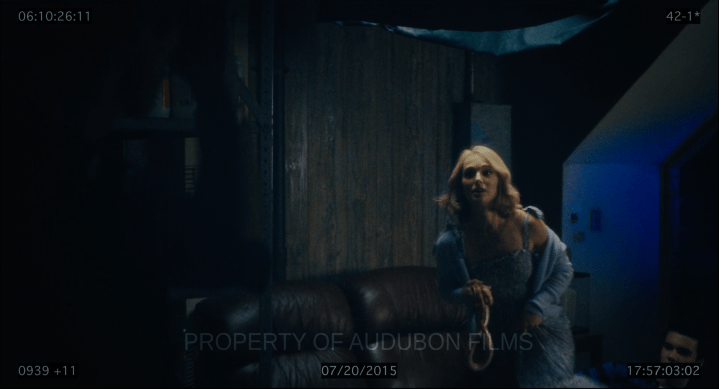
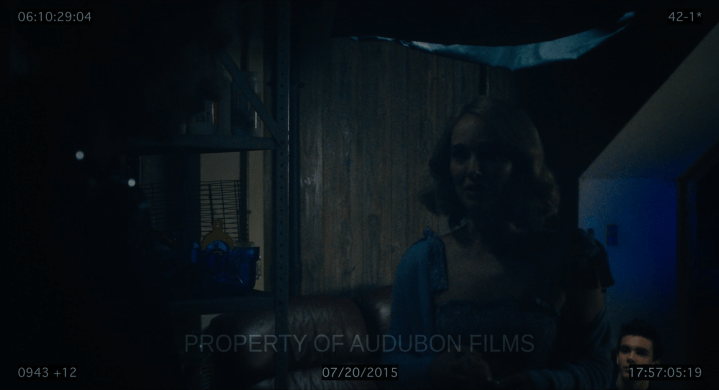
Even though the director is happy with the third take, Elizabeth insists on another because she claims that “It’s getting more real.” Haynes represents the irony of her plea by having Elizabeth walk from the lit set into a literal gray area. We know that what Elizabeth says is actually her interpretation of lies. Additionally, the scene drives home the underlying message of the movie about acting is an inherently deceitful profession.
Symbolism
I love it when a director uses symbols to communicate aspects of the story instead of relying on actors to spell everything out for the audience.

Elizabeth’s use of a vaporizer (and inhalers) tells us immediately that she’s so fragile that she can’t handle the sultry Savannah air. She eventually tells Joe the vaporizer isn’t working, portraying herself as a wounded bird to lure Charlie inside her house.

The roof of Joe and Gracie’s house represents the extent to which their children will go to escape the reality of their family life. Haynes also utilizes this setting to represent the boundary between childhood and adulthood. It’s fitting that the roof is where Joe smokes a joint with his son and finally completes an overdue rite of passage.

Haynes uses the Monarch butterfly chrysalises Joe cares for as a stand-in for the normal development process in nature. While Joe is able to ensure that the Monarchs are able to successfully transition from a caterpillar to a butterfly, his own transformation from a boy to a man was interrupted by Gracie. He never had the chance to fully develop into a man. Instead, he’s a boy trapped in a man’s body.
The Monarch also is analogous to Joe’s children leaving home for college. Unlike the butterfly he sets free, he’ll never be able to leave and explore the world. He’ll be trapped forever under Gracie’s spell.

Gracie’s skills as a hunter are confirmed when she tracks down a fox. As a predator, she has an undeniable ability to overwhelm weaker prey. However, in this particular instance, she takes pity on the animal and spares it.
 Detroit Cineaste