
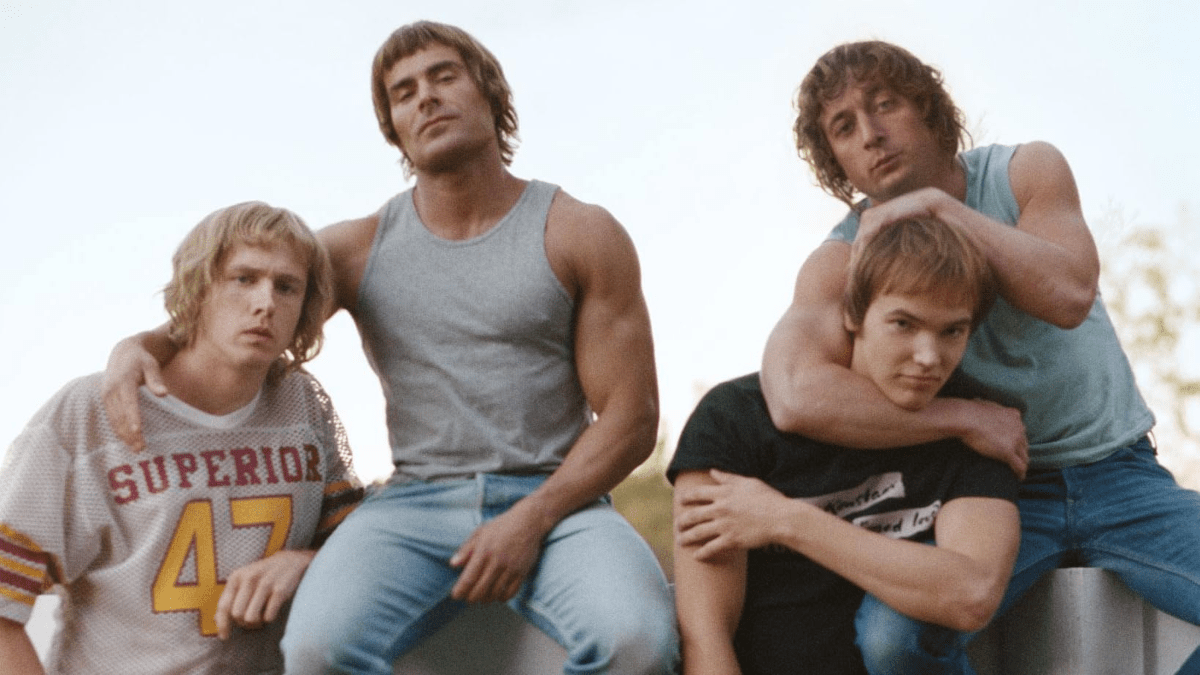
It’s easy to start believing in curses, when bad things keep happening to you. For Kevin Von Erich (Zac Efron), the eldest brother of the family at the center of The Iron Claw, the idea of a curse goes from being laughable to credible with each mounting tragedy. I can’t blame him for deciding that his children will not inherit the Von Erich last name, because if there really is a curse, it surely would pass over someone named Adkisson.
Of course, there is no curse hanging over the Von Erich’s, or even bad luck. Instead, the movie is about making bad choices and the consequences that result from them. While the Von Erich brothers make some obviously bad decisions, the most fateful one of them all is ironically the most innocent: agreeing to fulfill someone else’s dreams. Nobody wants to let down someone they love and respect, especially when that person is your father. In the case of the Von Erich’s, family patriarch Fritz (Holt McCallany) convinced his sons to pursue the wrestling glory he could not achieve for himself, and they were consumed by it. Even when son Kerry (Jeremy Allen White) brings home the title for the family, he’s haunted by the accomplishment. If it weren’t for the accidental death of his brother David (Harris Dickinson), he wouldn’t have gotten his title shot. In the end, what saved Kevin from the curse wasn’t winning, but choosing family and love over glory.
While nobody could pay me to watch an actual wrestling match, I’ll be damned if the sport hasn’t served as the basis for several great movies. Just like The Wrestler, the tragedy of The Iron Claw comes from chasing dreams at the expense of everything else. Whereas Mickey Rourke’s character was intent on getting back his former glory, Kevin’s brothers were committed to achieving the glory that escaped their father. The Iron Claw, with its focus on the overriding loyalty within a wrestling family, plays like a dark version of Florence Pugh’s Fighting With My Family. Writer-director Sean Durkin, who previously examined unhealthy family dynamics with Martha Marcy May Marlene and The Nest, makes this story of uncomplicated wrestlers into one that is surprising in its emotional complexity. This movie is ultimately a cautionary tale about living your life for someone else. If you’re going to die chasing a dream, make sure it’s your own. As far as physically transformative performances go, Efron’s is jaw-dropping. If his next role isn’t playing a Greek God, it would be a letdown. Lastly, the movie’s use of Rush’s “Tom Sawyer” is epic. Recommended.
Analysis
The sins of the father are to be laid upon the children.
William Shakespeare, The Merchant of Venice
Undeservedly you will atone for the sins of your fathers.
Horace
The gods visit the sins of the fathers upon the children.
Euripides
Keeping mercy for thousands, forgiving iniquity and transgression and sin, and that will by no means clear the guilty; visiting the iniquity of the fathers upon the children, and upon the children’s children, unto the third and to the fourth generation.
Exodus 34:7
I never fully understood the notion that a child would be held accountable for the transgressions of their fathers. It’s fundamentally unfair. Why would a child need to atone for something they didn’t do? I kept coming back to this question again and again while watching The Iron Claw, which doesn’t involve passing down sins, but dreams. As this movie recounts in horrifying detail, accepting responsibility for achieving your father’s dreams is tragic, regardless of whether you achieve them or not.
The dream at the heart of this story is being declared world heavyweight wrestling champion. For Fritz Von Erich (Holt McCallany), obtaining that title is all that ever mattered. He changed his name from the more pedestrian “Adkisson” to “Von Erich” probably because it sounded more imposing and mythical. Despite his best efforts, Fritz lost his shot at the title and was denied a rematch. Believing that the game was rigged against him, he became a promoter and businessman. This didn’t mean that Fritz’s dream died. On the contrary, it lay dormant until he could infect his sons with it.
As a wrestler, Kevin Von Erich (Zac Efron) was good but not great. As the movie shows, he was incredibly handsome and trained until he had a chiseled physique like a bodybuilder, leading to countless magazine covers. However, his father was never sold on him as being the one to bring home the title. Principle among his perceived shortcomings was that he wasn’t charismatic and wasn’t obsessed with wrestling. The irony is that while these reasons are why Fritz keeps passing Kevin over for title matches, they actually save Kevin from the fate of his brothers.
Early on, Kevin wrestles world champion Harley Race for a shot at a future title match. The juxtaposition of the Olympic stature of Kevin and the unformed mass of flesh that is Race is hilarious, until the match begins. Race may not be in shape, but he knows how to play dirty with an unsuspecting Kevin. Race body slams him on the concrete floor outside the ring, and a stunned Kevin struggles for several painful seconds to get back into the ring. Race manages to get himself disqualified, so Kevin ultimately doesn’t lose the match. However, Fritz tells Kevin afterwards that he’s not going to get another title shot because he took too long to reenter the ring and the optics looked bad. When Kevin explains that he couldn’t move, Fritz says that he should have pushed past the pain. The message from that exchange couldn’t be clearer. His father has lost faith in Kevin because he wasn’t willing to push himself to the brink for the title shot. Kevin is crushed that his father is disappointed in him, but his life manages to change for the better, at least temporarily.
When the US pulls out of the 1980 Olympics, Kevin’s brother Kerry, who was planning on competing in discus, has no choice but to return home. Before long Kevin, Kerry and David are wrestling alongside each other and Kevin couldn’t be happier. His run of good luck continues when he meets Pam. Much to Kevin’s astonishment, she immediately sizes him up as a good catch and asks him out. Credit to Durkin for not having her explain why she’s interested in Kevin. Aside from his obvious good looks, the reason why Pam took a liking to him echo the larger themes of the movie. Unlike his brothers, Kevin is a family man. With him, it’s family first, then wrestling. Whereas his brothers enjoy a hard-living lifestyle, Kevin is content to kick back with a beer. He’s obsessed with physical fitness and doesn’t do drugs. Kevin also doesn’t seek attention to himself and prefers to keep an eye on his brothers. Even though he’s physically imposing, Kevin has kind eyes. He’s sensitive. Pam knows that Kevin is the best catch of the bunch because family is more important to him than personal glory.
It’s fitting that the movie’s turning point is at Kevin’s wedding. While the event celebrates how he’s found himself a lifelong partner, it also serves to contrast how different he is from his brothers. While he will be starting his own family, his brothers will all be destroyed by father’s obsession with wrestling glory. Unlike his brothers, Kevin isn’t lacking in anything that would require him to devote his life (and health) to the sport. He’s content with having his family around him and being able to wrestle. The same can’t be said for his brothers. What’s particularly insidious on Fritz’s behalf is how he’s able to seize upon what his son’s lack and convince them that wrestling is the answer to their problems. David loves the spotlight and attention. Kerry can’t compete in the Olympics. Mike just wants his father’s love. In all of their cases, wrestling is the answer. The tragedy is that they all wind up being consumed by their father’s pursuit of wrestling glory at the expense of their own dreams. Only Kevin winds up being immune because his father loses confidence in him. As a result, Kevin is able to find fulfillment by focusing on the business and his family. He learns to appreciate what he has instead of what he doesn’t have. The movie may never indulge in sentimentality, but the overriding message of love being what saves us from self-destruction is unmistakable.
Reverberations
I’ve rarely seen aspects of my life reflected in a movie. To my amazement, The Iron Claw felt like it was written for someone just like me in the audience. Not that my life has been particularly remarkable or unique, but several elements of the movie resonated with me in ways that were almost uncanny.
The first is the “Tom Sawyer” needle-drop. My sister was a huge fan of Rush and I had no choice but to become familiar with their songs while she played their LPs over and over. (I gravitated towards Devo, Kraftwerk and other New Wave artists.) While I don’t have the same level of insight into their material that an avowed Rush fan would have, I know enough to recognize how the movie’s use of “Tom Sawyer” was masterfully ironic.
The song is about teenage swagger and confidence, which is probably why it appealed to the Von Erich brothers. The space-aged keyboard riffs and pounding guitar chords are the perfect for getting everyone’s attention while they make their way into the ring. However, the use of the song is incredibly ironic given the underlying theme of the movie. In the song, Geddy Lee describes Tom Sawyer as a modern day warrior, a young man confidently embracing his individuality despite pressures from his friends, society, religion and the government. Tom embraces his uniqueness defiantly, without regard to the consequences. While the Von Erich’s appreciate the song’s visceral thrills, the meaning of the song is completely lost on them. Instead of independence, they live their lives according to their father’s wishes. It isn’t until Kerry commits suicide that Kevin finally realizes the mistake he and his brothers have made by living their lives for their father. When Kevin chokes his father, his act both physically and symbolically severs himself from his father’s influence for good. Kevin finally stood up for himself and declared himself an individual, just like Tom Sawyer.
The other song that “took me back” was John Denver’s “Thank God I’m a Country Boy”. There was a period in the Seventies when Denver was everywhere: movies, television and on the radio. I hadn’t heard his ode to the simple joys of country living in decades, and I was surprised that I remembered the chorus after hearing the initial verse. Unlike Durkin’s use of “Tom Sawyer”, his inclusion of “Country Boy” speaks directly to the personality of the Von Erich brothers. They are fun-loving, God-fearing country boys who want nothing more than to enjoy what life has to offer. Like Denver’s country boy, they blame a curse for their misfortune instead of looking for honest answers as to why bad things keep happening to them. For example, their father pushes them to become entertainers without any support group behind them. They go from digging post holes to appearing in front of screaming crowds and are not mentally prepared for the stress and pressure that comes with performing. Even worse, they also don’t have the mental fortitude to handle failure. The most troubling aspect of the story is how his parents shrug off Kevin’s repeated requests for help. Instead, Fritz continues giving marching orders and Pam says that her sons need to work out their troubles among themselves. But the Von Erich boys are just simple country boys who lack the emotional intelligence to handle adversity and failure. When Durkin plays this song during Kevin and Pam’s wedding party, it signifies not just the last time when everyone was happy, but when life became much more serious than these simple country boys could handle.
The other part of The Iron Claw that resonated with me was how Fritz passed down his obsession with wrestling to his sons. Like many children, many of the things I grew to appreciate can be directly attributed to my parents. My father is directly responsible for my lifelong interest in The Beatles, science fiction, cats, travel, photography and fine dining. His primary obsession was golf, and try as he might, I never felt the same way about the sport as he did. We golfed together for a dozen years, practicing once a week and playing on Sundays with his friends. While I went along with it to spend time with my dad and have fun, he always wanted to improve his score and best his golfing buddies. When I eventually gave up playing golf I could tell my dad was disappointed by my decision. As I watched Fritz instill the desire to wrestle in his sons, that dynamic between the father and his sons struck a chord in me. Some have described the familial relationship Durkin depicts in the movie as like being in a cult, but that willfully ignores the foundation of a father and son relationship. Fathers always want to pass their interest on to their sons, and sons go along with the arrangement because they seek their father’s approval and/or love. It’s not fiendish by design, but it certainly can be abused.
 Detroit Cineaste