
I imagine that every employee working for Disney during the company’s centennial anniversary must feel proud at being able to take part in the celebration. Putting my cynicism aside for the moment, it’s possible that the people behind Wish made the movie as a nostalgia trip out of a genuine affection for the past. When it’s done right, references to other movies can add to the overall experience. For example, the inclusion of the Disney princesses in Ralph Breaks the Internet was funny because it was self-aware. I also laughed at the last-minute references to Star Wars and The Avengers in Free Guy because they fit within gamer culture and were done with a nod and a wink. Corporate synergy, when done with nuance, can enhance a story without becoming a distraction.
However, all that the callbacks in Wish accomplish is highlight how thin the concept of the movie actually is. When I mentally subtract all of the references made to the classic Disney animated films I mentioned above, the story is threadbare. While the elements that I would expect to be in a Disney animated film are included, they are all at the draft stage. Taking into account that work on this film began in 2018, the sketchy nature of the resulting movie is incomprehensible.
This is not to say that Wish is entirely charmless. Asha, the heroine of the story, is pretty and adequately voiced by Ariana DeBose. Her show-stopping number, “This Wish”, is a middling song but DeBose has the pipes to sell it. Chris Pine is decent as the villain Magnifico, but he does not have the range to pull off “This is the Thanks I Get?!” Those songs, fine as they are, are nonetheless inferior to their likely inspiration: Moana’s “How Far I’ll Go” and “You’re Welcome!”. The movie’s big theatrical number, “Knowing What I Know Now”, with its angry chorus and pounding drums, sounds a lot like “This is Me” from The Greatest Showman. Like many other aspects of the movie, quality control seems to have been largely absent when it was needed most. A Disney animated film with songs that sound too similar to others should have raised a red flag to someone along the line.
The story does have an intriguing premise that could have worked if the movie had stayed focused on it and not cute distractions. Wish takes place in the Kingdom of Rosas, which was founded by Magnifico as a place where people from around the world could settle and live safely and in peace. The tranquil nature of Rosas is maintained by Magnifico, who became a sorcerer after suffering a traumatic event in his distant past. (What happened to him is curiously never explained, or was so vague I don’t remember what it was.) In addition to keeping his people safe from harm, he also grants wishes. When a citizen turns eighteen, they tell Magnifico their wish. He captures it in an orb and stores it in his castle. After careful consideration, he may grant that wish or ignore it indefinitely. This is where Asha comes in.
Asha’s grandfather Sabino (Victor Garber) just turned one hundred years old and Magnifico still hasn’t granted his wish. Since Magnifico often grants his apprentices wishes, Asha applies for the position. She and Magnifico initially hit it off, but he’s irked that she would ask him about granting her father’s wish before he gives her the job. Nevertheless, he considers Asha’s grandfather’s wish but rejects it as being too dangerous. In addition to being vain, Magnifico is ridiculously paranoid, a dangerous combination we’ve seen play out before in other Disney films.
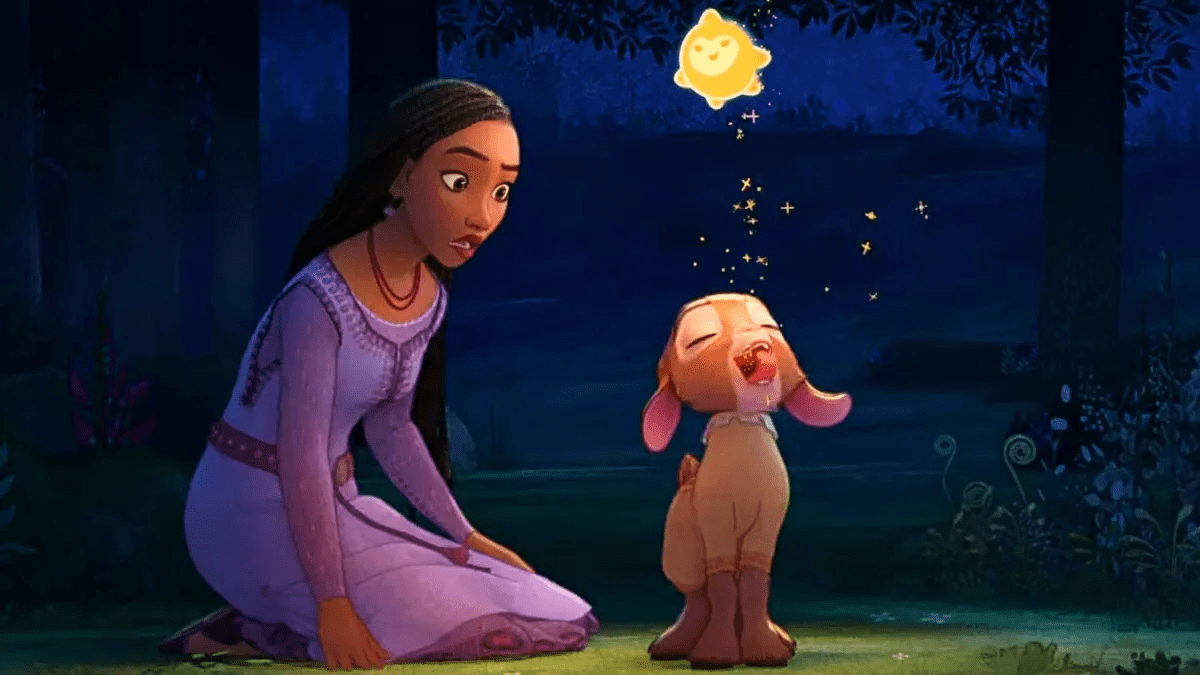
Upset at Magnifico’s dismissal of her wish, Asha wishes upon a star. Yes, just like the song. Her voice is so beautiful and moving that an actual star falls from the sky. He’s a tiny guy, but he’s just the right size to be made into officially licensed merchandise. (He reminded me of Lumalee, the blue star in The Super Mario Bros. Movie.) Star, as Asha cleverly refers to him, doesn’t grant wishes. Instead, he uses his magical powers to change things. For example, he makes it so that animals can speak English. When Star’s magic touches Asha’s goat Valentino (Alan Tudyk), he sounds like a grumpy old aristocrat. As far as Disney sidekicks go, Valentino is nothing special. The running joke of having an old man say childish things is funny initially but quickly becomes annoying.
The light from Star’s decescent makes Magnifico even more paranoid, so he reaches for his book of dark magic. What better way to deal with the unknown than by corrupting your soul with evil spells? Soon Magnifico insists that the citizens turn over Star. Unfortunately, one of Asha’s seven friends (yes, you read that right) tattles, and Magnifico captures Star. At this point, he doesn’t just want Star’s power, he wants the entire kingdom under his thumb. That leaves it up to Asha and her fellow theater kids to save everyone in a grand way that makes little sense, just like the movie itself.
I could forgive the questionable sensibilities that went into making Wish if it were entertaining, but it rarely is. I liked the aesthetic of the film, how it was designed to look exactly like a book of fairy tales. I also liked the color palette and its emphasis on pastel blues and purples. Unfortunately, everything about the movie underwhelms. The songs are mediocre at best. As the plucky Disney heroine, Asha has no journey or defining characteristics. Magnifico’s motivations are murky and his descent into megalomania is puzzling. The omnipresent callbacks to other Disney animated films don’t pay off because they’re rarely used as the basis for jokes. For example, if you’re going to have magic mushrooms ala Alice in Wonderland, they should say or do something funny. Ariana DeBose is fine as Asha, but she could sing the phone book and be entertaining. Chris Pine does what he can with Magnifico, but he’s facing the same insurmountable hurdle as every other voice actor in this film. All of the characters are one-dimensional and uninteresting. This movie should serve as exhibit A for Disney to not greenlight movies that are obviously underdeveloped, or at the very least stop cannibalizing their own legacy. Not Recommended.
Analysis
Nostalgia is a very powerful emotion. Recalling a special moment can bring us to tears or fill us with joy in an instant. Unfortunately, it’s not powerful enough to save Wish, a criminally underdeveloped and minimally entertaining animated film from Walt Disney Animation Studios. The story is thin and lacks imagination, a fact that the movie compensates for via the constant use of Easter eggs. Wish does have some creativity on display, it just doesn’t have enough to make the movie captivating.
The construction of Wish feels like it originated from a crass marketing exercise, where the creatives involved were challenged by executives on how many references to the classic Disney animated films they could cram into the plot. I counted seven, and there are probably more, all of which effectively turn Wish into an infomercial for those other movies. Perhaps Disney’s ulterior motive for Wish was to subconsciously compel members of the audience to sign up for a Disney+ subscription. Watching this movie definitely made me feel nostalgic for Snow White, Cinderella, Bambi, Peter Pan, The Jungle Book, Alice in Wonderland, Fantasia, etc. If that was Disney’s intent, I guess congratulations are in order if their subscription numbers increase as a result of this creatively bankrupt attempt at storytelling.
Magnifico problema
For a movie that I described above as thin, incomplete and undeveloped, Wish spends a fair amount of time explaining Magnifico’s backstory. According to the movie’s preamble, he suffered a traumatic experience when he was younger and studied sorcery so that he would be able to protect himself in the future. When he became a powerful sorcerer, he founded the kingdom of Rosas, so that he would be able to protect anyone who decided to live there from harm. While Magnifico’s intentions are definitely benevolent, they don’t mean much because we are never told who (or what) he’s trying to protect his citizens from.
If you eliminate Magnifico’s past from the story entirely, he aligns perfectly with the Queen in Snow White, another villain who is driven by vanity and insecurity. Unlike his precursor, his insecurity isn’t triggered when he’s compared to someone more handsome than he is, but to an unknown power. Again, without knowing who (or what) turned Magnifico into the person he came to be, his transformation into a power-hungry despot feels completely unearned.
I can understand why Magnifico would be unnerved with Star’s sudden appearance. Star’s light makes all of the citizens feel good, albeit in a nebulous way, something that Magnifico rarely does. He’s right to be irked that his people take him for granted, but he does little to remind them why he’s an awesome benevolent ruler. He rarely grants wishes, and at one point states that he granted fourteen in the past year–as if that were a lot. Even when he grants wishes, it’s usually for his apprentices, leading the general citizenry to believe that favoritism trumps need or humility.
When Magnifico is unable to identify the origin of the light from Star, he becomes so insecure that he turns to his forbidden book of dark spells. As someone who studied many years to become as powerful as he is, Magnifico is oddly incurious when something unusual happens. He could simply look around the forest or ask his people nicely if they’ve seen anything out of the ordinary. The Star’s light hasn’t threatened Magnifico or his rule at all. All it did was make his people feel happy for a few seconds, then vanish. If Magnifico had simply granted a few wishes, Star would quickly be forgotten. In other words, he could easily “out nice” his rival.
If Wish were a more nuanced movie, it could have used Magnifico’s choice of evil over good to comment on how some people in power are more comfortable being feared rather than loved. Unfortunately, the movie turns Magnifico into a standard villain because there had to be a reason for his people to rise up against him. If Magnifico had simply talked to Star about why it came to Rosas, he would have realized that he needed to grant more wishes to keep his people happy. Besides, granting Sabino’s wish would have had minimal impact, given that Sabino presumably wouldn’t have many years left to live anyway.
Magnifico’s reasons for why he’s denied Sabino’s wish all these years also make little sense. Magnifico believes that Sabino could use his singing and guitar playing to lead the people against him, but the only reason people have for rebelling is that their wishes aren’t being granted fast enough. Magnifico is the only one who can grant wishes, so threatening him wouldn’t compel him to grant more. If Magnifico is as powerful as he seems to be, he could simply leave Rosas and the people would never get their wishes granted. The same holds true for the person who wants to fly like Peter Pan. How can an all-powerful sorcerer feel threatened by one flying person? Or a person who wants to make beautiful dresses? Or a person who wants to be the best knight in the kingdom? These are things that Magnifico should never feel threatened by.
A fairytale ending
Of course, the conclusion of Wish left me with more nagging questions. If Magnifico becomes the spirit encased within the magic mirror, does that mean that his queen becomes the Evil Queen we meet in Snow White? If Asha becomes a fairy godmother, why does she wear the same outfit as before? Do Valentino and the rest of the animals continue talking after Star leaves? Do the citizens feel better having their wishes back, even though they no longer have any chance of them being granted? Did the bear eventually eat the deer?
The power of wishes
Another aspect of the movie that makes no sense is why everyone forgets their wish when they tell it to Magnifico. The movie implies that this lack of wish-awareness leaves them subservient to Magnifico, but they’re able to live their lives without remembering what their wish was. Even stranger is how better they feel when they get their wishes back. They seemed fine and happy before, so I didn’t understand how getting their wish back changed them. For a while I assumed that the source of Magnifico’s power was his citizen’s wishes, but he just lets them fly around in his castle indefinitely.
Where’s the funny?
I mentioned how Wish’s omnipresent callbacks are rarely used as the source of a laugh. Like Strange World, this movie has two or three funny moments overall. I did laugh when the deer asked the bear not to eat him. There are a couple of visually inspired shots that were funny, like when Star uses its magic to make a coop of chickens dance to music. Another is when a field of menacing bunnies subdues Simon (a.k.a.) Sleepy. Aside from that, the movie is content with stringing together earnest moments and callbacks.
We are stardust
How Asha and the citizens of Rosas defeated Magnifico in the end was particularly strange. Asha reasons that because wishes are made to stars, everyone is made of stardust and they have the power within themselves to break free of Magnifico’s black magic. The movie appears to be saying that we all have the power within ourselves to bring down those who prefer we remain meek and humble servants–through the power of song, no less. This is a noble sentiment, but the way the movie arrives at this message is incredibly contrived. Until that final confrontation, the only person the movie identified as having powers was Magnifico. At one point the movie implies that Asha’s father might have also been a sorcerer, and that she inherited similar powers, but the movie abandons that in favor of having the townspeople rise up.
The idea that the people always had the power within themselves to combat tyranny is a noble one, it just doesn’t work within the context of the story. Does every citizen under eighteen have “the power”? What about the people who had their wishes granted? There seems to be enough stardust around to make Magnifico weary, if the movie held true to its own underlying logic.
Stardust (revisited)
All of the talk of stardust at the end of Wish had me singing the lyrics from Crosby, Stills, Nash and Young’s “Woodstock (We Are Stardust)” in my head as the credits rolled:
We are stardust, we are golden
We are billion-year-old carbon
And we've got to get ourselves
Back to the garden
If only Disney would have had everyone singing that as the closing number. That would have been something.
 Detroit Cineaste
One thought on “Disney’s Wish”