
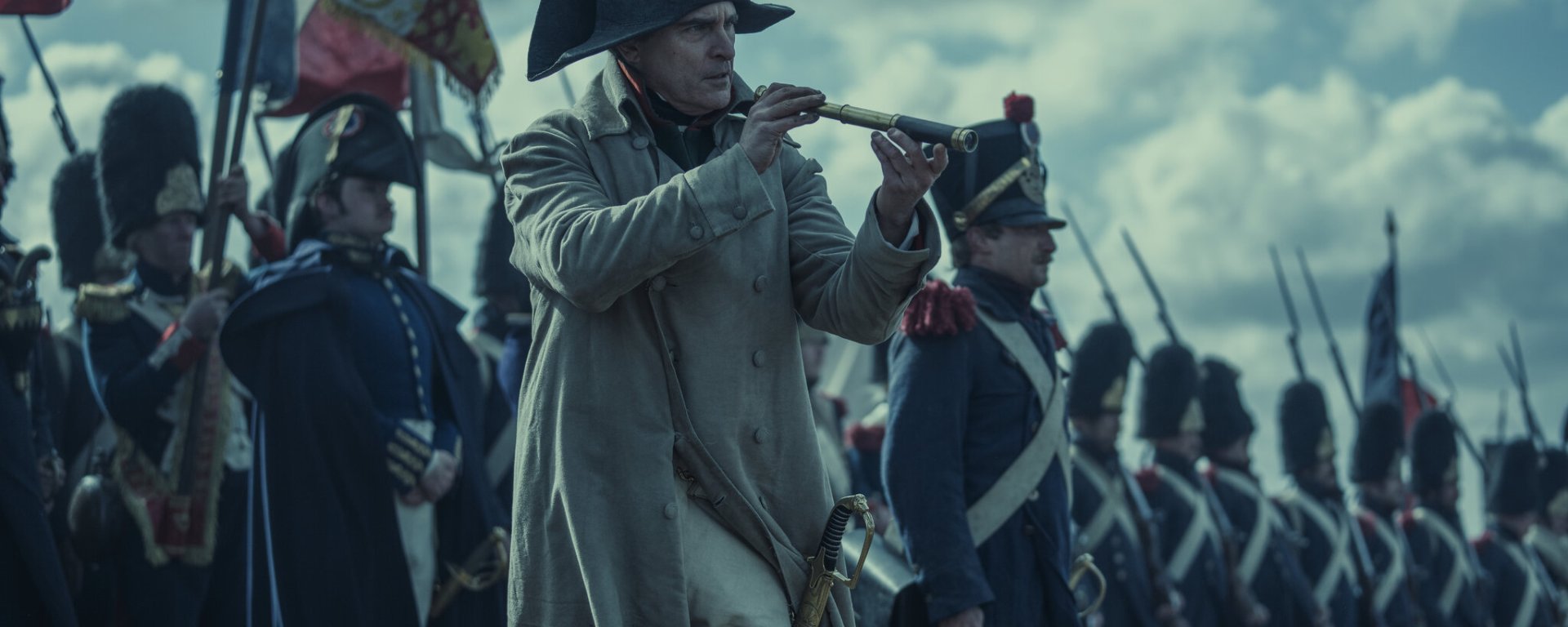
He came. He saw. He conquered–in spite of himself.
Napoleon may look like a classic historical epic from the Fifties, but director Ridley Scott–who has made several pictures in this category, is not interested in treating his subject with admiration or even respect. Instead, his movie mocks Napoleon from beginning to end, resulting in the cinematic equivalent of a rude gesture delivered for over two hours.
Scott leads off with Napoleon (Joaquin Phoenix) witnessing Marie Antoinette’s beheading. As far as beheading scenes go, this may be one of the best. This moment didn’t actually happen, though, but Scott runs with this crafty bit of poetic license because it symbolizes France’s dramatic change of leadership. Scott is mindful of history, but he also knows that movies work best when they take liberties and aren’t slavish to the facts. If you have quibbles with how Scott renders history in this movie, I’m pretty sure he’s got a rude gesture at the ready for you.
Napoleon, ever the opportunist, realized that with the royals out of power, he had an opportunity to improve his lot with the Revolutionaries. He wanted a promotion to general, English ships were blockading Toulon and the leaders of the Revolution wanted to regain control of the city and its port. He convinces Paul Barras (Tahar Rahim) to put him in charge of the assault, and his plan is incredibly successful. He also exhibits remarkable courage in leading the men, even after being knocked off his horse by cannon fire.
With Toulon recaptured from the Royalists and the British forces driven out, Napoleon is included in a ceremony marking the occasion. Even though he’s being promoted to general, he’s less interested in pomp and circumstance than extracting the shot that felled his horse. (He gives it to his brother with a curious directive, “For mother.”) I have no idea if this actually happened, but Scott wants the audience to be clear that his portrait of Napoleon is not what we were expecting.
At a party celebrating the victory, Napoleon meets the love of his life, Josephine (Vanessa Kirby). She notices him staring at her from across the room and confronts him about it, her words direct yet playful. Napoleon at first denies it but then bashfully confesses as such, and Josephine immediately knows he’s captivated by her. Later, when the two sit in a room alone, she cements their lustful bond by offering Napoleon a glance of her nether regions. As it turned out, this ploy worked so well that even when she cuckolded him while he was away on business (a.k.a. subduing Italy and Egypt), he couldn’t bring himself to get rid of her. Josephine is portrayed by Kirby in full-tilt maneater mode, so this makes perfect sense. When she demands that Napoleon state that “I’m nothing without you,” she would elicit the same response from any man within earshot.
At this moment in his life, Napoleon (the movie) suggests that Napoleon (the man) would have been content with being a general and married to Josephine. For the former, he’s able to strategize battles instead of leading troops, which is a good thing because he’s no longer in harm’s way. With the latter, his sexy wife is around whenever the mood strikes. Napoleon and Josephine don’t have much else in common, they understand each other’s desire for power over all else. (His domain is the battlefield, while her’s is the bedchamber.) Unfortunately, duty commands and Napoleon is asked to subdue a Royalist uprising, which he does with the help of cannons, then to lead a coup against the leaders of the Revolution. The takeaway from the latter is that there’s nothing funnier than pulling a French official away from his “succulent breakfast”.
Napoleon is made First Council and then, when the citizenry become restless with leadership by committee, the Emperor of France. He still leads the French troops to victory, but isn’t thrilled with being supreme ruler and all of its tiresome commitments. Josephine doesn’t produce an heir after sixteen years of marriage, so Napoleon must divorce the only woman he probably ever loved to make his followers happy. Napoleon also has no flair or patience for politics, and his efforts to woo the Tsar Alexander of Russia into an alliance ultimately fail. This embarrassing episode is the catalyst for his infamous march into Russia, then his exile, followed by his return and finally culminating with his resounding defeat at Waterloo.
While all of the events depicted in Napoleon are established historical fact, Ridley Scott could care less about dutifully presenting history and genuflecting to Napoleon. Instead, Scott skewers Napoleon to knock him down a peg (or two). The movie contains some of the funniest scenes and awkwardly comical dialog I’ve haven’t witnessed in a historical epic since Oliver Stone’s Alexander. One would probably come away feeling that Scott harbors a grudge against Napoleon, but I believe Scott wants to show how great men are only good at one thing, and how that thing defines them. A man like Napoleon was a courageous fighter and a great military tactician, but was awful in every other aspect of his life. By his own admission he was a Corsican brute, so it makes sense that he says things that he believes are profound but are actually ridiculous. Scott also commits heresy by stating in no uncertain terms that the great romance between Napoleon and Josephine was confined to their correspondence. As Scott would have it, Napoleon was the worst French lover ever. (Describing why would spoil the fun.) Even Napoleon’s signature battles are viewed harshly. Scott wants to remind us that every one of Napoleon’s victories (and defeats) came with a sizable human toll. Fittingly, Scott delivers his final rebuke of Napoleon when, after years spent in exile, he unceremoniously keels over and dies.
I would have been surprised by Ridley Scott’s rendition of Napoleon if I hadn’t seen his previous historical epic, The Last Duel. That movie took a very dim view of knights and chivalry and took it to a conclusion that was as logical as it was cruel. Scott’s Napoleon shares a similar attitude in that the movie ignores the legends and shows us a historical giant who was also a very imperfect man. In the title role, Joaquin Phoenix delivers another unconventional performance that audiences will appreciate if they are aligned with Scott’s general attitude towards the material. (They’ll hate it if they aren’t not on board.) As Josephine, Kirby commands the screen and her pairing with Phoenix is electric. The supporting cast is solid throughout, but Rupert Everett is brilliant as the snarling Duke of Wellington, the man who sends Napoleon to exile for good. As for the director himself, the movie would be a remarkable achievement for a man half Scott’s age. That he is still bringing stories this epic and audacious to the big screen in his eighties is remarkable. Recommended.
Analysis
There was a time when I thought I knew what to expect from a Ridley Scott historical epic. Gladiator and Kingdom of Heaven were straightforward narratives, for example. However, after The Last Duel and now Napoleon, I’m confident in my belief that Scott is no longer interested in meeting expectations, but gleefully subverting them.
Napoleon certainly looks and feels like a movie from the Fifties, with a sumptuous production design, exquisite costumes, breathtaking battle sequences and a large cast with noteworthy actors in the lead roles. However, that is where the similarities between this movie and something like Ben Hur, or even Scott’s Gladiator, come to an end. Scott isn’t interested in making a movie that glorifies Napoleon, his accomplishments or his relationship with Josephine. In place of a conservative or traditional approach, Scott depicts Napoleon and his legend in a surprisingly harsh light. According to Scott, Napoleon excelled at only one thing and became emperor because of it. Aside from that, he was terrible at everything else that life required of him.
That is how I interpret Joaquin Phoenix’s performance, which was not at all what I had expected. Scott, a director of twenty-eight feature films, asked Phoenix to portray Napoleon this way for very specific reasons. Napoleon was a man of low birth–a Corsican, so he asked Phoenix to talk and act accordingly. Napoleon wasn’t a nobleman, so he would not have been educated or well spoken. This explains why he says ridiculous things like “Destiny brought me to this lamb chop,” and “You think you are so great because you have boats!” Napoleon is a man of action, not words. He calls himself a brute and others describe him as vermin. Unfortunately, he never has the perfect retort at his fingertips. Instead, he says things he believes are profound but come off as silly because that’s the best he could in the heat of the moment. He’s not as polished and refined as his English, Russian, Austrian counterparts. He’s a man of the streets, a gangster.
Before seeing this movie, I had a general sense of Napoleon as a historical figure. LIke most people, I assumed that a man who led 61 battles and was triumphant in most of them must have been a refined and dignified man. However, my assumption was based on how Hollywood has typically depicted historical figures like Napoleon. A man who was a brilliant military strategist and later Emperor of France must have been refined and dignified. Scott and writer David Scarpa, however, give us a man who is basically a buffoon in all aspects of his life except leading men on the battlefield, which happens to be the only thing he takes seriously.
With this in mind, Napoleon’s behavior throughout the movie, which vacillates between inscrutable and cartoonish, is probably appropriate. He looks upon Marie Antoinette’s beheading with passivity because he doesn’t care about royalty or the revolution. He dozes off while Paul Barras explains the political landscape to him because politics bores him. He initially shrugs off becoming king because he doesn’t want to deal with the responsibilities the position will require of him. The only thing that he is excited about is war. Everything else puts him to sleep, literally.
Civilized life also makes Napoleon incredibly uncomfortable, because he doesn’t know how to act civilized. When Napoleon does become emperor of France, he quickly abandons the ceremony because he can’t wait to get out of the throne room and shed the costume. When Napoleon meets Tsar Alexander to agree to a treaty, he’s clearly out of his element but he’s the only one who can be there because he’s the king. He does his best at politely encouraging an alliance against England, but Napoleon has no social graces and his words are stilted and unconvincing. It’s no wonder that Alexander spurred him and sided with England. The King of England is a fellow nobleman and speaks the same language. The only words Napoleon can say with confidence are battlefield commands.
Scott also looks upon the great romance between Napoleon and Josephine with cynicism. The legend of their undying love has been fueled for centuries by the letters the two exchanged. According to Napoleon, the feelings they expressed were quite different when they were together. Scott acknowledges that Napoleon was spellbound by Josephine, even with her shorn locks. However, he implies that the relationship wasn’t equal and was decisively tilted in her favor. The one time Napoleon tries to shift the power of their relationship to himself, she steals it back without raising her voice. Scott shows how Napoleon was lousy in bed, something Josephine tolerated perhaps because she did love him, but also because she’s as much of an opportunist as he is.
Napoleon also asserts that Napoleon may have been the worst lover in history. He expresses his feelings for Josephine by acting like a horse in heat or a rutting pig. The movie’s two sex scenes are comical, with Josephine waiting patiently for him to finish, which thankfully isn’t long. These scenes ruthlessly destroy any romantic notions people may have had about the nature of Napoleon and Josephine’s lovemaking. The women Napoleon had sex with before Josephine were probably all whores, with those encounters intended to quickly satisfy urges and not learn the art of romance.
After subverting our expectations in regards to the physical aspects of Napoleon’s relationship with Josephine, the only part that remains to be dealt with is his battlefield prowess. On that front, Scott plays things honestly, probably because Napoleon’s victories are well established historical facts and his military acumen was unparalleled. Instead, Scott shows us the immense cost these battles had in human lives. In the Battle of Austerlitz, Scott lingers on the images of Russian and Austrian soldiers falling through the shattered ice, their blood spilling into the icy waters as they sink to their deaths. Napoleon was victorious, but Scott insists we acknowledge the men killed to achieve that victory.
Scott pointedly balances two of Napoleon’s victories with two resounding defeats: Napoleon’s invasion of Russia and Waterloo. In both cases, his hubris was the reason for those failures. Napoleon thought so little of his enemies and so much of his own greatness that he never considered that he could be outmaneuvered by inferior opponents like the Russians or the English. In the former, Russia abandoned Moscow and burned the city so that Napoleon’s troops would starve on their way home. In the latter, Napoleon wrongly assumed that the English were only successful warriors at sea. He never considered that his enemies would learn from his tactics and find ways to beat him. Napoleon’s infallibility was his ultimate undoing, and his men paid the price for his assumption that his opponents were inherently inferior to his own brilliance. To bring his point home, Scott includes a title card at the end that is a sobering indictment of how Napoleon achieved his greatness. A simple ledger notes how many of his men died as his most significant battles, with a staggering tally of three million. All of that for a man who was driven into exile twice.
Scott’s final scenes of Napoleon make abundantly clear what he thinks about him. After losing a battle where tens of thousands of men died for nothing more than ego gratification, Napoleon enjoys a delicious lunch aboard a ship. He holds court with a group of midshipmen, telling them to never blame themselves for the failures of the men beneath them, and that he’s never made a mistake. Then, when he’s on the island of Saint Helena, he argues with children who know that the Russians burned down his own city. After telling them to go play, he falls out of his chair and out of view. Scott never includes a final shot of Napoleon’s body lying on the ground because he’s relieved Napoleon is finally dead. In the end, Scott treats Napoleon’s death the same way Napoleon thought about all the men who died under his command, with supreme indifference.
Another way to appreciate Scott’s Napoleon is to view it as a companion piece to Stanley Kubrick’s Barry Lyndon. Kubrick spent years developing Napoleon as his next project only to abandon his plans due to the high costs of location shooting and the commercial failure of Waterloo. Kubrick instead made Barry Lyndon, which focused on an Irish soldier who transforms himself into a gentleman with a title, property and a beautiful wife. Regardless of whether or not Napoleon was influenced by Kubrick’s script, the arcs of the central characters are incredibly similar.
Like Scott’s Napoleon, Barry Lyndon is a brute who is nonetheless smart enough to leverage his sole advantage in life–his handsomeness–to better himself. Both men eventually achieve a station in life that only they thought possible, only to meet their inevitable comeuppance in the end. They both tempt fate one last time, only to underestimate their enemies’ resolve and suffer humiliating defeats. In this respect, Scott and Kubrick are in complete agreement: karma is a bitch.
Lastly, I mentioned above how Napoleon reminded me of Alexander. Napoleon, through a voiceover by Phoenix, compares himself with his hero in a letter to Josephine. In terms of the movies themselves, Alexander was also a spare no expense historical epic with an equally unconventional performance at its center. I remember reviews at the time proclaiming how Colin Farrell was miscast in the title role. I agreed with the consensus opinion back then, but seeing Napoleon has forced me to rethink my position. I might have dismissed what Oliver Stone was trying to achieve with Farrell’s performance because it wasn’t what I was expecting. With that in mind, I look at these three films: Barry Lyndon, Alexander and Napoleon, as kindred spirits even though they were made decades apart. Great minds do think alike, after all.
 Detroit Cineaste