
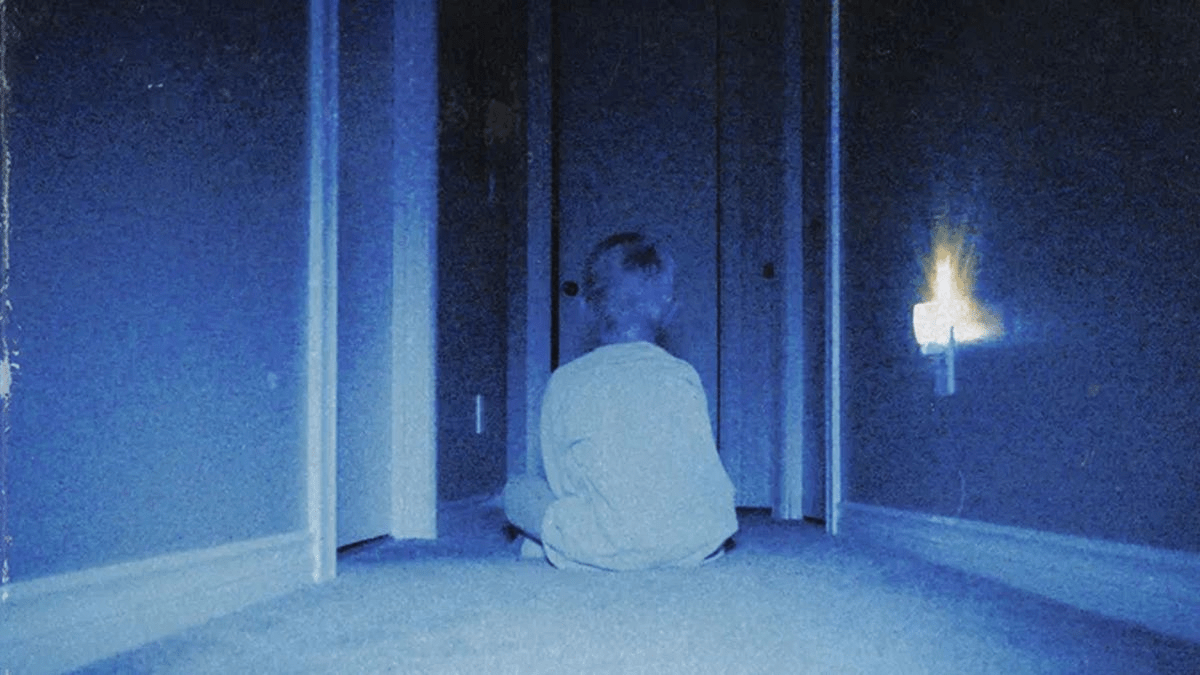
Skinamarink does something that I found uncanny. It reminded me of what it was like to wander around the house late at night as a child while my parents were asleep or otherwise preoccupied. There’s the sound of bare feet on carpet, lights being flicked on, the muted rush of water from the toilet. It also captures all the different sources of light that keep the fuzzy darkness at bay, from the blare of ceiling lights, a solitary night light shining in a hallway and shimmering television screens. Within this nocturnal landscape, pajama-clad children play with toys in their rooms, in hallways or wherever the mood strikes. The movie captures all of these moments brilliantly.
The movie also severely limits how we observe the participants in the story. The faces of Kevin and Kaylee, the two small children at the heart of the story, are barely seen. (One of their faces is shown at the end, along with another face.) We mostly hear them moving about, playing with their toys, breathing deeply while they are asleep and so on. When they do speak, their words come out in whispers. (The movie provides subtitles when their voices are little more than squeaks.) When Kevin and Kaylee do appear on screen they’re shown from the neck down. Whenever the children are only heard, the movie forces us to look at lamps, chairs, toys, a telephone, television screens, blankets, cereal bowls, etc. A television screen is shown so often that I considered it to be a character in the movie. (The cartoons it plays are so familiar to me now that I’d recognize them instantly.)
This “movie as a collage” technique confused me until I realized what writer-director Kyle Edward Ball was after (or what I think he’s after). Because he refuses to show the children’s faces, Ball prevented me from identifying with them as characters. Instead, he insisted that I experience this world as one of the children. It’s a bold and risky tactic, one that will probably infuriate most viewers. Watching a movie where things are heard but rarely seen is not a normal movie experience, even for horror movies. I could be ruining things by including my explanation here, but I feel that potential viewers might appreciate this movie if they understood what they were in for.
Skinamarink begins innocently and simply. The opening credits state that the year is 1995. Kevin and Kaylee are playing with a toy tape recorder in a hallway at night. The children push buttons on the device trying to get it to work. “Dad?” one child asks and enters a room where the father is watching an old movie. He gets the player to work, and the children listen to something while playing with Legos. Dad apparently puts the kids to bed, leaving every room dark except for the room with the television. Then the television is shut off and dad turns in.
With the house dark and completely silent, Kevin gets out of bed. He goes into the hallway and sits on the rug. Kevin doesn’t turn on a light. He grabs a blanket from a closet and whispers to someone, “Are you hiding?”. He then says “One, Two Three.” There are thudding noises, followed by crying. Dad gets out of bed and turns on the light. We hear the door close and the sound of a car driving away. The camera pans around the dark and quiet house, and the television turns itself on. Cartoon noises are heard briefly, and the television shuts off when Dad and Kevin return. Apparently, Dad rushed off with Kevin and left Kaylee sleeping. Hmm.
Dad calls someone and states that Kevin fell down the stairs, that they didn’t even need to do stitches and that Kaylee says that Kevin was sleepwalking. (The voice on the other end of the line is never heard.) When the house is dark and quiet again, Kaylee gets up, uses the potty and wakes up her brother. Dad has disappeared. Windows blink and disappear. The phone no longer works. Unsure of how to handle the situation, the kids play a video cassette and sleep downstairs. When the early morning comes, Dad is still nowhere to be found. The kids eat cereal and busy themselves with coloring. Some of the lights stop working, but not all. Fortunately, the television still works, providing a constant stream of classic cartoons.
The environment around Kevin and Kaylee begins to change dramatically. A chair appears on the ceiling. The toilet disappears. They wonder aloud why no one’s come yet. “Where do you think dad is?” “Maybe he went with mom.” “I don’t want to talk about mom.” They find toys stuck to the wall, which drop to the floor suddenly. (The movie’s jump scares are definitely of the lo-fi variety.) Later, a voice commands Kayle upstairs, where she sees dad and mom sitting on the bed at opposite sides. The conversation Kaylee has with her parents is tense, implying some sort of shared traumatic event that all three experienced. (The movie is steadfastly vague and refuses to explain what happened.)
Before long the house is in total darkness, with the only sources of light being the television and a flashlight. Then a voice is heard emanating from the toy tape player. The voice directs Kevin to go to the basement, where he finds Kaylee eerily transformed. With the house nearly consumed in darkness, the television begins to have a mind of its own and the voice becomes more threatening. With Kaylee gone, Kevin is left to confront the voice on his own.
Skinamarink is a slow-moving experimental horror movie with minimal plot. It strives for a specific mood and explores it patiently and thoroughly. The movie also intentionally withholds a lot of information so that its narrative is open to interpretation. While watching scene after scene of its dreamlike landscape, I surmised that the movie was a meditation on childhood anxiety. To drive that point home, items are periodically removed from the home (doors, toilet, electricity, parents, toys). I have my assumptions as to what is happening in Skinamarink, but given how the movie is designed to be open to interpretation, I won’t state them here.
Writer-director Kyle Edward Ball’s film is an intriguing exercise in how to build dread (and horror) while refusing to provide any concrete answers throughout. The ambiguous camerawork prefers to depict aspects of the house but rarely focuses on what is actually happening. Thankfully, the spartan sound design does provide clues–and the occasional shock. If I didn’t know better, I’d say that the movie was designed to be played in a loop in a modern art museum (or in the background of Halloween parties). The concept wears thin after an hour, though, rendering the movie’s descent into surrealistic abstraction less impactful than it could have been. At an hour and forty minutes, the movie definitely tested my patience. It is a contemplative experience that will either leave you rapt or bore you within minutes. Those who appreciate avant garde movies will certainly like Skinamarink. Moderately recommended.
Analysis
After my initial viewing of Skinamarink, I was convinced that the movie was a meditation on the aftereffects of divorce on the children. Several scenes led me to this conclusion. First is when Kevin and Kaylee discuss mom crying. Then there’s the scene where Kaylee goes upstairs and interacts with the ghostlike versions of her parents. Mom and Dad sit on opposite sides of the bed looking away from each other. Dad tells Kaylee to look under the bed. She looks twice, admits to not being able to see anything, and he disappears. Mom then says the following to Kaylee:
Your father…
We love you and Kevin very much.
Kaylee, I need you to close your eyes. Please.
Mom disappears with a loud noise and a jarring flash of light.
Those scenes, when viewed together with the scenes that preceded Kevin’s fall, imply that Mom and Dad are divorced, that Dad is raising Kevin and Kaylee by himself and that Mom is no longer in the picture. As time passes, both children feel increasingly sad over her absence. Without her presence, the children feel isolated and alone with Dad as their sole caregiver.
After viewing the movie a second time, however, I came away with some other possible interpretations of the movie.
Suicide
Mom’s starting exit could imply that she committed suicide. Perhaps the children heard her take her own life and found her later. The scene I described above, coupled with the shot of blood dripping from the cabinets, could imply a self-inflicted gunshot wound.
Abduction
The fact that Dad is gone for long stretches could signify that he has abducted the children and is keeping them hidden within their new home. The sudden disappearance of the windows and doors symbolize how abductors sometimes force their children to live in complete isolation. Dad could be restricting Kevin and Kaylee to the inside of the house so that the neighbors won’t see them and ask questions like where their mother is, why they aren’t in school, etc.
Spousal Abuse
The shot of blood dripping from the cabinets could have been the outcome of an incident of physical abuse by Mom or Dad. The fact that Kevin doesn’t actually stab himself in the eye means that the blood could be from one of his parents. The recurring image of what looks like blood on the floor that appears late in the film suggests Kevin witnessed something violent.
Broken Family
Regardless of what caused the family to break apart, the events in the movie symbolize how that event has affected the children. The sudden disappearance of things around the house could represent the loss of safety and security Kevin and Kaylee feel over their current situation. Kevin’s fall was a triggering event that unlocked a lot of suppressed feelings both in him and his sister over the breakup of their family unit. Later, when Kevin finds himself walking on the ceiling, this could be a metaphor for his world being turned upside down.
Depression
Kevin could have had lingering feelings of depression over his parents separation before he fell down the stairs. When that traumatic event fails to bring his mother back, he feels abandoned. Kevin realizes that his mother won’t be there to soothe him and comfort him ever again. The movie externalizes his growing depression with the steady removal of objects in his home. Things that once brought him comfort are abruptly removed. Kevin’s shrinking world is echoed by the cartoon rabbit that shrinks itself into non-existence. The image of the upside down pyramid of toys subtitled “572 days” that recedes into the distance symbolizes how time passes for a person suffering from depression. The shot of the house from a distance symbolizes how depression isolates you from those around you.
Schizophrenia
While the symptoms of schizophrenia usually don’t manifest until a person is a teenager or older, the nightmare world of Skinamarink could be the result of Kevin having a psychotic break from reality.
The appearance of another face at the end of the movie could indicate that Kevin created another personality to help him cope with his situation. This new personality isn’t content with meekly accepting things as they are, though. Instead, this personality wants Kevin to take harmful action in an effort to draw attention to himself.
Concussion
Another possibility is that Kevin is suffering from the lingering effects of a concussion. Almost every strange incident happens after he returns home. Without proper medical care, Kevin is hallucinating what is shown. (Kaylee could have turned the television on when Kevin and their dad are out of the house.) This explanation, as uninspired as it is, is not as bad as the following one.
A Demon is to blame
This simplistic explanation for what happens in the movie, which I found on YouTube, is probably the least imaginative one there is. It effectively makes the movie exponentially less interesting when applied.
Movie as Rorschach Test
I believe that writer-director Kyle Edward Ball intended Skinamarink to be both evocative and vague. In place of a more traditional narrative, Ball has crafted a work of art that asks the viewer to provide meaning to the images that comprise the narrative. As such, the movie isn’t a puzzle to be solved but a psychological test. The viewer is required to use their own emotions and memories to make sense out of what is happening. This transforms the movie from a passive to an interactive experience that can be frustrating unless the viewer adjusts their perspective accordingly. With this in mind, any (or all) of the above interpretations could apply to the movie. Skinamarink reminded me of Lynch’s more abstract films, particularly Eraserhead and Inland Empire. Fans of Twin Peaks probably assumed that Skinamarink takes place entirely in the Black Lodge.
I stated above that the movie proceeds incredibly slowly for its hour and forty minute run time. If you lack patience to watch until the end, I would suggest watching the movie at 1.5x speed. That reduces your commitment to a more manageable fifty minutes, and the movie works exactly the same.
 Detroit Cineaste