
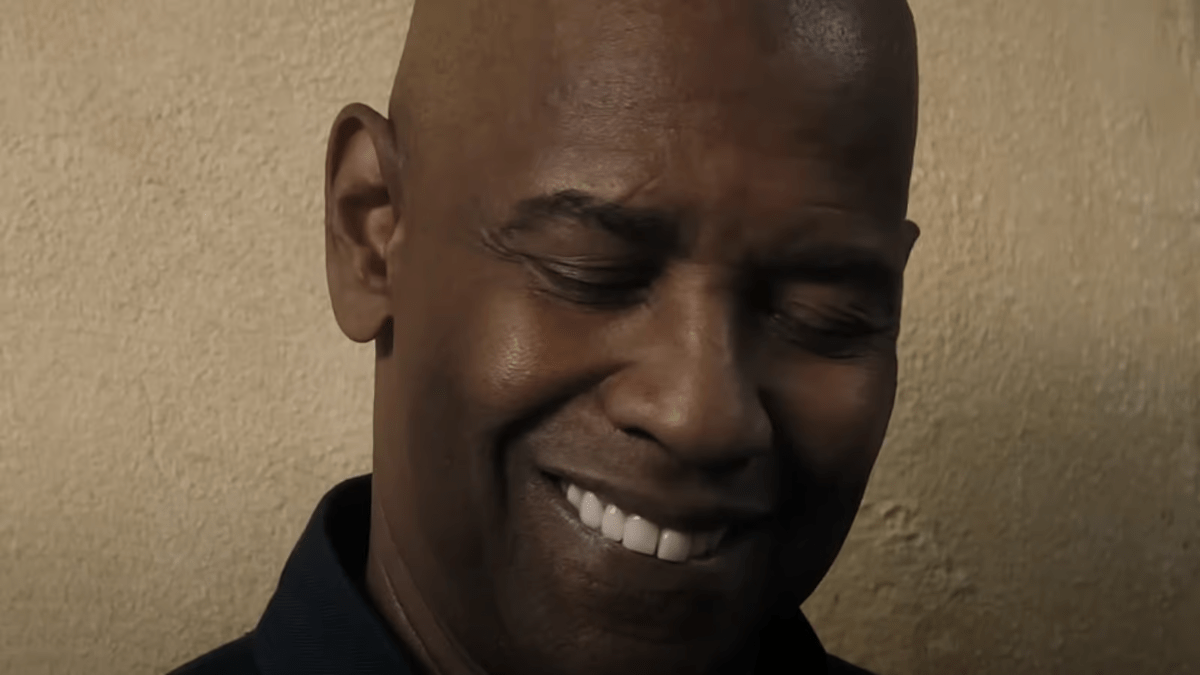
Among Denzel Washington’s many talents as an actor is his ability to play a character with no redeeming qualities and still be likable. In movies like Training Day (corrupt detective), Flight (drug-abusing pilot) and American Gangster (gangster), his characters reveal themselves as bad news from the moment they first appear, and yet we still can’t help being drawn to them. Washington, with his indelible screen presence and charisma, makes it easy for us to root for him no matter how good or bad his characters are. He could play the Devil and we’d still love him, even while he’s condemning a doomed soul to burn forever in Hell. Washington would flash that sly grin of his and we’d be happy for him even though we can hear the victim’s cries for help in the background. Gotta give the Devil his due.
The Equalizer 3 is a perfect example of Washington playing a character who we really shouldn’t like, but we do anyway because he’s played by Washington. In this movie (and the previous two entries in the series) Washington plays Robert McCall, a man who meets good people who have been wronged and takes it upon himself to make things right. He’s known as “the equalizer” because he helps people who have been taken advantage of, returning what has been taken from them. McCall is basically an avenging angel, albeit one with an extraordinary combination of skills. He can track people through the dark web and take out an army of bad guys without breaking a sweat. I suspect he’s a former CIA operative, but I don’t know that for sure because I haven’t seen either of the previous movies. If you’re familiar with the Eighties TV show upon which this series was based, that’s all you really need to know. (I’m guessing the Queen Latifa version is similar.) The main difference is that these movies are much more violent than the TV show starring Edward Woodward. His version of McCall was someone you didn’t want to cross paths with either, but he never killed a man and then shot another man through the first man’s eye socket, like Washington does in this movie.
Before the movie begins, he’s already laid waste to at least ten gangsters at a winery in Sicily before the boss arrives. After walking past McCall’s bloody handiwork, he finds him held at gunpoint by a couple of his men. McCall calmly tells the boss that he and everyone else has nine seconds to live and sets a timer on his watch. When his watch beeps, McCall springs into action like a wind-up toy and quickly and ruthlessly kills all of the flunkies. (There’s the aforementioned gruesome skull shot I mentioned above.). McCall shoots the boss but not fatally, letting him agonizingly crawl on the floor and beg for his life before dispatching him for good. McCall is so brutally efficient and nonplussed about his work I wondered if he was a serial killer. (The reason behind all of this bloodshed is explained in the end, and fits the ethos of the character.)
Unfortunately for McCall, the boss’s son was waiting in the truck outside throughout the carnage. In a moment of pity McCall decides not to shoot the kid, who returns the favor by shooting him in the back. McCall drives off and is soon found passed out in his car by Bonucci (Eugenio Mastrandrea), a local police officer. Bonucci takes him to Enzo (Remo Girone), a kindly old doctor who patches him up. Eventually McCall wakes up and tries to leave. Enzo tells him he must rest and that he doesn’t care why McCall had a bullet in his back. He asks McCall, “Are you a good man or a bad man?” and McCall replies, “I don’t know.” Enzo tells him later that only a good man would answer that way. Fortunately the old man guessed right.
After several days, McCall begins walking around the beautiful seaside town he finds himself in. The town’s slow rhythms and familiar faces stir something in him. Could it be happiness? He finds a nice little cafe and orders tea, performing a little ritual with the napkin and spoon while he waits. To his surprise, a comely waitress returns with coffee and tells him that “tea is for old ladies”. McCall smiles that bashful Denzel Washington smile that affirms McCall is a really good guy who coincidentally does incredibly bloody things. He calls a CIA tip line and tells Emma Collins (Dakota Fanning) that the winery from the opening scene is a front for drug smuggling. If you’re guessing that Emma and her CIA friends will come to Italy to check it out, you’d be right.
McCall’s impromptu vacation is interrupted by mafia henchmen led by Marco (Andrea Dodero), who torment a grocer for not paying up. Marco is a brutal thug with the subtlety of a hammer, and Bonucci inquires into a license plate. Unfortunately for Bonucci, his boss is on the take and reports back to Marco’s even worse brother Vincent. How much worse is Vincent than Marco? He kills an elderly tenant in a way that reminded me of how the Nazi’s killed an elderly wheelchair-bound man in The Piano. Unlike movies that either romanticize or idolize gangsters, the mafia in The Equalizer 3 are overwhelmingly detestable, in addition to killing innocent civilians, they are also in league with Syrian terrorists. That McCall takes on these thugs isn’t merely justice, it’s a public service.
After Marco roughs up Bonucci and his family, it’s just a matter of when McCall will get involved. When Marco intimidates Bonucci at a restaurant where McCall is also dining, McCall glowers at him. Marco mistakenly believes he can intimidate McCall, only to discover that McCall knows a lot about pressure points. McCall transitions from cold-blooded avenger to hot-blooded defender and promptly gives Marco and his men a fatal talking to. Vincent vents his frustration at Bonucci’s boss, then sends Emma to the hospital. When he arrives in town seeking revenge on McCall, the townspeople come to his defense. Washington has several good line readings in this movie, and the one where he tells Vincent how he knows pain and death but not hope is particularly moving because he imbues it with raw pathos befitting one of his Oscar-calibur performances. There’s a final confrontation between McCall and Vincent, and even though you know how things will end, I won’t spoil it here.
The character Denzel Washington plays in The Equalizer 3 is straight out of a classic Western, where a stranger comes to town and winds up defending it against bad guys. Eastwood recently played a version of this character in Unforgiven as Will Munny. As with Washington’s McCall, Munny was also good at killing and was only a bit remorseful about doing it. Eventually he just got tired of it and wanted a different life. But then evil came calling and there’s only one way to stop evil in these movies. The Equalizer 3 isn’t nearly as good as Unforgiven, but it shows how effective this storytelling trope can be when it’s in the right hands. While director Antoine Fuqua has always made decent action movies, it certainly helps having Washington, one of the best actors of his generation, on hand. A movie without him would still be solid entertainment, but with him it achieves flight velocity. Washington is so good at his craft, he makes all of McCall’s glances, smirks, gestures and everything else worth paying attention to. Nothing Washington does is throw-away. Even when he is getting his strength back by walking around town, there’s nuance in every slow, cautious step and weary glance. What Washington does in this movie is the equivalent of a great jazz musician being called to the stage of a night club and wowing everyone in the audience. Washington is great in whatever role he plays, even in so-so material like this. Given that this is Washington’s swansong in the role, all I can offer to whomever takes his place is good luck. These are some awfully big shoes to fill. Recommended.
 Detroit Cineaste