
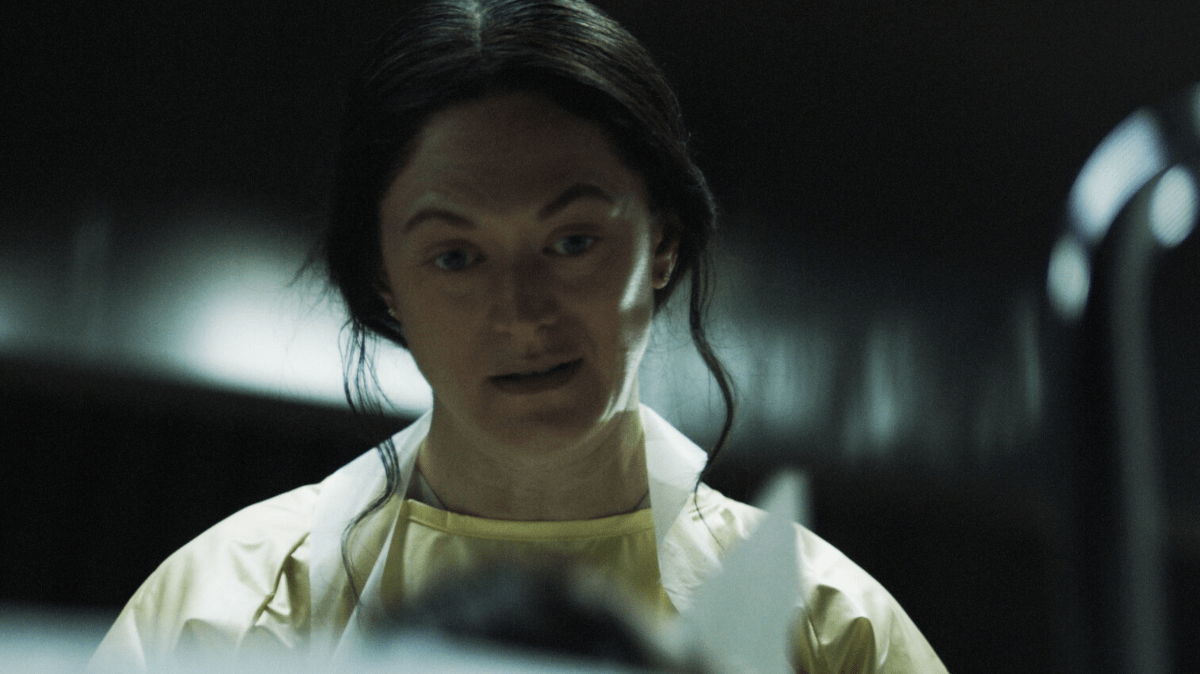
If there is a worse nightmare for a mother than her child dying, I can’t envision it. She carries the baby with her for around nine months and physically brings it into the world. Then she nurtures and cares for her child every day, never believing for a second that the unimaginable would ever happen to her. And then it does, and her life suddenly becomes a tragedy she cannot escape from.
This scenario is only the beginning of Birth/Rebirth, a chilling debut from director Laura Moss. Celie (Judy Reyes) is a single parent who splits her days working long hours as a nurse and raising Lila (A.J. Lister), her beautiful and precious daughter. One fateful morning, Celie hits the snooze button and oversleeps by several hours. Running very late, she forces an unwell Lila out of bed. Celie apologetically hands Lila over to her neighbor and rushes to work. As usual, Celie’s day is busy and she ignores calls and texts from her neighbor. When she accidentally breaks her phone, Celie is visibly relieved. Finally, she can focus on the day’s work without interruptions. I can’t speak for every parent, but I would think most have had this fantasy once or twice.
When Celie returns to her neighbors apartment, the door is open and nobody is around. A panicked note on the table directs her to the hospital, but she’s too late. Lila has already died from bacterial meningitis. Celie coldly dismisses her neighbor’s entreaties but later processes her loss talking with a colleague. Later, when Celie tries to see her daughter’s body the pathologist, Dr. Casper (Marin Ireland), says that Lila has already been sent to the medical examiner’s office. On her way there, Celie see’s Casper loading a large bag into the back of her car. When she is told that Lila’s body isn’t at the medical examiner’s office, either, Celie knows that something isn’t right. (Call it a mother’s intuition.)
Understandably angry, Celie returns to the pathologist’s office and demands to speak with Dr. Casper. Dr. Casper has suddenly vanished. Celie, however, has followed Casper to her apartment. After some tense words are exchanged, Casper insists on addressing a troubling beeping noise emanating from within her apartment. Celie forces her way in and finds her daughter lying in a hospital bed, alive. At first Celie is stunned, but then joyful because her daughter is no longer dead. The question is how Casper has performed this miracle.
As you probably guessed, Dr. Casper is no ordinary pathologist. She’s a spiritual relative of Dr. Frankenstein who is also obsessed with bringing the dead back to life. Like Frankenstein, she’s gone to extraordinary measures to create a serum that brings a dead animal back to life. (How she does this is just one of several horrors the movie playfully thrusts into our faces.) Celie is naturally troubled by the process that led to her daughter’s rebirth, but those are minor concerns given the outcome. The most important thing to Celie is that she is no longer the mother of a dead child. Unfortunately, as it so often happens when scientists play God, the plan goes awry and Celie is forced to consider actions even more horrific to keep her daughter alive.
With Birth/Rebirth, first-time director Laura Moss has given new life to the legend of Dr Frankenstein and his monster. Not content with simply rehashing the familiar themes of a scientist with a God complex and a misunderstood monster, Moss shifts our focus to how they apply to both modern science and motherhood. First there is the ethical boundary of how far science can go to either save life or alleviate human suffering. Second is the notion of how a woman’s material instinct can be corrupted when given a second chance (and even a third). The movie deviously has the audience weigh what course of action is more horrific: how Casper abuses her own body in the name of science, that she’s brought a child back to life or the extreme lengths Celie and Casper will go to keep Lila alive. To her credit, Moss treats the subject matter seriously throughout, to the point where several scenes may be triggering for some. (The movie’s gore is limited but convincing and may force you to avert your eyes.) Like 2020’s excellent The Invisible Man, Birth/Rebirth makes an old monster relevant by viewing it from a woman’s perspective. Recommended.
Analysis
Birth/Rebirth (or B/R) is a singular achievement in many ways. It successfully transplants a classic Universal monster into a modern setting in a way that both honors the legend and gives it a compelling feminist twist. The movie reminded me of how Leigh Whannell’s The Invisible Man (2020) breathed new life into an old monster by telling the story not from the monster’s perspective, but from that of the woman he torments. The closest example to what b/r does is Ex Machina (2014), but that movie is more concerned with misogyny than feminism.
Like Frankenstein, B/R includes a mad scientist who is able to bring the dead back to life. However, the impetus of the story is not reckless experimentation in pursuit of scientific glory, but motherhood. In the beginning, Celie experiences the most horrific thing that a mother can ever experience, the death of her child. Her horror is amplified by the guilt she feels from ignoring her caregiver’s calls and ignoring her after her phone dies. Even though her daughter’s death was not Celie’s fault, she can’t help but blame herself for not being there in her daughter’s hour of need. Like most parents who have lost a child, Celie believes-rightly or wrongly-that she was a failure as a mother because she could not protect her daughter from harm.
Fortunately for Celie, Dr. Rose Casper is a mad scientist and has used her serum to bring Lila back to life. Celie is obviously overjoyed by this macabre turn of events because her daughter, whom she loved fiercely, is no longer dead. Deep down, however, Celie is also relieved to no longer have the stain of being a failed mother. Casper’s miracle has given her a do-over, something any mother in Celie’s position would be grateful to get without question.
Casper is clearly the Dr. Frankenstein of the story. She’s a like-minded scientist who is obsessed with bringing the dead back to life. Casper has devoted her life to the endeavor, beginning her experimentation on animals when she was six years-old. The main difference between Frankenstein and Casper is their gender, a change that forces us to confront our stereotypical notions of what is acceptable behavior for a scientist. Casper is logical, practical and driven, with a cold and detached demeanor that makes her colleagues ill at ease. (She’s so unfriendly and unapproachable that her lab partner calls out when she smiles. He’d never seen her do it before.) If Casper were a man, everyone around her wouldn’t think twice about her behavior. Being a woman, however, she’s seen as an odd and strange person because she isn’t warm and empathic like women are expected to be.
Another way B/R utilizes a gender-swapped mad scientist character to horrific effect is by making the nature of Casper’s experimentation even more grotesque than Frankenstein’s. Whereas he presumably created his solution from chemicals and natural compounds, Casper uses her own womb to produce the ingredients she requires. Dr. Frankenstein’s ghoulish perversion of the dead looks quaint in comparison to Casper impregnating herself and aborting her pregnancies. Furthermore, the transformation of the mad scientist into a woman enables the movie to draw parallels between Casper’s gruesome tactics and several hot button issues. First is with the ongoing debate over stem cell research. Some regard the use of fetal tissue in scientific experiments as immoral and unethical, a line never to be crossed regardless of whether it saves lives or ends suffering. Second is on abortion rights, where a woman’s right to choose is being restricted and/or eliminated throughout the country. B/R addresses both of these concerns by turning Casper into a biohacker, effectively arguing on the side of her body, her choice, her experiments.
Having Celie play the role of Igor is the movie’s next diabolical twist on the Frankenstein legend. Initially, Celie is a grieving mother who is thrilled to have her daughter back. However, when Casper is no longer able to get pregnant, she becomes a willing accomplice. First she steals tissue from the hospital, but that source fails to produce the serum. Celie then performs a bone marrow extraction on Casper, which produces a weaker serum that barely keeps Lila alive. Next, Celie agrees to prolong unnecessary amniocentesis tests on a patient in order to have access to the amniotic fluids. Unfortunately, when the patient grows weary of the procedures and switches hospitals, Lila dies due to a lack of life-preserving serum. Unable to accept the final end of things for her daughter, Celie places her daughter’s body in a cooler and induces labor on her patient in order to get the placenta. For Celie, nothing matters but her daughter’s life, not even Casper’s earlier recommendation that she let her daughter go. In her quest to bring the dead back to life, Casper managed to not only create one monster but two.
This brings me to the remaining leg of the Frankenstein triangle: the monster. From the beginning, Frankenstein’s monster garnered sympathy because of the cruel anonymity behind his creation (or birth). Brought to life without a past or a family, he was born an orphan. His metaphorical father only views him as a successful experiment, the results of which will garner him fame and respect. However, the monster’s attempts to connect with others are met with fear and disgust, and we feel sorry for him because he cannot help being who he is. In B/R, the monster isn’t an abomination, but a resurrected child. Her role in the story is even more tragic than Frankenstein’s monster because we were shown what she was like before she died. As a result, the sadness and horror we feel for Lila is rooted in knowing that she is really not Celie’s child anymore and is being kept alive to alleviate Celie’s pain. Whereas Frankenstein’s monster didn’t deserve to be treated badly during his life, Casper’s monster is being treated badly because Celie refuses to let her die. Unfortunately for Lila, she will never be at rest because her mother’s corrupt maternal instincts will keep her alive forever.
Appendages
Ariel Marx’s original score is by turns ethereal, mournful and unnerving. If I were in charge of (theatrical distributor) IFC, I would spend some money campaigning b/c for Best Original Score. Given the Academy’s recent affection for eclectic scores (Joker, All Quiet on the Western Front, Dune, The Shape of Water), it could have a shot at being nominated, maybe even winning.
This is Judy Reyes’ second role in a horror movie. Is the Scrubs alumnus turning into a scream queen?
I loved how Celie, Casper and Lila quickly evolve into a family unit. Celie is the mom, cooking, cleaning, chastising dad for not eating or being mindful. Casper is the dad, a workaholic who forgets to eat and ignores his child when she’s had enough. Together, they bicker over who’s stuck home minding the baby, Lila.
I also appreciated when Casper asks if the same song in every episode of the cartoon Lila watches. As a beleaguered parent who’s watched the same animated film countless times and sat through hundreds of episodes of Elmo: yes, they do the same thing over and over again.
I didn’t understand the significance of Celie becoming pregnant with Lila using in vitro fertilization. Celie mentions that the father is not in the picture, but never bothers to explain why. IVF is a very expensive procedure, one that usually doesn’t work the first time out. For the movie to never provide context for it was a noticeable omission, albeit a minor one.
When Celie and Casper debate the ethics and morality of tricking Emily into getting multiple amnio tests, they repeat how there are little risks involved with the procedure itself. I rarely advocate for or against things in my reviews, but I would strongly urge anyone whose doctor has recommended this procedure to challenge the necessity of it. The risks aren’t zero and the results might not cause you to change the course of your pregnancy anyway. Don’t blindly accept medical dogma when the health of your baby is at stake. If a medical procedure isn’t necessary, say no.
 Detroit Cineaste
2 thoughts on “Birth/Rebirth”