
By the time you read this review of The Beanie Bubble, the internet will already have produced at least a dozen think pieces discussing 2023 as “The Year Brands Came to the Movies”. I would assume that they all touch on what is the most logical reason why movies are suddenly suffering from brand-itis: marketing these movies is so much simpler than selling a biography. What would you be more inclined to watch, a movie about Ty Warner and the people behind the company that produced beanie babies, or a movie about the untold story of beanie babies? Marketing a movie about a product is so much easier because generations of people are familiar with Beanie Babies. It stands to reason that they’d be interested in a movie about a product they bought at some point in time.
Personally, I could give a whit about Beanie Babies. At one point they were everywhere, then suddenly nowhere. They were cute, and several of them once resided in my house. (They were gifts.) I never cared when they took America by storm, nor did I care when the beanie bubble burst. Products like toys become hot for any number of reasons, then fall out of favor for just as many reasons. (Remember Cabbage Patch Kids?) Making stuffed animals an investment was a curious thing to do, though, and I would have appreciated it if this movie explained the craze to me with some detail. Unfortunately, The Beanie Bubble is not that movie.
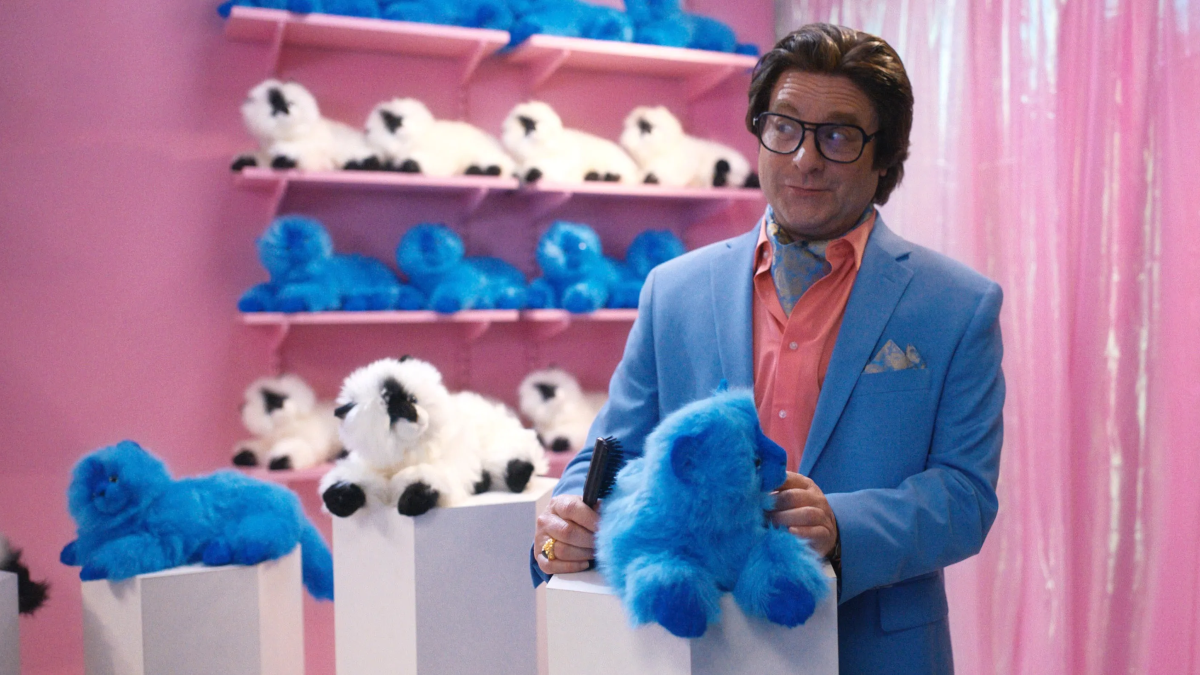
Instead of diving into why beanie babies suddenly became popular and why the bottom dropped out of the collector market, the movie spends almost all of its time telling us about four people at the epicenter of the craze. First are the company co-founders Ty Warner (Zach Galifianakis) and Robbie (Elizabeth Banks). Next is teenage marketing whiz Maya (Geraldine Viswanathan). Finally there is Ty’s fiancee Sheila (Sarah Snook). In a misguided attempt to add an air of mystery, the movie bounces back and forth between an earlier timeline with Ty and Robbie, then a later one with Ty, Maya and Sheila. Seeing how the four of them eventually intersected on one day was clever, but the event explained nothing about the people themselves or the beanie babies on which they dedicated their lives. This gimmick also lessens the boom-bust-boom-bust history of the toy company itself.
In the earlier timeline (1983-93), Robbie is an oil change technician who takes care of her wheelchair-ridden brother Billy. I assumed he had a terminal illness, because he had an IV bag attached to his wheelchair. At one point, when Robbie packs for a toy conference, he tells her to stop feeling sorry for him and just leave. Which she does, and Billy is never seen or heard from again. That the movie never bothers to tell us when he passed away is just one example of its shallowness. But I digress.
Robbie and Ty “meet cute” when she believes that the ambulance outside her apartment complex is for her brother. It’s actually for Ty’s mother, who just died. After that awkward introduction Robbie befriends Ty, who explains how he wants to build a better toy. His radical notion? Understuff the toys so that they’re softer and easier for children to hold. This one change accelerates the growth of Ty and Robbie’s company, and suddenly they’re millionaires and married. But hold on. Robbie wants to expand to the UK. Ty, a fervent America-firster who doesn’t want to do business in the UK, senses a power struggle and has Robbie removed as co-founder. Robbie stays, but after several miserable years as The Bickersons, they divorce.
Jump to 1993, and the “Ty” company is struggling when Maya takes a job as a receptionist. She understands computers and the internet and sees how an avid collector market has built up around beanie babies. She explains all this to Ty, who lets her create one of the first corporate websites dedicated to advertising its products. (I can’t deny that the scenes showing how people connected to the internet back then, using baud modems AOL Online, brought back memories.) Ty doesn’t really get it and hates the idea of people reselling his toys at a huge profit, but goes along. Maya drops out of college to become the company director of marketing, but Ty eventually feels threatened by her.
Sheila meets Ty on the exact same day that Maya is hired. (Something consequential also happens that same day between Ty and Robbie.) Sheila is a single mom with two adorable kids who insists she does not want to remarry. Unfortunately for her, she can’t resist Ty’s affable nature, and the kids love him. (The fact that Ty has the emotional maturity of a child is never really explored outside of one key scene.) Sheila and Ty become engaged, but Sheila wants nothing to do with Ty’s insecurities. His addiction to face lifts is disconcerting and says she won’t marry him if he will be needier than her children. Ty senses another power struggle and deals with it the only way he knows how, by putting himself first and erasing the dynamic of the relationship completely. If you haven’t guessed yet, Ty is a real piece of work.
What saves the movie from being completely trivial is Galifianakis’ portrait of Ty. His performance was amazing and might be the best acting of his career. I say this because I haven’t seen him in anything since the Hangover movies. His passive-aggressive man-child shtick got old after one movie, and he seemed to have faded into obscurity after that trilogy concluded. Perhaps this movie will lead to a Jack Black-like renaissance for him.
The other reason to watch this movie is for Elizabeth Banks. She’s an incredibly gifted actress who always turns in an interesting performance, even when the material expects little from her. She brings great emotional depth to Robbie, one that implies a completely different approach to the material was warranted instead of the sitcom level material the movie becomes. For example, there is a scene later in the movie when Robbie has a very unexpected rendezvous, and basically shrugs it off without diving into the dynamics at play. Banks has spent more time behind the camera, and has had her share of hits and misses. I hope that she continues to look for roles like Robbie, because I would miss seeing her sharp wit and energy in front of the camera.
While The Beanie Bubble makes its case that company co-founder Ty Warner was a narcissistic, insecure bastard that treated the women in his life horribly, its is not enough to hang a movie on, let alone a movie that purports to be about a product that was a major cultural touchstone for millions of people. The movie is not an inside look but a soap opera, and not a very interesting one at that. Time and again I waited for the movie to do more than just tacitly acknowledge the product at the center of the story, but it never budged from its sitcom impulses. Even more frustrating was when one character predicts the beanie bubble, the movie doesn’t bother to explain why that was fatal. Why did the market for the product suddenly fall off a cliff? Weren’t people still buying the toys because they liked them? The movie easily could have devoted five minutes to specifics instead of confirming again and again that Ty was a douchebag. Even though I liked the performances by Galifianakis and Banks, the movie simply does not do enough to warrant its existence. It’s sappy when it should be serious, light when it should be dark, timid when it should be going for the jugular. Not Recommended.
 Detroit Cineaste