
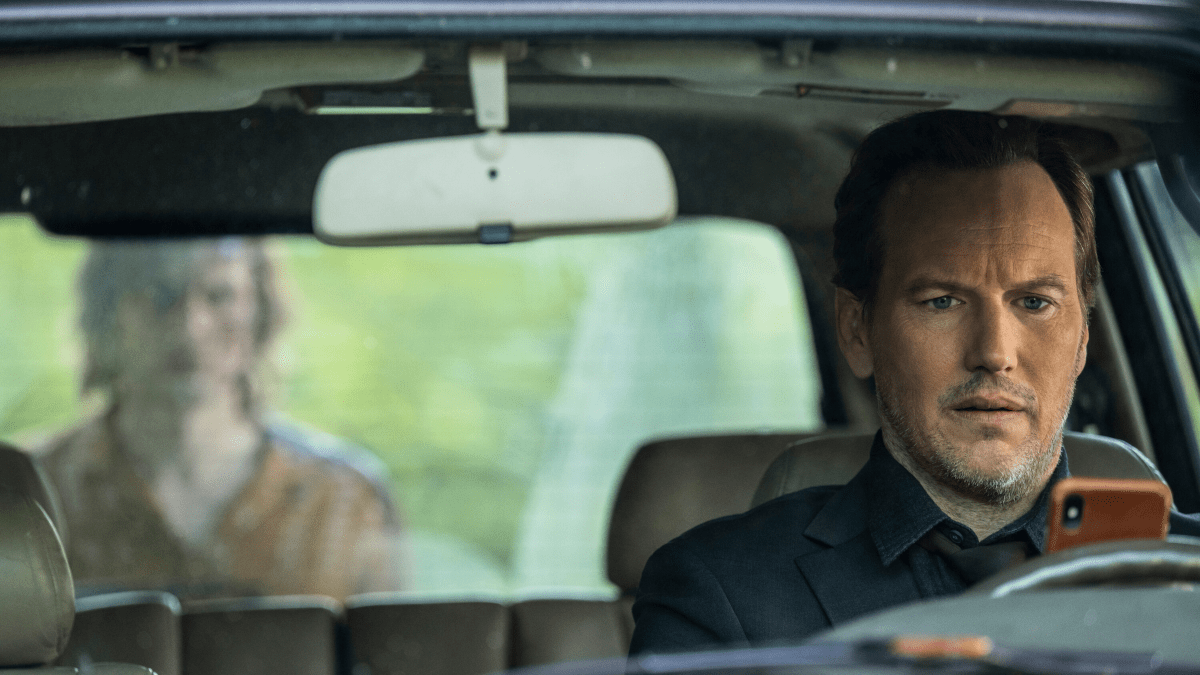
In The Red Door, the fifth entry in the Insidious series, the Lamberts are once again pursued by demons who want to possess members of the family. The Lamberts have to be the unluckiest family unit since Craig T. Nelson and company in the Poltergeist movies from the Eighties. You would think after one failed attempt, the evil beings would move onto another family, but no. If at first you don’t succeed, scare, scare again, eh?
The movie picks up ten years after the events in Insidious: Chapter 2. If you’re like me, I was surprised at how much time has passed since that movie came out. When this movie begins, I was taken aback by how much brothers Dalton (Ty Simpkins) and Foster (Andrew Astor) are as tall as their dad. Their parents Josh (Patrick Wilson) and Renai (Rose Byrne) still look about the same, though. Which gave me solace because if I ever get tormented by demons for the better part of a year, I want to come out of it looking as good as Patrick Wilson did.
The movie opens at the funeral for Josh’s mother Lorranine. (Barbara Hershey was the only original cast member who didn’t return for this outing.) The details behind her death aren’t discussed, so I assumed it was just “old age”. For some reason, Josh and Dalton aren’t getting along. The tension between the two of them makes the ceremony incredibly awkward for the entire family. A flashback reminds us that Josh and Dalton had their memories of their demonic experiences erased by a hypnotist ten years ago. Could it be that what seemed like a good idea at the time has somehow gone horribly wrong? Bet on it.
In addition to Josh’s frayed relationship with Dalton, he and Renai have gotten divorced. The two are still cordial to each other, and Renai suggested Josh make nice and drive Dalton to college. Unfortunately, more deep-seated animosity between the two ruins the day. (Calling your son an “ungrateful little shit” will do that.) Shocked at his own behavior, Josh decides to find out whatever is making him so irritable. He sees a doctor to get a brain scan and the procedure scares the wits out of him. (This movie ruined MRI machines for me forever, by the way.) When the doctor explains that his scan is clean, Josh is perplexed. He explains that he always feels like he’s always in a fog. I fully expected the doctor to write-off Josh’s symptoms off as long COVID, but he asks Josh whether there’s any history of mental illness in Josh’s family. Why yes, there is! Josh’s father, who was only mentioned once in this series until now, was institutionalized and killed himself at the mental hospital. Could this dark element from Josh’s past be impacting his behavior? Yes, but not how you would expect.
Meanwhile, Dalton meets-cute with Chris (Sinclair Daniel) when she’s accidentally assigned as his roommate. She is fine with toughing it out for one night, but Dalton insists on having his nightlight on. He confesses that he’s been afraid of the dark since he was a child, ever since he spent a year in a coma. Of course, the audience knows what really happened back then. It’s just a question of when Dalton figures it out.
As (bad) luck would have it, Dalton’s art teacher, Professor Armagan (Hiam Abbass) is an amateur hypnotist. She believes that her students will be able to access their unconscious minds better when they’re in a trance-like state. (You know where this is going.) Before long, Dalton is astral projecting around his dorm and seeing dead people at frat parties. (There’s an especially gross ghost at a frat house. You really don’t want to be eating popcorn during that moment.) His nocturnal travels soon attract the red-faced demon who tormented him all those years ago. (He’s known as the “Lipstick Demon” in the credits.)
Back home, Josh is forced to confront his past by a demon who won’t leave him alone. He pleads with Renai to tell him if there’s any reason why he shouldn’t think he’s going crazy. She relents and tells him about how he and Dalton agreed to be mind-wiped all those years ago. As a result, he turned into a distant and irritable bastard and she was forced to lie to Dalton about what really happened to him. Repressing those traumatic experiences tore the family apart and left Dalton unprepared for when the Lipstick Demon would pay him another visit. Everything dovetails to another spooky meet-up in The Further, where Josh must rescue Dalton before it’s too late.
As with the previous entries in this series, the acting in Insidious: The Red Door is solid throughout, led by Wilson, Byrne and Simpkins. Simpkins started out with a nice run as a child actor with Insidious 1 and 2, Jurassic World and Iron Man 3 (among other movies) and is the standout here. Along with his performance in The Whale, he’s proven that he’s a solid actor and someone to keep an eye out for. The Red Door continues the franchise’s tradition of crazy jump-scares, and I shamelessly admit that all of them hit their mark with me. First-time director Wilson hews close to the recipe that has made this franchise successful. He keeps things simple, letting the mood build with abrupt changes in lighting and sound before turning the demons loose. This movie adds a welcome twist by incorporating artistic expression as a bridge to the unconscious, focusing on the tactile nature of sketching and painting. Hopefully the movie doesn’t dissuade parents from letting their kids take art class.
Credit goes to Wilson for getting series regulars Lin Shaye (as Elise), Leigh Whannell (Specs) and Angus Sampson (Tucker) to make appearances in this closing chapter. Their cameos were fun and gave the movie a “the band is back together one last time” feeling. The Red Door ultimately succeeds because it provides closure to the story of the Lamberts and their demons. Chapter 2 supposedly did that as well, but this time I got the impression that the story had come to a definitive end. That said, I wouldn’t be surprised if another Insidious movie arrives in a couple of years. Perhaps the filmmakers will get clever and it will be titled Behind The Red Door. Recommended.
Further Thoughts (a.k.a. Analysis)
I did my best to avoid spoilers before this point. If you keep reading, significant plot developments are discussed.
The Red Door confirms what I suspected all along: Chapter 3 and The Last Key were superfluous prequels. Both of them focused on the origins of professional astral plane walker Elise (Lin Shaye) and were “fine” but completely unnecessary. I hate to call them cash grabs because they were still entertaining–albeit in a workmanlike way. Given how The Red Door doesn’t even acknowledge them proves that they were little more than placeholders intended to keep the franchise going until the filmmakers came up with a way to bring the story of the Lamberts to a satisfying conclusion. If fans of the series describe the two prequels as the cinematic equivalent of treading water, I would offer a mild defense of them. I like Lin Shaye’s characterization of Elise, and Whannell and Sampson’s Abbott and Costello routine is funny and weird.
I was surprised that none of the new characters introduced in The Last Key made an appearance in this movie. I figured that Spencer Locke’s Melissa, who was introduced as Elise’s niece and could astral project, would be carrying on the tradition for her deceased Aunt. That, unfortunately, was not the case. With that in mind, if you are considering seeing The Red Door and haven’t seen the previous two movies, don’t fret. They have no bearing on the events in the current sequel at all.
One risk that The Red Door took that completely worked for me was having Sinclair Daniel as Dalton’s surprise roommate. As Chris, Daniel is funny and brings a completely different vibe whenever she’s on screen. As I mentioned above, I’ve enjoyed all of the movies in this franchise. However, and I say this with love, all four of the previous movies have had the most morose group of white people as the focus. If the Insidious franchise is going to continue, it needs an infusion of fresh blood to keep it interesting. Having someone like Daniel around is critical to preventing any subsequent movies from feeling like retreads. Thankfully, Daniel’s character wasn’t killed off in this sequel, so I’m guessing she’ll return. If anyone can keep Dalton from taking things too seriously, it’s Chris.
An aspect of the series I hadn’t realized until The Red Door is how Wilson’s Josh was a bad dad all along. In the first Insidious, he stayed late at school instead of heading home to deal with the family issues. He then unwisely decides to confront his old demon tormentor, only to become possessed and kill Elise. He torments his family throughout Chapter 2 until he finally frees himself from his demon. In The Red Door, he’s so difficult to be around Renai divorces him and Dalton wants nothing to do with him. I don’t believe the franchise is making any big statement about how fathers are bad or anything. However, I can’t escape how the movies repeatedly enforce the impression that Josh isn’t a nice person and kinda deserves the anger directed his way.
Something I wasn’t aware of before seeing the movie was that distributor Sony asked the filmmakers to make the movie more scary. This may explain the frequent lapses in logic in the story that I noticed. For instance, why does Josh only start seeing his deceased father at his mother’s funeral? If his dad realized from The Further that his son and his grandson were in danger, there was no reason for him to wait ten years to come onto the scene. Similarly, I didn’t understand how the revelation that his father was also haunted by a demon played a role in the outcome. While it does force Josh to reconcile with his past and ask Renai for help, he could have seen Renai without his father doing anything at all to force the issue.
Speaking of Josh’s father, I don’t understand how he was able to burst through a pane glass window and hurl Josh into the closet. If I understand the logic of this franchise correctly, demons can impact the physical world, but ghosts “traditionally” have not had that power. Even though I would rank the scene in question as one of the better Lo-Fi scares in the series, it broke the “rules” the series had established for ghosts who are stuck in The Further. (Before this movie, ghosts could only help the living from within The Further.)
The other big scare in the movie, when Josh is freaked out by a ghost while in the MRI machine, also makes little sense in hindsight. The movie didn’t bother to explain who they were and what connection they had to Josh, if any. If they are just random demons, why are they pursuing Josh now?
Another logical lapse in the story is when Chris decides to help Dalton out. She decides this after she’s nearly choked to death by the Lipstick Demon and tells him that she’s out. So, why does she change her mind and befriend him again? Not explained.
Another thing The Red Door doesn’t bother to explain is how the Lipstick Demon has the power to turn off all of the electricity in an entire dorm. I remembered how he was able to impact the physical world when he possessed Dalton as a boy in the first movie, but now he’s incredibly powerful even before he possessed Dalton.
As for Shaye’s cameo appearances, why have them at all when her character plays no role in the outcome of the story? The movie implies that she’s still in The Further, so why couldn’t she have tag-teamed with Josh’s dad to help rescue the two of them?
Random Questions
Nobody has counted backwards from ten around Dalton in the past ten years?
Nick the Dick has to be based on someone who pissed off one of the filmmakers in college, right? The savagery with which the character is treated has to be score-settling on some level.
How much does the estate of Tiny Tim make off of his song being played in these movies?
Finally, why did Wilson include himself singing a song over the end credits?
 Detroit Cineaste