
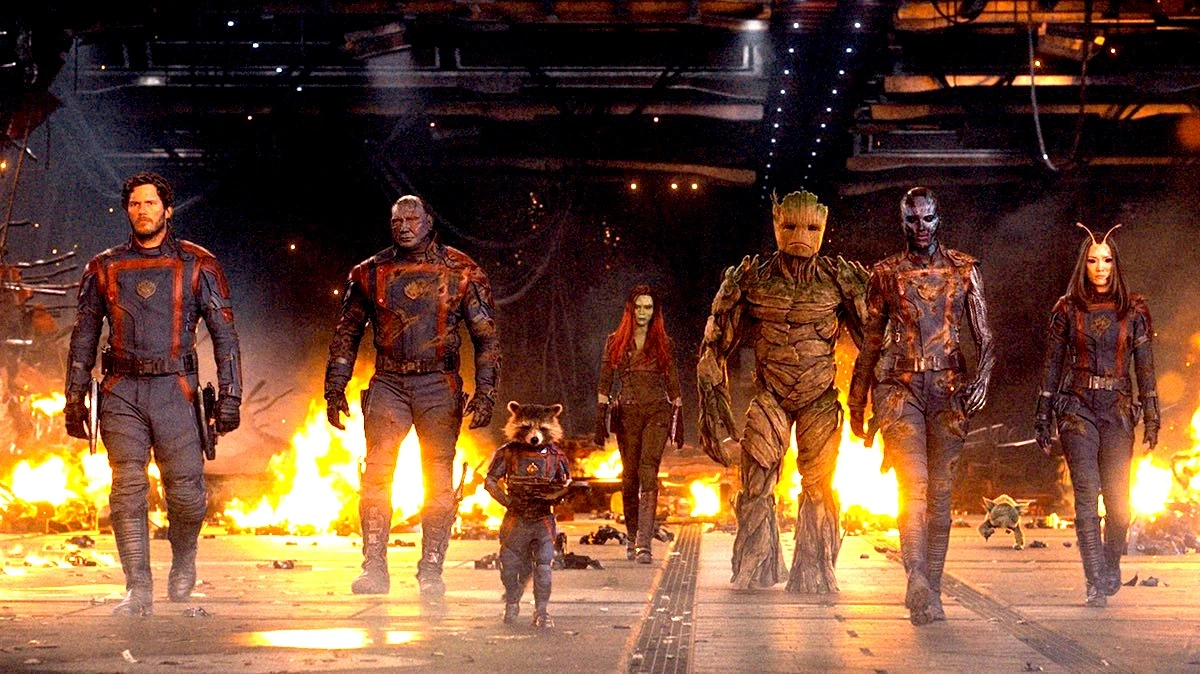
This is the end of the road for the Guardians of the Galaxy. After pitching in to defeat Thanos and working as intergalactic mercenaries, the team has decided to hang up their guns and put down roots on Knowhere. You remember Knowhere, right? You know, the place that’s actually the severed head of a dead god. The place where Thor gave the Soul Stone to the Collector (Benecio Del Toro) at the end of Thor: The Dark World for safekeeping. The place Thanos destroyed after taking the Soul Stone from the Collector in Avengers: Infinity War. The place with Howard the Duck. Yes, MCU lore is dense. Thirty-two movies into the MCU saga (thirty-three if you include this one), you either jump-ship or swim. I’m still swimming, although the boat has been taking on water the last couple of years.
If you watched the Holiday Special on Disney+, you know that the Guardians now call Knowhere home and have been fixing it up. It now looks like the kind of place where everybody’s cool and minds their own business. A place where the residents would say, “It may be a dump but at least it’s our dump.” A place that comes with a bumper sticker that says, “Don’t laugh, it’s paid for.” You get the idea. Unfortunately for the Guardians, no matter where they go, there they are.
The group collectively is suffering from ennui, a pervasive theme throughout the MCU’s Phase 4 and Phase 5 entries. What is a superhero to do, now that Thanos is gone and the universe has been restored? Peter Quill (Chris Pratt) is having a difficult time coping with his new normal, where he’s simultaneously grieving the death of Gamora (Zoe Saldana) and being rejected by her edgy, 2014 version. The rest of the gang are basically drifting without a mission to focus on. This being a Marvel movie, a call to action soon arrives in the form of a golden man who flies across the galaxy and crashes into Knowhere. This shimmering interloper is Adam Warlock (Will Poulter), a member of the race of uber-people known as the Sovereign. Rocket (Bradley Cooper) pissed off the Sovereign back in Vol. 2, and Warlock was introduced in a credit cookie. (With Marvel, you should know by now that everything is always on the test.)
Warlock’s mission was to retrieve Rocket, but mortally wounds him in the process and is driven off by the rest of the team. (Nebula totally rocks in this movie, by the way.) Unfortunately, the team can’t heal Rocket because of a “kill switch” integrated into Rocket’s physical enhancements. To disable the kill switch, the Guardians must retrieve a code from Orgocorp, a company that creates genetically enhanced species (like the Sovereign) and is led by the High Evolutionary (Chukwudi Iwuji). With Rocket having only 48 hours to live, the team blasts off for Orgocorp while Rocket lies in a coma, dreaming about his origins.
As the story toggles between the Rocket’s past and the present, we learn that he was a member of a batch of experiments by the High Evolutionary (or HE) to give him the ability to think and speak. (The horrific procedure is straight out of The Isle of Doctor Moreau and fortunately is never shown.) To the HE’s surprise, Rocket evolves at an incredible rate. Unfortunately, Rocket figures out a problem that was bedeviling the HE, resulting in the immediate obsolescence of himself and the rest of the batch. In what has to be one of the saddest moments in the MCU, Rocket manages to escape the HE, but his friends do not. Since then, the HE has been searching for Rocket to provide the missing ingredient for his current experiments.
Meanwhile, the Guardians infiltrate the Orgosphere, a space station constructed out of living tissue. (It’s a completely superfluous set piece but hilarious nonetheless.) They steal Rocket’s code, only to discover that part of it was taken by an Orgocorp employee who works at the Orgocorp complex on Counter-Earth. (The search for the macguffin continues!) After some funny sitcom interactions with the anthropomorphic denizens of Counter-Earth and a stand-off with the HE, the team rushes to save Rocket’s life and put an end to HE’s delusions of grandeur for the betterment of the galaxy. The climactic battle between the Guardians and HE’s forces is one for the ages, featuring a ballet of violence, the Beastie Boys on the soundtrack and everyone pitching in, even Cosmo the SpaceDog. In the end, the Guardians are triumphant but splitting up. Ah well, it was a good run while it lasted. Time to crank up the Zune and dance!
As advertised, Guardians of the Galaxy Vol. 3 is the final adventure for this group of a-holes. Gunn’s affection for these characters has been evident from the beginning, and he gives them a sendoff that is incredibly moving, hilarious and exciting. The plot connecting everything is a little clunky, but the movie is filled with everything that I’ve come to appreciate from this franchise: the adolescent humor, the sci-fi weirdness, the bonkers physical comedy and most importantly, friendship. (Every wisecrack and insult is rooted in love. Believe it.) While the ever-evolving relationship between Peter and Gamora remains a focal point of the story, Gunn gives the other members of the team moments to shine. Having oddballs Drax, Mantis and Nebula play key roles in the outcome was an unexpected stroke of genius. The practical and CGI effects are some of the best the MCU has ever done. There’s one fight scene in the last act that was simply awesome. Vol. 3 is not only one of the funniest Marvel movies I’ve seen, but probably the saddest as well. The tragedy of Rocket’s origin story was so moving, I completely forgot I was getting misty-eyed over a CGI character. Speaking of which, Vol. 3 makes a very impassioned and convincing argument against using animals for scientific experiments. That Disney allowed Gunn to speak out on such a difficult issue, in a superhero movie no less, is commendable. I’ll miss Star-Lord, Drax, Rocket, Groot, Nebula and Mantis. Whomever follows this group has a tough act to follow. Highly Recommended.
Analysis
This is how all superhero franchises should end: on a high note.
After the previous two entries, appearances in two Avengers movies, a cameo in Thor 4 and a holiday special on Disney+, the group had run its course. The Guardians were a fun counterpoint to the rest of the MCU, but they no longer served a purpose in a post-Thanos universe. Sure, they could appear in more sequels doing mercenary-for-hire jobs, but that would have grown tiresome before long. Now that they’ve settled down on Knowhere, it was apparent that the team needed to split up to grow, like members of a rock supergroup pursuing solo projects. As such, Vol. 3 brings this franchise to a logical and satisfying conclusion, something that cannot be said for any of the other Marvel franchises.
That Marvel has effectively closed up shop on the Guardians is an outlier for superhero franchises. Many superhero franchises never have a definitive ending. (Chris Nolan’s Batman trilogy might be the only one.) DC and Marvel, the studios responsible for the current Age of Superhero Movies, usually reboot a franchise when the actors get tired of the role or audiences stop showing up. In Marvel’s case, with Iron Man and Captain America, their trilogies did not include a finale for either eponymous character. Instead, those two characters effectively signed off in the fourth Avengers film. Captain America will continue on with a different person wielding the shield, and Iron Man’s continuing legacy will be explored with a series on Disney+.
With this in mind, Vol. 3 won’t be the last time we’ll see the Guardians in a movie. I’m confident that a different version of the team will arrive in the future. The characters are popular and have made a lot of money for Disney. A rebooted team seems most likely, with Chris Pratt returning to pass the torch over to a younger team. Until that happens, Vol. 3 marks the end for the current iteration of the Guardians, as both Bautista and Saldana have said they will not return. As such, Vol. 3 serves as an excellent send off for the a-holes we’ve come to know and love.
Since Vol. 3 is the final chapter in the trilogy, it wisely focuses on what many fans of the Guardians would say is their favorite member of the team: Rocket. This movie is his origin story, similar to how Vol. 2 was Quill’s origin story. It’s odd that two of the three entries of this series were origin stories, but it works because the last entry was six-years ago, with Thanos in between. Given that Rocket’s origin has been shrouded in mystery since his introduction, it makes sense to finally reveal how he came into being. (If there was going to be a fourth entry it probably would have been devoted to Groot’s origin story.)
To explain why Rocket is who he is, writer-director Gunn constructs the plot through an unlikely combination of plot devices. First is the “clip show”. After Rocket is mortally wounded by Adam Warlock, members of the team look upon him worriedly while the movie flashes back to moments of Rocket’s past. The only difference between Vol. 3 and a traditional clip show is that Rocket’s past has never been shown before. I’d like to think that Gunn is being meta here, since a child of the Eighties like Quinn would have been very familiar with clip shows, right down to the beeping monitors.
Next is the pursuit of a macguffin. The Guardians must hunt down the code necessary to disable the “kill switch” that prevents them from healing Rocket. They first infiltrate Orgocorp and steal the Rocket’s file, only to discover that part of the code has been removed and stored in one of the High Evolutionary’s recorders. They then proceed to Counter-Earth to retrieve the missing code from the recorder, only to have part of the team stranded on the High Evolutionary’s ship. All of this bouncing around is counter-productive since The High Evolutionary needs Rocket alive so he can extract his brain and study it. By forcing the Guardians to jump through hoops, he’s unnecessarily putting Rocket’s life at risk, especially since he knows that Rocket was mortally wounded by Warlock.
While both of these plot devices are obvious, they are useful in explaining who the High Evolutionary is. Through the flashbacks of Rocket’s past and excursions into the HE’s present-day activities, the movie shows that he’s always been an amoral megalomaniac with no redeeming qualities. Then and now, he treats the results of his experiments as completely disposable materials, to be destroyed when they have served their purpose. In other words, the High Evolutionary is an evil person that must be stopped.
While the story feels like a hodge-podge of curious narrative choices, Gunn is excellent at constructing a movie that is flat-out fun to watch. The visits to Orgocorp and Counter-Earth serve as set-pieces for Gunn to deliver all of the elements we’ve come to appreciate from the Guardians movies. There’s the adolescent sniping, the juvenile sense of humor, the weird science-fiction elements, the wanton violence and, of course, the heart underlying all of it.
One of the reasons I believe the Guardians have become so popular is how they serve as a smart-alecky response to that other team of mighty heroes. The Avengers come off as bickering adults, whereas the Guardians are like teenage siblings who fight and argue with each other all the time. The Avengers are filled with gravitas and take things seriously, while the Guardians turn up the music and start blasting shit. The Guardians may get on each other’s nerves, but they come together like brothers and sisters when they need to.
I love that Gunn understands that comedy is more than snappy one-liners. He introduces a joke and builds on it over multiple scenes. Lines like “the boss’s nephew”, “if you know its a trap it’s not a trap, it’s a faceoff”, and “You’re a bad dog!” are modestly funny initially, but they get funnier each time afterwards. The joke cadence in the movie reminded me of a stand-up comedian returning to a bit that worked several times during their routine.
Vol. 3 provides many examples of how masterful Gunn is at physical comedy. His tendencies remind me of Tim Burton in his heyday, and how he utilized strange and bizarre landscapes as the launchpad for his weird sense of humor. In Burton’s Beetlejuice, the afterlife was Burton’s funhouse. In Edward Sissorhands, it was the suburbs. In Gunn’s Vol. 3, it’s Orgocorp.
The sight of the Guardians in colorful space suits bounding over the skin-like hull of the Orgosphere had me laughing simply because it’s silly. Having the Orgocorp employees stick their hands into bowls of goo to operate equipment was a nice way of showing how gross the Orgosphere is in every way. Finally, Quill sending the security personnel ping-ponging weightlessly around the ship so they can escape was a nice callback to the prison escape scene in the first movie. The sight of people floating helplessly and banging into things was something straight out of a Looney Tunes cartoon. (I’ll explore the ridiculous needle-drop in this scene below.) Throughout the movie, whether it’s having Mantis regularly land on her head, or Drax beaning a child with a ball, Gunn’s lack of concern with offending people for a laugh is admirable. As he has shown throughout the trilogy, when it comes to comedy, Gunn is fearless, confident and very funny.
Gunn is also a deadly sniper with his needle-drops. The soundtrack is an eclectic mix of pop, rock, soul, rap and alternative, with each song specifically chosen like one of the mix tapes Quill listens to. Of the sixteen songs on the soundtrack, these stood out to me:
- Radiohead’s “Creep” verbalizes Rocket’s feelings of inferiority and self-loathing.
- Rainbow’s “Since You’ve Been Gone” blaring when the team heads to Orgocorp with Rocket’s life hanging in the balance. Resurrecting this long-lost power rock chestnut to underscore the team’s desperation over their fallen teammate was an inspired choice.
- Earth, Wind & Fire’s “Reasons” while the gang escapes from the Orgosphere has to be the most incongruous (ironic?) use of a love song since “Try a Little Tenderness” in Doctor Strangelove.
- Matt Johnson’s “This is the day” signals the Guardian’s determination and optimism before their climactic battle with the High Evolutionary.
- The Beastie Boys drum-fueled stop “No Sleep till Brooklyn” playing over the orgiastic violence when the Guardians fight the High Evolutionary’s guard. (Incredibly, this song is in both of Pratt’s 2023 movies.)
The movie crosses the hour and forty-five minute mark when Rocket is finally healed. If anyone besides Gunn had spent that much time on flashbacks and tracking down a macguffin, the movie probably would have been a disaster. That this movie was so entertaining without moving the plot forward for such a long period of time is a testament to Gunn’s skill as a filmmaker. That said, the remaining thirty-forty minutes are dynamite and are well worth the wait.
When it comes to gleefully depicting violence, the scene where the Guardians eviscerate every member of the High Evolutionary’s security team is one of the best fight scenes in the MCU. Marvel movies have typically opted for a bloodless approach to violence, which makes Gunn’s free-for-all so unique and so thrilling. He pivots to each member of the team doing their thing, capturing the action with a GoPro (or something similar). The choreography behind this scene is so complex, it must have taken forever to map out and shoot. For those who complain that all of the MCU’s fight scenes are filmed with drab gray backgrounds, here’s one that is brightly lit, visually kinetic and incredibly intimate. Too bad Gunn is leaving Marvel to head DC Studios, because the MCU will miss his singular vision.
Underneath all of the teasing, sarcastic remarks and name-calling, the Guardians movies are filled with love. Everyone on the team loves each other, they just can’t bring themselves to say it out loud. Each of them was damaged by a traumatic event in their past, so they keep their guard up as a defense mechanism to avoid getting hurt. Nobody personifies this better than Rocket, and Vol. 3 explains why he has kept the team at arms length. After seeing his friends killed by the High Evolutionary, he doesn’t want to experience the pain of losing a close friend again. Fortunately for him, the rest of the team always considered him as a friend and readily criss-crossed the galaxy to save his life. Rocket has always had friends, even though he insisted he didn’t need them and frequently pushed them away.
Since Vol. 3 is Gunn’s farewell to the characters he clearly loves, I understand why he gives several supporting characters their own moment to shine. Mantis uses her powers to befriend the Abilisks. Drax reveals that he can speak the children’s language. Nebula pilots the HE’s ship during the evacuation. Gunn even carves out space for Cosmo the Dog, Kraglin and Warlock (of all people) play significant roles in the final outcome. Sure, it’s a bit much, but it all ties into the movie’s theme that all life is valuable and everyone can make a contribution to the greater good when called upon.
For the most part, the MCU has rarely let current events influence the storylines. Battles are fought between clear-cut heroes and villains. Occasionally the movies have been a bit more reflective of the real world, with Thanos and Loki as stand-ins for fascism. Hydra can be viewed as a reflection of domestic terrorism if you squint hard enough. Some view The Avengers as a reenactment of 9/11, but that analogy is too simplistic to be considered clever or insightful.
With that in mind, none of the MCU’s previous entries prepared me for the incredibly specific and passionate case Vol. 3 makes against animal testing. The HE clearly represents the scientific community and their belief that destroying life to the benefit of humanity is justified. The movie shows how all the pain and suffering animals endure is not only cruel, but ultimately pointless. The HE can only produce a society that looks exactly like ours with the same problems (homelessness, drug use and violence). Vol. 3 argues that experimenting on animals is more about control and dominion than scientific progress. The movie argues that using animals in scientific research is wrong, and that all lives should be treated with dignity and respect. I don’t know what is more shocking: to hear this message in a superhero movie, or that Marvel let Gunn say it at all.
Strangely, the aspect of the movie I’ve had the most trouble reconciling is Rocket himself. Absent the HE’s experiments, Rocket would not exist in his current form. He would have lived out his life as a normal raccoon, completely unaware of rockets, spaceships, weapons and everything else that makes Rocket who he is. As such, Rocket owes his evolved existence to the HE. Rocket may have been happier if remained an ordinary racoon, but he enjoys firing guns and flying spaceships. The universe might have survived without him as one of its heroes, but the universe needed all hands on deck when Thanos arrived on the scene. The thorny question I can’t answer is whether Rocket and the universe were better off because the HE changed him. Rocket never had a choice in the matter, but the question of whether the ends justify the means is too philosophical for a superhero movie to answer.
Lastly, I appreciated Gunn for finally giving the Guardians an interesting villain to square off against. After the original movie’s Ronan the Accuser and Vol. 2’s Ego, the High Evolutionary is a definitive step up in villainy. The best villains in the MCU have been the megalomaniacs with a flair for the dramatic, and the HE matches up well with them. Since Vol. 3 implies that the HE was the result of experimentation, his enablers wound up creating the thing that destroyed them all–a lethal combination of Dr. Frankenstein and his Monster. In Iron Man 3, Tony Stark says, “We create our own demons.” I doubt Gunn intended to associate his movie with that one, but it’s an interesting coincidence nonetheless.
The HE’s modus operandi remains a conundrum to me. He insists that all he wants to do is create the perfect society, but his creations are all variations on a theme. He complains that the Sovereign and the people of Counter-Earth are stepping outside of their genetic programming, an indication that he cannot create people that act like he wants them to. Furthermore, injecting Rocket’s inspiration into the children would result in the same rebellious traits. I would assume that a person as intelligent as the HE should understand that creation is unpredictable, and that creating a race of people who are docile but with inspiration is a contradiction. Also, the notion that you can manufacture inspiration is ludicrous (sorry to break this to all the AI programs out there). I guess when you think you are a God, you believe that you can reconcile the irreconcilable. It’s fitting that HE’s hubris is what destroys him in the end.
Vol. 3 repeatedly drives home the conclusion that the HE’s quest for perfection is both pointless and destructive. As Rocket says, “He didn’t want to make things better, he just hated things the way they are.” Manipulating genetics may produce a better looking race of people that are free of disease, but life is more than beauty and good health. Sometimes, life produces a being with the body of a raccoon, the mind of a rocket scientist and a voice direct from New York City. There’s no sense in trying to understand why he is the way he is, or trying to fix him. Just appreciate him for being the unique being that he is, a character unlike any other.
 Detroit Cineaste