
After watching the first trailer for Buddy, I wondered why it took so long for someone to make a parody of Barney and Friends. I remember news reports back when it was airing sharing the views of concerned parents who thought the show had Satanic overtones. How else should a reasonable person interpret the sight of children walking gaily in a circle around a toy version of him while singing a song? Now, at long last, we finally have a movie that reveals the Cult of Barney for being what those ninnies have always suspected. He wasn’t a gentle character played by a person in a costume, but evil incarnate!
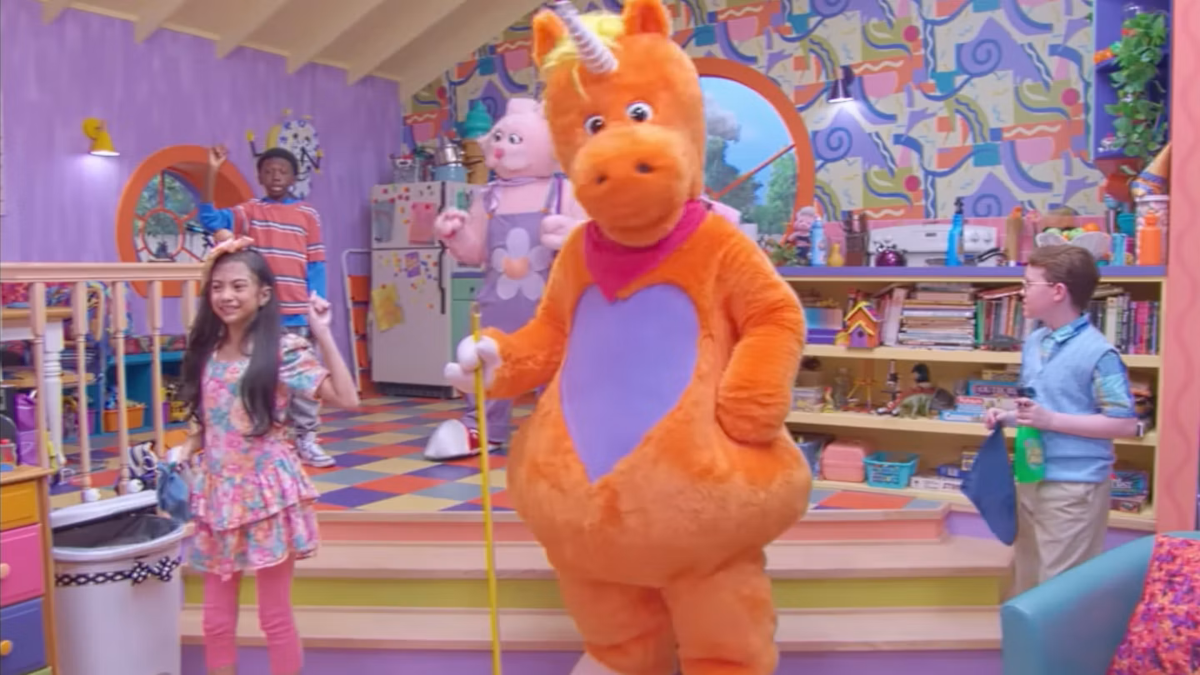
Buddy begins with three episodes of the It’s Buddy show. Like most children’s programs, this has several kids in the cast: Freddy (Delaney Quinn), Wade (Caleb Williams), Josh (Luke Speakman), and Oliver (Tristan Borders). There’s also Mailman Miles (Bennie Taylor) and Nurse Nancy (Phuong Kubacki). The set is filled with inanimate objects that talk, including Mr. Mailbox, a couch (“Couchy”), a clock (“Clocky”), a backpack (“Strappy”) and a train (“Charlie”). The star of the show is Buddy, a giant magical unicorn who appears when the children sing his song.
If you’re of a certain age, or have children of a certain age, it won’t take long for you to recognize the actual children’s shows being referenced, like Pee-Wee’s Playhouse, Thomas the Tank Engine and Barney and Friends. Folks online have pointed out several others that my son wasn’t interested in watching, like Blue’s Clues and Dora the Explorer. There are probably several more Easter eggs in the movie, but you get the idea. If you watched American children’s television shows from the last thirty years, you’ll feel right at home.
The first episode plays out like an average children’s show, except when it comes to Josh. He’s a grumpy loner who doesn’t want to go to a party and dance and instead wants to be left alone to read his book, A Wrinkle in Reality. (I like this kid.) Buddy takes exception to Josh’s attitude and kills Josh off screen. When Freddy asks Buddy what happened to Josh, Buddy lies and says that Josh was so thrilled with his dancing shoes he’s touring Diamond City. (Diamond City being a stand-in for the Emerald City of The Wizard of Oz.)
In the next episode, the peppy Hannah (Madison Skyy Polan) has replaced Josh. Freddy finds Josh’s book in the trash covered in blood stains. When she confronts Buddy with it, he claims that Betty Bunny spilled red paint on it. Betty contradicts Buddy’s story, so Freddy tells Buddy a lie so that she and Wade can see Nurse Nancy, who agrees to ask Buddy about it. Freddy and Wade then watch helplessly as Buddy strangles Nancy. For a children’s show, this one has an unusually high body count.
The third episode finds Freddy, Wade and Oliver terrified of Buddy. They hatch a plan to escape to Diamond City via Charlie the Train, but Buddy dismembers it before they can leave. Freddy sets Buddy on fire, but he recovers and kills Wade. Freddy and Oliver manage to escape into the forest nearby, with Buddy on their tail. To paraphrase Bill Murry’s character in Tootsie, this is one nutty children’s show.
Buddy then cuts to the real world, where mom Grace (Christin Milioti), dad Ben (Topher Grace) and their two sons are living a typical suburban existence. For some unknown reason, Grace believes that she had another child, even though the family stickers on the mini van contradict her. Ben is sympathetic at first, but then turns caustic and patronizing when she becomes obsessed with the idea. When she sees the It’s Barney show on TV, she searches the web for information but comes up empty. Grace then hires a psychic to snoop around the house, which pushes Ben over the edge.
After Grace and Ben have a fight, the living room TV turns itself on to reveal Buddy. He pulls Grace into the TV, where she becomes Nurse Grace on the show. Meanwhile, Freddy and Oliver encounter George (Clint Howard), an old man wearing a child’s cowboy outfit and a puppet who resembles Howdy Doody. After a narrow escape, they discover that Diamond City isn’t what it looks like, and have no choice but to return to the set, where the wishing well could be put to good use. But then they’ll have to make nice with Buddy, who probably will kill them for being disloyal. Trust me when I say that the final episode is a killer!
Recommendation
Buddy is one of those movies where what works covers up for how the it never gels. The parody of children’s shows is wickedly funny and perfectly captures how innately creepy these shows are. (I say this as a longtime fan of Pee-Wee’s Playhouse, which is one of several shows that provides inspiration for this movie.) The performances by the child actors in these scenes are terrific, which also features amazing physical sets and puppetry. Buddy is what adults secretly thought Barney was, a homicidal maniac disguised as an ingratiating oaf.
The other half of the movie, which is set in the real world, has its moments. Christin Milioti (Grace) and Topher Grace (Ben) are odd couple parents who interact like a couple trying to be nice, only for their mutual irritation for each other to come out when Milioti’s Grace becomes unglued. While not long, this part of the movie provides an effective tonal counterpoint to the world of Buddy’s television show.
Unfortunately, the merging of these two worlds is clunky and the movie never bothers explaining how the connection between the two is even possible. Which is ironic because Ben actually verbalizes this to Grace during one of their passive aggressive arguments. I suspect writer-director Casper Kelly used Grace to express his own inability at being able to tie things together, which is clever on a meta level but still doesn’t excuse basic narrative requirements.
Buddy’s ending doesn’t make any sense either, an incoherent series of images that are the equivalent of cinematic hand-waving. Kelly appears to want to say something meaningful about his subject matter, but he chickens out and offers up visual brain candy instead. Overall, the movie benefits tremendously from having a very clear concept and vision behind it, while also having pieces that are conspicuously underbaked.
All of the child actors do an excellent job giving their characters distinct personalities while meshing perfectly within their TV (un)reality. Delaney Quinn is the standout as Freddy, the focus of the story. Milioti and Grace are hilarious in their brief supporting turns. I haven’t seen Grace since Spider-Man 3, and he’s still reliably smarmy and obnoxious. Milioti is always great in whatever she’s in, just a beautiful presence who is comfortable in strange environments filled with weird characters.
The voice cast has several heavyweights in it, including Keegan-Michael Key taking a well-deserved break from hawking for tater tots and hotel rooms to voice Buddy. Patton Oswalt has done a lot of voice roles and is reliably good as well. Michael Shannon turning up in this took me aback because he always plays such serious roles. Veteran voice actor Eric Bauza single-handedly brings five of the puppets to life.
Buddy works best as a satire on Barney and other children’s shows. Its overall construction is a jumble, but when the movie hits, its black comedy gold. Cristin Milioti gifts her fans with another engaging performance in her increasingly eclectic career. Recommended.
Analysis
When I begin writing a review, I recall what Roger Ebert said when he was struggling with formulating his take on a movie. He would ask himself, what is this thing trying to accomplish and how well does it pull that off? Those questions help keep my focus on the big picture, so to speak, and not get bogged down in the weeds.
This is because very few movies are perfect. The vast majority of movies I’ve seen always have problems of varying degrees, like moments where the dialog isn’t quite right, the lighting is poor, an individual performance isn’t the right fit for the movie, scenes transition awkwardly and so on. Unless the movie is overloaded with those kinds of problems, I’m fine with ignoring them so that I can let the movie cast its spell. Basically, I want to enjoy the overall experience, which does not involve presenting my tally of all the CinemaSins I found when it’s over..
This is the main reason why I enjoyed Buddy as much as I did. Even though it has several glaring plot holes, they didn’t cause me to turn against the film. I enjoyed all that did work, and that was more than enough for me to recommend it. As I mentioned above, the movie has a lot working in its favor. It’s very funny, has great performances throughout the cast, has an imaginative production design and most importantly–puppets! Movies that make good use of puppets are few and far between, and Buddy gets bonus points for that alone.
However, I do want to explore the movie’s issues because they’re intriguing. If you’ve read my previous reviews, you already know how much I like to go into detail on any given film. Not to pick it apart, but to understand how it pulls off its own kind of movie magic. Buddy is an interesting case because its issues are plain for all to see, but the movie succeeds despite them.
The first problem with Buddy is how it links the real world to the alternative reality where Buddy resides. The movie eventually reveals that Buddy is a demon who uses his show to bring people from the real world into his world. At one point he literally pulls Grace through her television set. I assumed he does this to increase his demonic powers. The longer he keeps the cast under his control, the stronger he becomes.
Buddy isn’t the first movie to depict television not as a passive medium, but as a portal between worlds. Pleasantville and Videodrome are two examples that come to mind. That Buddy also uses this plot device isn’t a problem. It’s how blithely the film refuses to explain how Grace could lose a child and nobody remembers but her.
There’s a point in the movie where Ben becomes exasperated over Grace’s insistence of a missing child and asks her how everyone–including the Social Security Administration–wouldn’t know that she had disappeared. It’s a fair point, one that neither Grace nor the movie has an answer for. I’m not going to offer suggestions as to how Casper Kelly should have or could have addressed this, but I did find it odd that the movie never bothers to.
The reason why Grace is part of the story is clear, though. The children aren’t strong enough to escape from Buddy themselves, so the plot needs an adult to help them get to the other side. Grace is a logical choice because she’s Freddy’s mother. Grace is a means to an end, but her reality should have had residual connections to Freddy in order for this connection to make sense, even in a film about an evil children’s television show.
The second problem is with the film’s ending. After Freddy and Oliver escape through a door at the bottom of the wishing well, they find what appears to be an evil broadcast studio. The rooms Freddy investigates have weird experiments going on, because the movie doesn’t explain any of it. The imagery implies that Buddy’s part of a larger nefarious plan, but what the plan is remains frustratingly opaque. Having Freddy get back to reality via television is logical, given that’s how she left originally. The problem is that the setting she experiences to get to that point is visual nonsense.
Even still, the movie’s pluses outweigh its minuses. Milioti is a great actress and she makes it easy for me to forgive that her character exists only to get Freddy from A to B. Having Freddy randomly reappear in a Spanish-speaking home was brilliant. Kelly’s script had enough good stuff in it that even though it has plot holes the size of moon craters, his movie never suffers. How’s that for strange magic?
Cristin Milioti
This is not intended as a “mash note”, but reflective of my growing appreciation of the actress.
I’m coming around to the opinion that Milioti is the cult actress of her generation. She would follow in the footsteps of Judy Grier, another actress who’s talented, pretty and quirky in equal measure, and always gives memorable performances. There’s no reason why Milioti and Grier should be resigned to cult status, besides the fact that Hollywood is always unsure of what to do with actresses who are both beautiful and funny. (Emma Stone is currently the rare exception to this rule.)
I never watched How I Met Your Mother, where Milioti played the eponymous mom in the series. I first became aware of her in the second season of FX’s Fargo (2015), where she had a supporting role opposite Kristin Dunst, Jesse Plemmons, Owen Wilson and Ted Danson. Milioti’s role as Nanette Cole in the Black Mirror episode “USS Callister” (2017) brought her into the cultural zeitgeist, where her character was viewed as a rebuttal to President Trump’s vulgar comments to an entertainment reporter that were leaked to the press before the election.
Her run of singular performances continued with 2020’s Palm Springs, which first gained attention as setting the record for the highest acquisition price paid for a movie premiering at the Sundance film festival in January of that year. The movie was then widely viewed on Hulu during the peak of Covid lockdowns, and her performance as the object of Andy Samberg’s affection while he was trapped in a Groundhog’s Day existence was funny and touching.
Milioti was next seen in HBO’s Made for Love (2021-22), a twisted but realistic dystopian allegory where her character Hazel is implanted with a tracking device that allows her tech billionaire to have complete insight into her state of mind. The show was unfortunately cancelled after two seasons, a casualty of the Warner Brothers Discovery merger.
Despite the unfortunate end to her previous HBO series, the studio tapped her for what was her biggest television role to date, starring opposite Colin Farrell as Sofia Falcone in The Penguin (2024). Her performance is a tour de force, one that showcases her ability to be crazy, sexy and darkly funny, with an arc that ends in the most heartbreaking way possible. A second season hasn’t been announced, and it would be just Milioti’s luck if WB deems the show to be a one-season-and-done affair.
I’m not sure what drew Milioti to appear in a small indie like Buddy. Whatever the case may be, the movie exceeded box office expectations in its opening weekend, resulting in its theatrical footprint being expanded for its second weekend. It would be incredibly ironic if her performance in Buddy turns out to be the one that finally solidifies her as a feature film actress.
Burnt ends
Even though Clint Howard, who plays cowboy George, is sixty-seven, he’s too young to be a cast member of a Howdy Doody type show, which went off the air in 1960.
Speaking of which, what did George eat for all those years spent wandering the wilderness?
In a career defined by playing weird characters, seeing George kiss a puppet has to be near the top.
I’m not sure what to make of the faux nature setting outside of the It’s Buddy set. Why is this area, which is still part of an alternative reality, the cause for the children to regain their biological functions? (I suspect it’s because Buddy’s powers have limited reach.)
Although Buddy does an excellent job skewering the aesthetic of children’s television programs, it still acknowledges that they can have a positive influence on kids’ development. In particular, the movie highlights how the songs in them can help kids overcome difficult situations, like fear and anxiety.
Buddy also made me realize that children’s shows often rely on non-human beings to impart wisdom to children. Why are children receptive to advice from a puppet and not an adult?
Since Hollywood has abandoned dramas, comedies and romantic-comedies, the only way for actresses to get noticed for their talent is via horror movies. This was the case for Inde Navarette in Obsession, Amelia Even in Insidious: Out of the Further and now Milioti in Buddy.


Madison Skyy Polan as “Hannah”
LikeLike