
Since 1993, almost every movie released that featured dinosaurs had “Jurassic” in the title. This is strange, given how often Hollywood studios copy off of each other’s homework. The End of Oak Street is the first serious attempt at a dinosaur movie outside of that franchise, and it made me wonder why it took so long. There’s plenty of action involving humans either running away from or being eaten by elaborate CGI dinosaurs, which is precisely what we want from a movie like this. If anything, it should inspire those behind the Jurassic films to make better sequels.
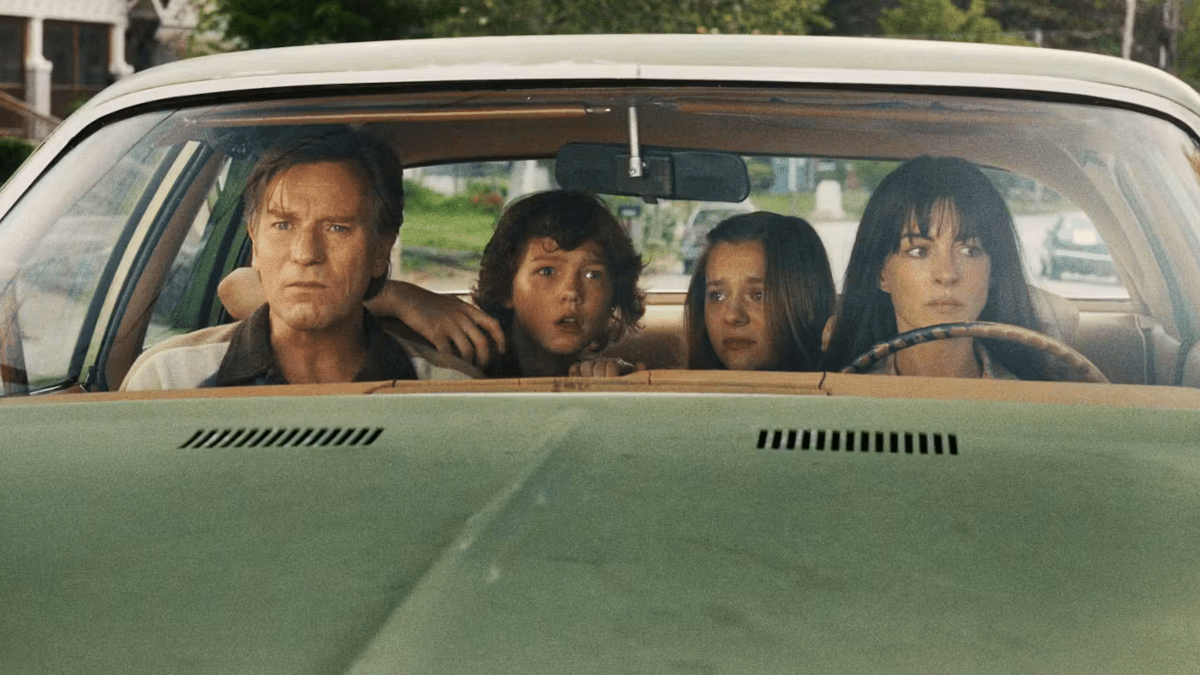
Things begin peacefully, with a brief introduction to the Platt family, a.k.a. those who will soon be chased by dinosaurs. Father Greg (Ewan McGregor), mother Denise (Anne Hathaway), daughter Audrey (Maisy Stella) and son Brian (Christian Convery) and Starbuck the dog comprise an average suburban family who live in the fictional suburb of Flowervale, Michigan. The time frame is 1982, and the film is full of period details. (Yes, people really wore clothes featuring shades of brown.) The story could have been set in the present day, but the film thankfully isn’t weighed down with nostalgic references.
Over the course of the day, we see that the handsome and seemingly happy Platts aren’t quite so perfect. Greg was recently called back at Chrysler, but still delivers pizzas for some reason. He and Denise bicker over their different opinions on parenting. Audrey’s plans after high school are up in the air. She’d like to go to Cornell to study astronomy, but she might end up at Michigan Bell. Brian broke a kid’s arm and is now being chased by the kid’s older brother. Denise is an aspiring novelist who secretly bangs away at a typewriter in the basement, but she’s uncertain about submitting her material to a publisher. This setup obviously will pay off by having the family learn what’s really important. Now all we need is an earth-shattering event that will snap the Platts out of their suburban malaise.
The movie’s inciting incident comes in the form of time portals, which swap sections of the past with the present, and vice versa. The first sign that time travel is going to wreck havoc on the Platts and their cul-de-sac is an extinct plant that suddenly appeared in a neighbor’s yard. Then there’s the presence of huge piles of dung in neighbor Mel Jacobs’ (P. J. Byrne) yard. Mysterious lights flash in the dead of night. But all of those things are just a prelude to what comes next.
Late the next evening, at precisely 11:05 PM, there’s a whooshing sound and something causes the Platts’ ears to collectively pop. The electricity is out and there are strange noises all around. Greg has the family sleep together in the living room, hopeful that the power will be back on in the morning.
Unfortunately, things haven’t improved at daybreak. The water is also off, and Denise insists that the refrigerator remain closed at all times to keep food from spoiling. After a family breakfast of Fruit Loops, Greg and Denise take a look around their block to see what’s up. This is when they learn that there are dinosaurs in their midst, and they’re all hungry. Greg and Denise are chased by a feathered carnivore and nearly don’t make it back home alive. A panicky drive in the family car reveals that the end of their street (the Oak Street of the title) runs smack-dab into a prehistoric jungle.
Denise and Audrey put two and two together and figure out that their neighborhood has somehow been teleported back into the past. However, since time portal bubbles are popping up in the area, all they need to do is find one that will hopefully take them back to their time. But that’s not so simple, given that the dinosaurs are sneaky buggers who creep up on you at any time of day.
In short, the Platts need to survive long enough for a bubble to appear and jump into one before the dinosaurs gobble them up. Can the family put aside their personal issues long enough to get back home for the latest episode of Three’s Company?
Recommendation
The End of Oak Street effectively answers the question as to why there have been so few dinosaur movies outside of the Jurassic Park franchise. It’s not the cost of CGI, because this movie uses it plenty with a very modest budget. And it’s not an unwillingness of legitimate actors to appear in a movie like this, because Anne Hathaway and Ewan McGregor are on board. What’s critical is having a reasonable explanation for why humans and dinosaurs have been brought together.
The middling 65 (2023) had a doozy, involving human-looking alien space travelers who landed on Earth 65 million years ago. The End of Oak Street goes with a time travel angle, but doesn’t bother explaining why it happens to this particular neighborhood. The movie figuratively waves its hands in the beginning, and then it’s off to the (dinosaur) races. Problem solved.
After the first 10-15 minutes, Oak Street settles into monster movie mode, with many tense chase sequences and narrow escapes. With the biggest budget he’s ever had, writer-director David Robert Mitchell showcases his ability to stage big action set pieces with special effects, and his movie has a Spielbergian feel to it, with its dramatic lighting and a bombastic score by Michael Giacchino.
Mitchell, however, is more attuned to horror than Spielberg, and he positions his dinosaurs as slasher movie villains. Mitchell’s dinosaurs lurk in the background and sneak up on their unsuspecting prey from the ground and the air. There’s one extended scene involving a huge albino snake attack that only a horror fan like Mitchell could pull off effectively.
As such, The End of Oak Street plays as a friendly rebuttal to Jurassic Park, often showing us what Spielberg wasn’t comfortable with. Mitchell has dinosaurs snacking on people of all ages, which makes the movie less family-friendly but more realistic. Mitchell also shows us dinosaurs copulating, something Spielberg would never do. Even though both moves are PG-13, Oak Street earns its rating and could probably have easily gotten an R with a bit more blood.
Where Mitchell makes his biggest mark on the dinosaur movie genre is in bringing his visual eye to the proceedings. After Spielberg’s The Lost World: Jurassic Park, subsequent directors in the franchise have spent their energy framing CGI dinosaur shots. Mitchell, however, makes dinosaur action look amazing and thrilling. He includes a 360 shot, dolly shots, and one scene of the family talking that had at least a dozen split diopter shots. Overall, it’s a movie that makes you appreciate filmmaking techniques from thirty-forty years ago.
I’m not sure what attracted Anne Hathaway and Ewan McGregor to this movie besides money, but it’s nice having their familiar faces headline the movie. Their skills as actors were enough to make me care about their paper thin characters, basically a handsome couple who have drifted apart. Hathaway makes for an effective scream queen, while McGregor is his typical laid-back self. (Costumer Erin Benach deserves a shout-out for making Hathway look beautiful in all of her early Eighties outfits.) Maisy Stella and Christian Convery are fine as the children, with Stella bringing pathos to her subplot.
My issue with the movie is its well-made escapist entertainment, nothing more. There wasn’t a theme that unified the spectacle and the human drama together in a way that Jurassic Park and Jumanji did, for example. A movie like this didn’t need to say something consequential to be more entertaining, but the absence of it from a director who usually has a lot on his mind is glaring.
The End of Oak Street is a fun and very well-made dinosaur movie that evokes similar movies from the Eighties and Nineties, before CGI took over filmmaking. There’s nothing profound in it, but it’s a satisfactory thrill ride. Recommended.
Analysis
When I got to the end of The End of Oak Street, I failed to identify whatever point writer-director David Robert Mitchell was making in his film. People online have commented how the movie reminded them of the Amblin Entertainment films from the Eighties, like Poltergeist, Gremlins and Arachnophobia, and Oak Street is definitely cut from the same cloth. It too tells a story of a family unit who are under duress by strange forces who invade their home and neighborhood.
But I don’t believe that a director as thoughtful as Mitchell would spend his energies making what essentially is a throwback movie, even though the movie is very successful on that level. It reminded me of those old (!) movies because of how well it’s made. Oak Street may use CGI for the dinosaurs, but Mitchell directs it as if he stepped out of a time machine from the Eighties.
As I mentioned above, Mitchell uses every tool in his directorial toolbox. The movie is also well-lit, particularly in the nighttime scenes, and has none of the digital camera sheen that makes modern films so dull and uninteresting. The actors inhibit practical sets that are lived-in (although I’m sure green screens were used) and the overall aesthetic perfectly matches the early Eighties. I could tell that Mitchell emphasized “old fashioned” production techniques because the movie looks good throughout.
Does this mean that the point of Oak Street was to prove that present-day filmmakers can make escapist entertainment that’s just as good as it was forty years ago, given the money and resources? That would imply that Mitchell is a huge proponent of nostalgia for nostalgia’s sake, which I have a hard time believing.
Regardless, what else stands out about Oak Street is its lack of substance. The movie never really takes the time to tell us something important. That every family member of the Platts is leading a double life implies something, but what? There have been countless movies stating that your squeaky-clean neighbors are not what they appear to be. What is this movie saying about this beyond a tacit acknowledgement of that truism?
Others online have postulated that Mitchell is drawing attention to how life in the Eighties was illusionary. I suppose, but the movie fails to say anything negative about the time when the story takes place, in terms of culture, politics or society. If anything, Oak Street celebrates 1982 with references designed to make us recall that time with fondness.
Maybe there’s more to how all of the characters have a double-life than I’m able to discern. Each of the Platts would be happier doing something besides being a member of the family. The movie is subtly implying that the family unit construct limits personal growth. Denise wants to be a novelist. Audrey wants to come out as a lesbian and be a scientist. Dad wants to deliver pizzas instead of work for the Big Three. Brian just wants to get away from the stupid bully that’s tormenting him. Unfortunately, society demands that they all remain committed to their family, with their individual hopes and desires placing a distant second.
If Mitchell is expressing a negative view of family life, his movie has a strange way of advocating the alternative. The only way the Platts finally see each other for who they really are is due to a bizarre experience that no family would ever have. (At least, I hope not.)
Or perhaps Oak Street’s underlying theme is honesty. The Platts are miserable because they’re all lying about what’s important to them. It’s only after they’ve returned home from prehistoric times that they collectively accept that they should be up-front with their feelings. Which makes sense because you never know when a time portal will appear and suck you back to the Jurassic era.
And then a spaceship lands
One of the funniest bits in City Slickers is how the men broach a philosophical discussion with an event completely out of left field. The silly line “and then a spaceship lands” serves as the lead-in to a talk about whether it’s OK to cheat on your wife. Since nobody will ever know if you had an affair with an alien being, does that make it OK?
Oak Street borrows that idea to effectively jump-start the plot, as in “A time portal opened up and pulled the neighborhood into the past.” It felt odd that the movie never bothered with explaining why time portals were happening, why there were big ones and little ones, and what the connection is between 1982 and the distant past. The time portals simply happen and that’s that. It’s one way to answer the question of “why dinosaurs?” Why not?


It was a great movie, I loved it!
LikeLike