Doctor Strange In The Multiverse of Madness

Doctor Strange 2 is a superhero-horror movie mashup that takes chances and mostly succeeds. Director Sam Raimi brings some a sense of anarchy and fun to the proceeding. As Strange Benedict Cumberbatch gets to flex his acting muscles for the first time as the character, bringing subtle shadings and tinges of vulnerability to the character. Recommended. Continue reading Doctor Strange In The Multiverse of Madness

Downton Abbey: A New Era

If you aren’t a fan of the television series, there’s no point in seeing this movie.  If you are a fan, A New Era delivers the goods.  All of your favorite characters are on hand once again in a new chapter that is more of a continuation of the main plot line than the previous movie.  The Crowley’s (a.k.a. the poorest rich people you know) need money to fix a leaky roof.  As luck would have it, a director wishes to film a movie on the estate.  Lady Mary (Michelle Dockery) is all for it, but Lord Grantham (Hugh Bonneville) has his priggish qualms about it, as usual.  As (even more) luck would have it, Lady Violet (Maggie Smith) has just been left a villa in the south of France from a Marquis she met eons ago.  (Yes, before she was married.)  Mary sends her father and a contingent of her family off to the villa so that she can supervise the production.  Unfortunately, technology catches up with the director, who must shift gears and make a talkie.  Mary thinks they can pull it off, but unfortunately the lead actress sounds like a wench in a pub.  (What movie does that remind you of?)  Meanwhile, in sunny France, Lord Grantham has to confront the idea that his mother had a dalliance out of marriage, making him a bastard!

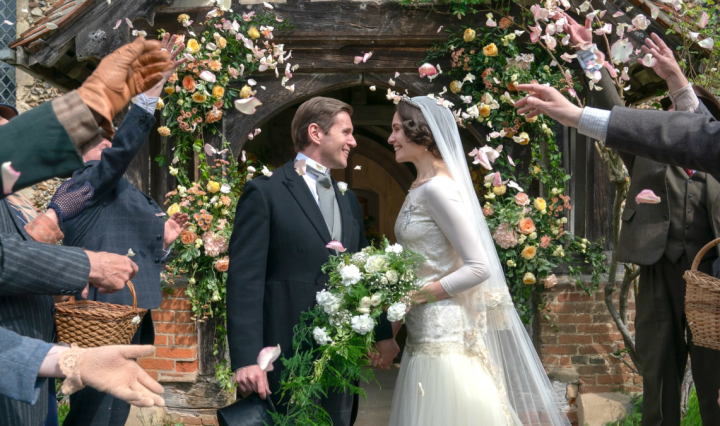
Like the series and the preceding movie, A New Era delivers what fans have come to expect and appreciate:  impeccable production values, top-notch acting, dollops of melodrama, wonderful costumes and snappy dialog, all set to that iconic orchestral score.  I liked how several of the supporting characters continue to grow in interesting ways, including resident nebbish Mr. Molesley (Kevin Doyle).  It goes without saying that this movie includes a wedding, a proposal and several professions of love, some expected, some surprising.  In the end, there’s the unexpected departure of a character who’s been around since the beginning, as well as the not-so-unexpected death of a beloved character.  Julian Fellowes, the mastermind behind Downton Abbey, makes it look so effortless.  Regardless, Tom Branson (Allen Leech) is still the luckiest chauffeur ever, and he knows it.  Recommended.

Continue reading “Downton Abbey: A New Era”

Top Gun: Maverick

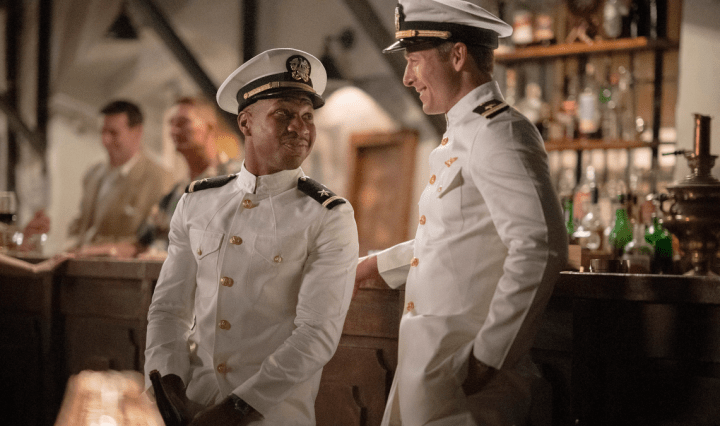
Top Gun: Maverick is a direct sequel to Top Gun and just like its predecessor, it’s an endorphin-fueled joyride of a movie.  Tom Cruise is back as Pete “Maverick” Mitchell, a gifted Naval aviator with a need for speed only matched by his penchant for taking risks.  Thirty-some years later, Maverick is still doing his thing, flying experimental aircraft.  He’s haunted by the death of his wingman Goose, a tragedy that he still feels guilty about.  (An official investigation cleared him, but, you know.)  A top-secret mission pulls him back into the TOPGUN program, where he’s tasked with playing the role of instructor to a bunch of hot-shot pilots almost as arrogant as he was way back in 1986.  In between training missions, Cruise alternates his free time between romancing bar proprietor Penny (Jennifer Connelly) and dealing with the anger from Rooster (Miles Teller), the son of Goose.  Director Joseph Kosinski manages to recreate the spirit of the original, which is no small feat for a rebootquel.  Like its predecessor, Maverick is expertly made, very entertaining and features a performance by Cruise that makes him look a bit more mortal than usual.  If you liked the original, you’ll like this one.  Recommended.

Continue reading “Top Gun: Maverick”

Everything Everywhere All at Once

Everything Everywhere All at Once is a story featuring a reluctant superhero who is forced to confront a villain who threatens the multiverse with imminent destruction.  Sound familiar?  No, this movie isn’t set in the Marvel Cinematic Universe.  Instead, it features Evelyn (Michelle Yeho), a put-upon proprietor of a failing coin laundromat.  Her incredibly kind husband Waymond (Ke Huy Quan) believes he’s the reason she’s miserable and files for divorce.  Her angry and distraught daughter wants Evelyn to recognize she’s a lesbian.  Adding insult to injury, Evelyn and Waymond are facing an IRS audit.  While trying to explain Evelyn’s haphazard bookkeeping to cheerless auditor Deidre (Jamie Lee Curtis), Evelyn learns via her husband’s counterpart in the alpha verse that not only do multiple parallel universes exist, but that a malevolent being named Tupaki threatens to destroy it and everything with it.  Through the copious use of verse jumping, Evelyn learns kung fu (among other skills) so that she can defeat Jobu and her nefarious, multiverse-annihilating everything bagel.

Directors Dan Kwan and Daniel Scheinert (a.k.a. Daniels) gleefully combine several genres and several of their favorite movies in a blender and produce what is decidedly a singular cinematic achievement.  The movie is a lot of fun and features excellent acting throughout, non-stop action and a heavy dose of humor (slapstick and otherwise).  The movie is an extremely busy one, and at times overwhelms when it should pause to allow the audience to take in and appreciate not only the incredibly bizarre visuals but the powerful dramatic moments as well.  The movie is caffeine-added to a fault, in a bouncy castle filled with rubber balls kind of way.  It won’t be everyone’s cup of tea, but for adventurous types, there’s plenty to enjoy here.  Just be sure to strap yourself in and prepare yourself for a wild ride.  Recommended.

Continue reading “Everything Everywhere All at Once”

The Last Duel

At its core, the story The Last Duel tells is straightforward.  Set in France circa 1386, it concerns itself with three characters whose lives become fatefully intertwined: Carrouges (Matt Damon), Le Gris (Adam Driver), and Marguerite (Jodie Comer), the woman who both covet, albeit for vastly different reasons.  Based on our knowledge of other movies or television shows, one might comfortably assume that these three would comprise a standard love triangle.  As the movie progresses, however, any preconceived notions that the story will be romantic in any way, shape or form are thoroughly and decisively trounced.  

The Last Duel begins with an almost casual, unassuming tone, concerning itself with Carrouges and Le Gris fighting the good fight, as they are commanded to do.  A reckless action by Carrouges puts him on the outs with Count Pierre (Ben Affleck).  Le Gris, intelligent and ingratiating, strikes up a relationship with Pierre, who quickly becomes prosperous, often at the expense of his former friend Carrouges.  As the enmity between the two grows, the movie’s tone dramatically shifts from uncomfortable, then to brutal, ending with terrifying.  As a man in the audience, I likened the overall experience to being repeatedly punched in the gut.  I suspect women will be able to take solace (relief?) in how the movie ends, but the journey itself is long and arduous, regardless of your gender affiliation.

The movie clearly is a polemic, a categorization I don’t apply dismissively.  The Last Duel may be a tale involving medieval knights set in the fourteenth century, but it is also unequivocally (and unapologetically) a #MeTo story.  The movie serves as a pretext for the argument that the injustices on display in the movie have been endured by women for centuries, long before there was a hashtag associated with it.

Directed with gusto by Ridley Scott, scenes in the movie will certainly echo with those familiar with Gladiator.  As expected, there are scenes of snow-flecked battle vistas that work in spite of being poorly framed.  The scope of the battle gets lost among screams, sudden spurts of blood and clanging swords.  The hand-to-hand combat scenes are where Ridley excels, and the duel for which the movie gets its name is a tour de force.

The emotional and moral center in The Last Duel is Marguerite.  As acted by the incredibly capable Jodie Comer, she brings raw, emotional honesty to a character whose life is in the hands of men who are pigheaded, self-absorbed and deceitful by varying degrees.  Matt Damon fares well as human battle axe Carrouges, useful during a fight but simplistic and vacant in all other environments.  Adam Driver serves up oily charm as the opportunistic Le Gris, employing 

his intellect only to satisfy his desires.  Damon and Affleck’s portrayals are a bit heavy-handed and cartoonish.  Damon’s Carrouges is presented as thick-headed and prideful, and could have used more subtlety.  Affleck’s performance is geared towards comic relief, and comes across as a strange mashup of Jeremy Irons aristocratic drawl and John Malcovich debauchery.

At two-and-a-half hours, The Last Duel is an incredibly riveting and engrossing endurance test.  This is the rare movie that is completely unsparing towards its characters and its audience, forcing both to relive a brutal sexual assault in its entirety twice.  What the movie lacks subtlety it makes up for with an unsparing view of the reality for women, past and present.  Few movies set out to intentionally damage their audience, and this one definitely succeeds, dishing out a bloody nose and a black eye along the way (metaphorically speaking).  I’ve long since recovered from my wounds, but I suspect the resulting scars will never completely fade away.  Perhaps that’s a good thing.  Recommended.

Continue reading “The Last Duel”

No Time To Die

For the record, I’m a casual Bond fan.  How casual?  Of all the actors who’ve played Bond, the only one where I’ve seen all of their performances in the role is Daniel Craig.  I’m nearly there with Pierce Brosnan, but I have yet to see Goldeneye.  I’ve only seen a couple of Roger Moore’s movies.  The only Sean Connery movie I’ve seen is Never Say Never Again.  I’ve never gotten round to watching From Russia With Love, On Her Majesty’s Secret Service or The Spy Who Loved Me.  Maybe I’ll get caught up after I’ve retired.  The 007 movie canon is definitely on my bucket list.

Since No Time To Die is Craig’s finale, I want to say that I really enjoyed his turn as Bond.  Craig’s entries have eschewed the desire to become live-action cartoons, an impression I’ve had with the movies that preceded him.  The raw physicality he brought to the part, coupled with an almost pathological desire to confront mayhem head-on, made even his lesser entries watchable (I’m looking at you, Quantum of Solace and Spectre).

So how does No Time To Die stack up with the previous four Craig entries?  I’d put it behind Casino Royale and Skyfall, but above Quantum of Solace and Spectre.  The pluses outweigh the minuses, but those minuses are difficult to ignore.  There is a great Bond movie in No Time To Die, but it treads water in the last act, and overstays its welcome by at least thirty minutes.  The movie is watchable and enjoyable, though, and as a grade I’d give it a solid B.  Recommended.

Continue reading “No Time To Die”

Malignant (long take)

Malignant is a combination of horror movie references, James Wan’s usual bag of tricks and other things that he likes thrown into a blender and pureed together.  The resulting mixture is slick and very entertaining, but not as engrossing as Wan’s previous horror movies.  The movie is a creepy funhouse, relying on paper-thin characters to drive the plot.  The movie works, and horror movie nerds will find it’s fanboy signalling endlessly entertaining, but the movie lacks the emotional connection that elevated The Conjuring to more than your average horror movie.  Recommended.

A detailed summary and analysis follow.  Spoilers abound.  You have been warned.

Continue reading “Malignant (long take)”

The Card Counter (Quick Take)

Stop me if you’ve heard this one before.  A lonely man who lives on the fringes of society seeks to atone for his sins by helping someone else.  This is Paul Schrader’s bailiwick, and with Taxi Driver, First Reformed and other screenplays he’s written throughout his career, he’s created a genre of films all to himself. (His body of work could be called a “franchise”, a commercial connotation that I’m sure he would find darkly humorous.)

Continue reading “The Card Counter (Quick Take)”