

Category: Movies

Blink Twice
One theory about crime that I’ve latched onto is how criminal activity is driven by the need to feel in control. Generally speaking, criminals want to control the things they lack. For example, a wealthy person controls money. When a person of limited means steals it, they obtain control over the other person’s money. (I’m grossly oversimplifying “Control Balance theory”, by the way. Search on it if you’d like to know more.) Similarly, a person can effectively control another person through a variety of criminal behaviors, principle among them being physical assault and murder. The latter examples came to mind while I watched Blink Twice, where the desire to control another person, both mentally and physically, explains what we see, if only superficially.
Continue reading “Blink Twice”
My Penguin Friend
Tragedy can strike anywhere, even on Ilha Grande, an island off the coast of Rio de Janeiro, Brazil. Based on the movie’s depiction of the place, it’s what I’d call a working-man’s paradise, where everyone tanned, smiling and walking around in summer clothes year-round. The beach and the ocean’s shimmering waves are only a short walk from anywhere on the island. If the movie’s depiction of it is to be believed, it’s a happy place for everyone who lives there. Well, almost everyone.
Continue reading “My Penguin Friend”
It Ends With Us
While watching It Ends With Us, I was reminded of the last romantic melodrama I’d seen, Where The Crawdads Sing. Although the heroines in both movies couldn’t have been more different, they both experienced a similar set of trials and tribulations. Given my admittedly small sample size, is it fair of me to assume that all romantic melodramas follow the same formula? And if so, is that part of the appeal with movies like It Ends With Us?
Continue reading “It Ends With Us”
Trap
Serial killers are a fortunate bunch. While the job does require a commitment to planning, attention to detail and a level of perseverance that few can muster, it’s also heavily dependent upon luck. Take The Butcher, the serial killer at the center of Trap, who somehow manages his homicidal enterprise in addition to being a devoted family man and a firefighter. His dedication to all facets of his life is nothing short of admirable. For starters, The Butcher’s daily schedule must be a logistical nightmare. He must ping-pong between his home, putting out fires and attending to victims–residing at any one of his covert murder houses–without getting caught. The Butcher may be good, but nobody’s that good. Luck is always present to give serial killers a little helpful nudge when they’re so close to being caught. In Trap, The Butcher is so darn lucky that he must be living the Life of Riley.
Continue reading “Trap”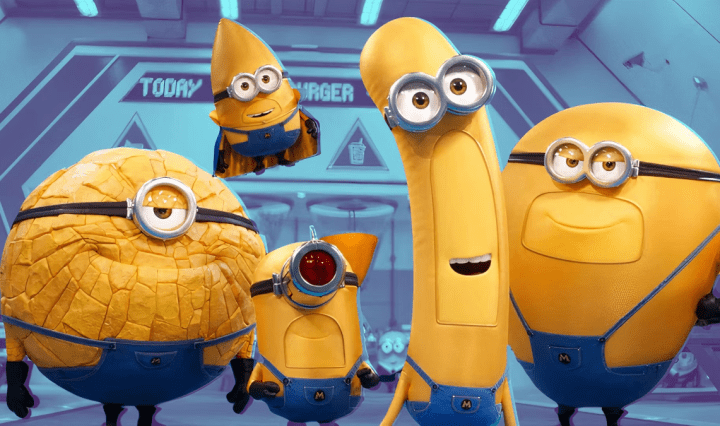
Despicable Me 4
Has Gru always been a government agent? I still haven’t seen Despicable Me 1, 2 or 3, so I’m at a disadvantage when it comes to grasping the nuances of this franchise. I did see Minions: The Rise of Gru, where a grade school-aged Gru helped the Anti Villain League (or AVL) capture bad guys of his own free will. Given how Despicable Me 4 shows that Gru is still in kahoots with “the man”, describing him as “despicable” is such a misnomer. He may be irritable and occasionally get into mischief, but his heart is in the right place. With that in mind, perhaps the time has come to give these movies a more appropriate name, like Disagreeable Me? Or Dyspeptic Me? Cranky but Admirable Me? If anyone at Illumination Studios is reading this, I offer up these suggestions free of charge. Consider it a public service.
Continue reading “Despicable Me 4”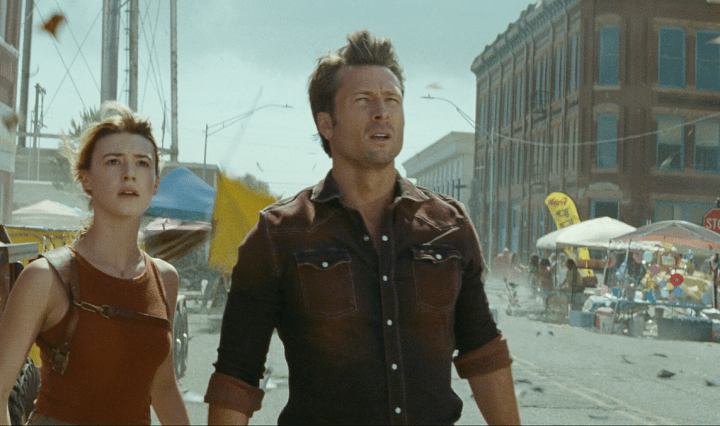
Twisters
Twisters fits in the same category as Sony’s recent Jumanji movies in that it’s not a remake or reboot of the original, but is clearly inspired by it. Aside from the title, it has few things in common with the first movie. Like Bill Paxton’s character in Twister, Kate (Daisy Edgar-Jones is a “human barometer”, able to read the weather without the help of instrumentation. Then there is Dorthy, a suped-up trash can filled with little scientific devices intended to be sucked up into a tornado. And it goes without saying that the movie has a number of tornadoes and related hijinks. Otherwise, this entry in the “Twister Universe” is very much its own thing. So why did the filmmakers decide to call it Twisters? Studios have had a tough time lately convincing audiences to see original movies, so a touch of nostalgia goes a long way towards increasing awareness. But another way, if the movie had been named Tornado Alley or The Tornado Wranglers I doubt it would have generated the same level of interest that it has.
Continue reading “Twisters”
Longlegs
I certainly admire Perkins’ Longlegs, a loving homage to the serial killer genre. The movie proudly wears its influences on its sleeve, and those familiar with The Silence of the Lambs and Se7en will have fun identifying all of the ways Perkins references them in this film. Given the movie’s incorporation of encoded messages, I would include David Fincher’s Zodiac in the mix as well.
Continue reading “Longlegs”
Inside Out 2
Would it surprise you to know that even after writing well over two hundred reviews, I still feel anxious whenever I start a new one? I always ask myself the same questions. What if I don’t have anything interesting to say? What if nobody reads it? What if I say something dumb and lose what little credibility I have? What if I miss my self-imposed Tuesday morning publication date? Fortunately, after seeing Inside Out 2, I now know that all of these expressions of anxiety emanate from an orange, bug-eyed Muppet who has usurped control of my mind.
Continue reading “Inside Out 2”
A Quiet Place: Day One
Here’s a trick question: How do the aliens in the A Quiet Place franchise arrive on Earth? The answer is…we don’t know. In the sequel and this prequel, all we are shown is streaks of light tearing across the sky. The assumption is that they arrive in space ships, but neither film gives us any indication of what those look like. For a typical alien invasion movie, seeing the alien spaceship(s) is the money shot–think Independence Day, War of the Worlds and The Day the Earth Stood Still. Amazingly, three movies into this franchise, the alien’s mode of transport is still a mystery.
Continue reading “A Quiet Place: Day One”
